
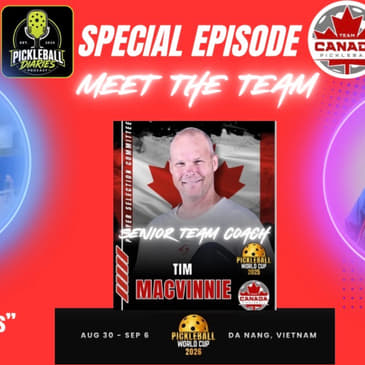
Canada is headed to the Pickleball World Cup in Da Nang, Vietnam!!!
PBD sits down with the players representing our country on the world stage!!!
This episode:
Senior Team Coach: Tim Macvinnie
Support Team Canada at the World Cup:
Go Fund me here:
https://www.gofundme.com/f/pickleball-world-cup-team-canada
Website:
Team Canada Pickleball | World Cup 2026 Vietnam
Pickleball Diaries Theme: Written & Produced by TrackOps Media
Tyrol is the official footwear of the PBD podcast!
For that Pickleball shoe that delivers Stability, Breathability, Comfort & Durability head over the Tyrolpickleball.com and enter agorman20 at checkout for 20% off your order.
Host clothing and gear powered by Aniviia Pickleball. Head to Aniviia.com and enter in Agorman15 at checkout for 15% off.
We all need eye protection while playing!
So Head over to Kitchenblockers.com and enter AGORMAN10 at checkout for 10% off.
For the best Performance compression wear, head over to Klyngpickleball.com
Get an exclusive 15% discount on Saily data plans!
Use the code ANDREW16178 at checkout. Download the Saily app or go to: https://saily.com/ ANDREW16178!
[00:00:36] Hi everyone, I'm Victor Chen from the Pickleball Diary. I'm supposed to be co-host now. I'm the host because Andrew Gorman is unavailable, so I'm still taking charge of the podcast. Today I have another special guest over here. I have Tim with me. Tim has been coach of Team Canada for the last few years.
[00:01:02] He has also been part of the selection committee and now also coach this year for the senior team. And you're located in BC, right? Am I right? That is correct. Surrey BC. To be specific, yeah. Awesome. But yeah, I've been out here since I've been 18, so yeah. Wow. If I say 35 years, do I give my age away? Yeah. Yeah. Honestly.
[00:01:32] Oh, that's great. Yeah, I've been maybe BC one subtype in my life, usually like Vancouver, a surrounding area for Asian food mostly. Yes. So yeah. So yeah, there you go. Obviously a very nice place in Surrey also. So Tim, can you talk to me about how did you get into Pickleball? Well, the funny story is if we go, I'll give you the long version. Yeah.
[00:02:00] I work for the city of Burnaby in recreation. So I've been playing sports my whole life. And I was playing squash at the, at the rec center that I worked at, played in the Vancouver squash league, got up to like a pretty high level. And then I injured my hamstring. And at this time I was working at a different center where pickleball had kind of started.
[00:02:25] So I kind of fooled around with them, but I was still playing squash and I was using a wooden paddle when they asked me to play. But after I hurt myself and I couldn't fully play squash, I was just playing more pickleball with some of the members. And then I heard about tournaments. I'm like, there's tournaments for this? Like this is kind of a, and then I went and watched some of them. And then eventually I was doing like skinny singles and all this. And then I was like, where do the good players play?
[00:02:53] And then that's where I got into pickleball. And that was like 12 years ago. Wow. Maybe 13 years ago. And then, yeah. So within six months I was, I think we only usually had about four, five local tournaments, four to five local tournaments a year, including the nationals in Kelowna, one outdoor tournament and two indoor in gymnasiums. So, and then I was hooked.
[00:03:23] So, yeah, that's the long. Now BC has so many more tournaments. Obviously this weekend you have, we have the PPA coming. That's correct. The first one in Canada. So yeah, my buddy Steve Deacon, shout out to him. One of the top, top male performers that's played pro down in the States. I know we have Catherine Branko still doing it, but one of the OGs like, and then I'll brag about myself.
[00:03:52] So briefly I was better than him. Not really, but played higher level than him. He started his first tournament at 4-5 while I was in the 5-0 level at that tournament. Oh, wow. Yeah. Yeah. At least you can brag a little bit. And then it was only a matter of time. It's like, yeah, he, he, his ratings going to pass me pretty soon. So yeah. When I don't know if everyone knows, but we used to have only two digit ratings.
[00:04:17] So you're a 4-5 or you're a 5-0 or you're a 3-0 and then they made it into the four digit rating. So when that happened, I was ahead of Steve Deacon by barely. And then like two tournaments later, he passed me and never looked back. So yeah. Oh my. A few things I can claim to fame, but yeah, that's, you know. No, that's great.
[00:04:41] Like Steve has been our ambassador of, for Canada in our, in our sport. Very, very nice guy. I think 2023 and I was in Regina. I briefly passed and met him. We chatted a little bit and he was so, so kind to those. I was 3-0 at that time. Right. So not that. Oh, you gotta start somewhere. Yeah. Yeah. No, Regina was a fun nationals.
[00:05:10] Um, uh, that was my, the first year I was 50. So I, uh, I didn't have to play against him. Yeah, exactly. You can, you can go over to the, uh, the, the other bracket. I go over to the old side where most people don't care about. Yeah. The, the, I have a funny story. It's still important. The, the, the, the, the, the, the, the, the, like just to point out, we had, uh, like we were in the round Robin for the 50 plus and me and my partner, we got put
[00:05:37] on the show court, uh, that in the Regina one, but Steve had been warming up with his partner. And all of a sudden there's maybe like 150 people ready to watch it, 200 people. And then when they left to go to another court and we started warming up, there was maybe eight people left. They all, they didn't want to watch us. Yeah. Definitely. There's different, different, different. We're still important, but we realize we're not the, uh, the prime show at these tournaments anymore.
[00:06:08] No, unfortunately. So, uh, yeah, definitely. Um, so obviously you, uh, Tim, you have been playing in a very high, high level and you have been coaching a lot of the, uh, obviously a lot of different, uh, different player. Uh, I'll say how, how has it gone to the preparation for, uh, like, especially like, let's say now, like last year you did, did for team Canada this year also, you're going to do for team Canada again.
[00:06:34] How, uh, because you, you'll see different, uh, player with different skills and everything. How would, would you prepare them like for a tournament of the, uh, this size, like for, uh, at the World Cup? Well, the, uh, like for these big events, like just like any kind of event or any kind of player, you gotta constantly be working on your game. Um, but the, the uniqueness of taking higher level players is often they're very self-motivated.
[00:07:04] They will do a lot of the work on their own. So it's not as much skill and skill development or technique development. It's more like strategy, how to work with your partner. What are our strengths versus the other team's strengths? How are we going to put our team or players in a better position to win or, and then, and conversely, how do we defend what the other team does well? Like, how do we take that away from them kind of thing?
[00:07:32] So it's more court positioning, um, strategy, target location, shot selection, um, stuff like that. So it's a very different kind of coaching. Cause the other thing going into an event, you can't tell someone to change their game the day of the event. It's just, they don't have time. So to tell them to completely change something, even if it's long-term going to be better for them, that's the worst thing you can do.
[00:07:58] Um, get them in their own heads, trying to overthink when you just want reaction. You want them? Yeah. I agree. So coaching at the higher levels with higher level players is, is, is just different than coaching your beginners, your three O's, your four O's, et cetera. Trying to teach like a group how to drive the ball or how to defend the lob or whatever. Um, that's very much skill development. Um, we're coaching.
[00:08:25] Like I also now coach in the CNPL. It's more strategy and, and trying to take our strengths and, and amplify them and, and take our weaknesses and minimize them. Yeah, definitely. I agree. Yeah. Which is a different mindset when, when you're playing, uh, when you have those higher, higher, higher level, like mostly they will have just, just a skill that's your, your, sometimes just blow your mind already. But some, sometimes it may be, uh, during, during the game or during the court, you realize,
[00:08:54] Oh, the other team are not, not as good in some, some places that you want to exploit. That weaknesses. Right. And then you get players like I'll shout out to last year's team Canada, Anna Deichenko out of Saskatchewan is on the Vancouver Owls. She has a very unique style. Um, for those who've been lucky enough to see her, it's not like most other players. So do you try and change that? Like, no, you don't.
[00:09:22] You try and like give her the best possibility to take her. Cause she's got advantages with her style and some disadvantage, like any style. And, but she's very good and unorthodox and she creates a lot of problems for other players. So to teach her proper technique, like, yeah. To say that better, like, but you're not going to teach beginners how to play like that.
[00:09:45] Like that's, that's, you never do that because it's just unorthodox and certain players at the highest level had, they have their little nuances or whatever you want to call it. A little, that's just that person, or that's their thing. Um, and it's very efficient. I call that like uniqueness. And sometimes you, you need, you, you need that in order to maybe have an edge against others. Exactly.
[00:10:11] Because at some point those, those players are the, they're almost at the same skills, but some player has that little uniqueness here and there. It makes them stronger in some ways. Yeah. Right. Yeah. And yeah, just cause it's not as known. It's like the owl paddle. Oh yeah. I'm now using a lot of people who've never played against it. It gives you an advantage because of the lack of sound. Oh yeah. I think once you've played against it enough, you, you, you, you, you learn to deal with it.
[00:10:40] But like for the first time, people are like, what the heck's this? It can like, so unique, it can give you some, uh, a little bit of an advantage till people figure it out. Definitely. Yeah. I agree. Like I, I have that all part of my, my, myself, but obviously some, I use it sometimes. I don't use it sometimes and stuff. Not every opponent's using that paddle also. Like I think yesterday I, I play against someone that used our paddle.
[00:11:05] It took me maybe two, three shots to get you like used to it because like, like, uh, I, I think a lot of people just don't realize we use a lot of our years to actually use, like, especially the sound to actually judge how fast the ball's coming in. You know, how, how, how, how slow, slow it's getting, getting hit. And that all paddle basically just dampened sounds so much that you have no, basically, if you don't be aware that, that the sound get dampened, you will caught by surprise.
[00:12:04] Basically. Like, you know, the sound and whatever, just to see like, yeah, it's, it's information. Our brains use. When live to calculate things. Definitely. I agree. Uh, so another question. So, uh, for also for coming from a, uh, in the terms of team Canada. So obviously you, uh, last year, the senior won the bronze medal, which is a great achievement. Yeah. You basically almost have the same team this year.
[00:12:32] How exciting you, you, you get that team and what would you do better maybe to, to get to the next level? Um, so this year, this year, like the women, the men are the same. Yeah. We'll make that a little change. I, I, I just heard there's some change. Yeah. Robin can't make it. And I met on as a coach, but I've enlisted as a player in the event. There's an injury, which we cross our fingers. Hope there isn't one.
[00:13:01] So Rob and Corey are, are, are going to be our men. Um, and Maggie's returning. Um, Mar, Margaret was supposed to be on the team, but she had to pull out last minute. So that's why we added Amy and Susan added to the team. So those three all know each other. So I think we have just as strong a team. Um, if not stronger, one of the things I've asked them to do is really work on their singles. Cause that was the last year in the dream breaker.
[00:13:28] We got thumped by the Americans like 21 to 10 or something. And like, it was, it could have been between nine and 12. I, I blocked it out of my mind. I don't want to remember it. Um, but like every player on the Americans was like a former tennis player. And we only had really one strong market was she actually won more of her points. She was in and it was the other three combined. Just, we would like no match.
[00:13:56] So we tied them to two great. They just pushed us to the side and the dream breaker. And unfortunately then we had an easy three zero win in the bronze game. And I saw the silver medalists. We would have three of them too. So, um, this year you have to hit the American. And that's just the nature of tournaments. It is what it is. Um, so this year, again, we can't take anything for granted.
[00:14:21] We have to just try and beat whoever's put in front of us, but it's going to come down to like those top. Um, few teams and, uh, it could come down to a dream breaker and you know, it's up, like I said, it's up to our individual players to like, cause we're spread across the country to include singles play as part of your, um, lead up into the tournament. Definitely.
[00:14:45] And, uh, yeah, that like, as far as our, like we have to, cause there's a couple new females. We're going to have to figure out what are better mixed matchups are and who are best women's partnering is. But that, I mean, that can change match to match as players are playing better or worse or, or, you know? Yeah. Yeah, definitely. Definitely.
[00:15:10] And, uh, yeah, dream, dream, dream breaker is like a lot of people is just thinking about, oh yeah, the team is just a doubles game, but, uh, it went, went again, come down to the wire. That's seeing singles dream breaker. It matters. Uh, is it for, is it still four points, right? Am I not mistaken? The rotation. I, to be honest, I can't remember. I'm there's so many formats, whether it's three rallies or four rallies per player, and then you just rotate.
[00:15:38] I, yeah, I know in the CNPL. The CNPL is three rallies. And I think this was four. Okay. Gotcha. Pretty sure last year was four and we have a different format than the, um, open team. The open team, as you probably know, has six matches per head per matchup. We only have the four. Yes. So that the senior team does the extra two singles matchups.
[00:16:05] So if it's three, three and the, in the open age, then they go to a dream breaker and the juniors are similar to us. They, they, they last where they played four. Yeah. Awesome. Yeah. That's, that's true. And, uh, and, and also the format, I think in team Canada also is a little different. I don't think it does, uh, that a world cup, they don't have the, uh, uh, the freeze like at that 20. So it means like, basically if you're down, you're, you basically had to, yeah, I don't think there's no, no.
[00:16:35] Yeah. Last year. Crawler way back and you can lose, you can basically lose on your serve. Let's say you dumped your, your, your strip into the net. Well, if the other teams at 20, then it's game over. Yeah. Yeah. Which is, I mean, it's fair for everyone. We all know it. Every. So the points at the beginning of the match are just as important as the ones at the end. Mm. So I definitely, I definitely, definitely. I agree. It makes it tougher. Some, at some time, some somewhat, I feel.
[00:17:05] Yeah. But you know it going in, so it's, yeah, you can't just throw points away just cause you're serving or whatever. Like, and I've heard that mentality with people. It's like, oh, I go for more when it's our serve in the traditional side out scoring. And it's like, aren't you just trying to win every point? Cause they, it does matter. You know, you can't just throw points away. Oh, it didn't matter. We were serving. So they didn't get a point. So yeah, not the right strategy. Definitely.
[00:17:34] One last, one, one last, uh, last quick question. Obviously, uh, representing, I can't Canada as one of, uh, like every athlete or even every play player's dream. What does it represent to you now? Also, you're also the coach of the team, team Canada. Yeah. Like, it's funny. Cause like as an athlete, my whole life, I was really good at almost every sport, but there was those there's levels to every sport.
[00:18:01] And I knew I was never at the top of any sport. So like pickleball is kind of like a godsend that it's still so new. Um, and some of our best athletes aren't playing yet that I've been afforded a kind of a luxury. Like, yes, I'm not 18 in the sport. I'm 53. I'm 53. But still, I've been able to play at the highest level. I've played with some players that are now currently in the pickleball hall of fame and, or will be. And I've competed at the highest levels.
[00:18:29] Um, and then you put all that on top of now doing it on behalf of your country. I mean, they're like, it's not like I've had great individual moments in certain tournaments and whatever, but like, this is at another level. Like the juniors are playing and it's like, that's part of you too. Now, even though I'm the senior coach, it's like, even though that's not my responsibility, but that's my team. You know, it's kind of like our, like we're national identities with hockey.
[00:18:58] Like I'm not a hockey player, but damn, that's my team. So now to be kind of part of one of those teams and I'm not trying to compare us to hockey. Like, no, they're a lot bigger and whatever, but like, it still is a big deal. Like, regardless of what it is to represent your country, um, and do it with your friends and, uh, and these other players as like a team. Like it's cause it's not an individual sport. Like, it's kind of cool. It really is cool.
[00:19:28] I mean, and I realized it's at the beginning and like things like, I don't know how many of the players, like we don't have the funding structure kind of set, but like, you know, all the players are like, yeah, no worries. We'll pay our way. And some of the fundraising might get us a kickback of some of it or all of it. We don't know, but every player is pretty much to, I don't care. I'm going to go represent our country and I'm in. Um, so it's, it's really like, it is patriotic.
[00:19:55] Like a lot of the life we don't think patriotism or think of like the maple leaf or anything. And then all of a sudden, boom. And it's like, yeah, like what a, what an honor. Like, you know, and like I said, like 15 years ago, there is no outlook. I had the being anything to help represent Canada. Like I played basketball and soccer and squash and badminton, but I knew I wasn't at the level. And now all of a sudden, you know, 12, 15 years later, it's like, well, how did this happen? You know? Yeah. It did.
[00:20:26] So yeah. No, we're so definitely super excited for this and hope, but I wish you all the best. Hopefully this time we get the different color, man. Well, not just the same color, but more of them too. Yeah. Yeah, exactly. Every year it's going to be harder and harder to hold on to what we've done because more and more countries are getting involved.
[00:20:50] And to be honest, like when I look eight years ago, nine years ago at the American nationals, I was at, I was a notch below the best players in the world, but I was at their level. And I was just telling some buddies the other day, it's like, I'm, I'm still that notch below Steve Deacon and he might not like me saying this, but he's also not at the level of the top players. Like, so now I'm feeling like now I'm two or three levels below them instead of just maybe
[00:21:20] half or one. So, but I'm also better in my own opinion than I was eight years ago. So how did I fall further behind? Yeah, exactly. Like there are so much better players coming into the game at all age levels. They're the elevating the game. So, you know, if you're not getting better from where you were five years ago, you might have been a four Oh then. And now you're a three Oh, like it just is like, if you haven't evolved your game, you're not the same level. You've been passed by everyone. Yes. I agree.
[00:21:50] So that's part. And it's going to, and it's going to happen like that. Like when you look at tennis, the best players from five, six, seven years ago would kind of be the best players today. It wouldn't be like, oh, they couldn't beat the best players today. The game of pickleball is evolving so fast. Yes. The paddles, balls, the technology, and then just the better athletes coming in. The book, the amount of spin people are using now didn't exist eight years ago. Okay.
[00:22:19] How are people are hitting with? It wasn't there eight years ago. So the game has definitely changed and the better athletes are taking advantage of it. Oh yeah. We see it that big time. And also I think we, that's the, that's a little controversial argument. At that point, they say, oh, all the tennis player are coming in. They're going to take the pickleball by storm. But now you just see it. They, they don't, they can't. It's a completely different sport now.
[00:22:48] Like all, all the skills that's coming from, from it. Uh, uh, we'll, we'll like, there's some, some of the older, uh, older generation of 10 tennis player. Like I just give example, like, uh, Sam Curry, Jack saw the Jack's always still in the top, but still, but you can see, he did fall off from quite a bit from compared to what, what he was before. And you, you can use that argument and say, oh, uh, if you're coming from tennis, you're going to be great at the sport right away.
[00:23:18] Uh, that's not true anymore. Uh, yeah, really wasn't true outside of singles anyway. Like, uh, like, like one of my fun stories is my very first us nationals. Um, you know who I played with Tyson McElfin. Wow. We did before Tyson was a household name. So this, like I said, this is 2016, 10 years ago.
[00:23:43] So, um, and we went two and two and it is what it is, but like, uh, the point. Oh yeah. Yeah. So it's like, I actually just got so excited about a story. I forgot you were talking about the, yeah. So Tyson was a super strong tennis player and whatnot, but he was really, really, really, really good at singles. His doubles game was like nothing. It took him years to develop the doubles game. Cause it's a different, it's a completely different game.
[00:24:11] And as we all know, he did a very good job of not just being a single specialist. Yes. And I think when you look at the top of pickleball, you see those players, whether it be a Zane Ford or a Lucian Goins or some of these, or even like a Hunter Johnson or Chris Hayworth. And then you go, well, they've been dominating. So someone like, where's the, how are they doing in doubles or mixed? Yeah. And it's like, well, they're still really good, but they're, they don't, they're never
[00:24:40] in the place in the metal games. Yeah. They don't, they don't pass quarterfinals at least. And the only one that I think is, was Ben before, but he stopped playing singles. He's like fed fed is, is the one who, and whether it's mixed, he can get there. Men's he can get there and singles, he can get there. So a testament to him. And I think it's goes with his non traditional single style where he will cat and mouse you.
[00:25:07] He will, instead of just standing at the baseline and trying to blast by people. Um, well, because like, I will say two years ago, like there was like the men's single was a lot of cat and mouse game. Uh, yeah, just, and just, just the field, like maybe year or two ago. Now, every, everyone stays back because they're blasting ball from, uh, from the back. They're hitting their line and they hit so hard. Yeah. So that's why they come in anymore. So. Yeah.
[00:25:37] And that's why they rumored shrinking the court by. Yes. A little bit so that the players who, to encourage people to still come to the net and then they can actually cut off the passing line lines. But these players are like so good now that they can hit their lines. So it's like, unless they can get to the net, there's like, you don't want to get caught getting to the net, watching the ball, just go for an easy winner. So I'll stay back. You stay back and let's just play tennis on a pickleball court.
[00:26:07] And people are like, well, I'd rather watch tennis if that's what it's going to be. Like the cat and mouse is when you see the pure athleticism of some of these guys and that you go, wow, I can't believe he ran in that corner and then ran back there. Like some of those Connor Garnett, like that one infamous ATP, like he ran 50, 60 feet just to get back there. And the other players just like, what did just, uh, like that's when people are like, this game is awesome.
[00:26:35] But my, my opinion, I never played tennis at a high level or really at all. Just watching two players baseline rally is not fun. It's kind of like, we also don't want to see, we also don't want to see Ben and Colin Johns playing Dylan and JW with 50, 60 dink rallies every rally. Oh man. I admit, I know that's also not fun. Yeah, exactly. I, I, I, I, I, those matches I was tired watching.
[00:27:04] I was like, guys, someone can, someone speed up or to do something. I was like, oh my God. Yeah. Yeah. So they still dink, but they, they, they do speed up a lot more. So it, yeah. And not as much as going. It's more dynamic. I feel like the dinking is, has been changed for like a more dynamic dinking there. There's more, much more movement. And, and I think, uh, the spectator, uh, the telespectator are like appreciating a little bit more, uh, versus a couple of years ago, which that those static dinking you're like, Oh yeah. Yeah.
[00:27:34] But that's also a testament to like what I said, and this is just my opinion, the better athletes to coming in, they can, from the yellow zone or the less dangerous zones hit targets that are much smaller and more accurate where before speeding up from there was just dumb because you just couldn't be as accurate and make them chicken wing or catch them. Um, and now like there's players, they're just doing like, how do you attack from down there and be successful?
[00:28:01] So it's like, you know, and they pick and choose their spots. Yeah. And, uh, paddle also pay plays a big role, right? The, uh, with the spin that you can generate with, with, with those paddle has, uh, changed tremendously compared to, uh, what, what you have been using at like, uh, I don't know how many years we had before. Right. Oh, I know. I, I still have my Selkirk Epic from, uh, yes.
[00:28:28] Like I remember that 12 years ago with the Enrique Ruiz edition. And that thing is so smooth and it's like, and it has no power. And it's like, how did we play with these things? Yeah. No, but people did back then because before then, like, I don't know how long ago people still use the wooden paddles. Yeah. Well, they, they did the wooden, wooden paddle, uh, and those, those players did not appreciate it. Obviously they're like, Oh, what's going on? No. Yeah.
[00:28:57] They were terrible and they got, and like pros, they got better as it went on. So by the time it finished, they were playing pretty well with them, but they weigh twice as much as a regular paddle, but have no power. It's like, yeah. No power, no spin. You can't do much about it. Oh man. Yeah. That's been definitely rough. Thank you. Thank you so much, uh, Tim, uh, for, for your time that, uh, that was a pleasure to having, having you on.
[00:29:22] So everyone, please, uh, make sure you, you, you follow the team team can, uh, Canada. We also have much, uh, uh, different, uh, uh, that per person that we're into interviewing from our, uh, from the team Canada. So don't, don't please do, uh, uh, do not miss it and make, make sure to cheer on our team Canada. Yeah. I, I can't be loud enough for everyone. And, uh, you tease, uh, Andrew that, uh, he missed the best interview possible. Oh yeah. Yeah.
[00:29:51] We, uh, this interview is a long, I think I, I make it the longest just to make sure that he, that he, I, I, I'm the host. He's not the host anymore. Okay. Maybe that needs to be discussed at a future meeting about who should host these things. That's okay. Thank you so much. Have a good day. Bye bye everyone. Bye bye. Bye.