
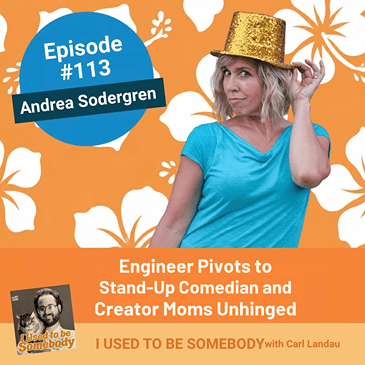
This month we have a guest with very unlikely career transitions --an engineering career to social media marketing strategist to a professional stand-up comedian. You'll find out that Andrea Sodergren has done many pivots in her career and life. She is fearless and hilarious, which makes for an awesome conversation.
She's more than a stand up comedian now, taking it to the next level. She is the creator and producer of the wildly successful "Moms Unhinged" comedy show. During the past 5 years, she's produced over 600 shows nationwide with attendance of 60,000+ adoring fans.
You will love Andrea's story. She is a great example of where a curious mind can take you. She says, "Safety is overrated. Do something a little scary!"
• More about Andrea Sodergren: https://momsunhinged.com/comedians
• Moms Unhinged: https://momsunhinged.com
• Episode Content: https://pickleballmediahq.com/andrea-sodergren-interview-engineer-turns-into-stand-up-comedian-and-creator-moms-unhinged
• Sponsored by How to Retire and Not Die: https://garysirak.com/how-to-retire-and-not-die
• Sponsored by Capital Advantage: https://capitaladvantage.com/promotion/retirement-planning-guide
• I Used to be Somebody World Tour 2027 Bordeaux, France: https://pickleballmediahq.com/tour
• Subscribe to the the I Used to be Somebody Newsletter: https://pickleballmediahq.com/contact/subscribe
[00:00:03] Pickleball Media presents the I Used to Be Somebody show produced live at the Landau Tiki Bar in Sacramento. Here's our host, Carl Landau.
[00:00:17] Welcome to Landau Tiki Bar and the I Used to Be Somebody show who starts out their career as a system engineer and ends up as a very successful stand-up comedian and now produces their own show. Just one person I know, today's guest, I'll explain in a minute.
[00:00:35] First, I want to thank this month's sponsors. Please check out Gary Sirak's very cool new How to Retire and Not Die video series. And a big thank you to our loyal sponsor, Capital Advantage Wealth Management. Following today's interview, we've got two fun segments. First, we talked to the Unretirement with the Wisdom guys. Today, we talk about the cool side hustles you can create in unretirement life.
[00:01:05] And lots of fun ideas there. That is followed by Pickball Chronicles with Traver. Today is a very special segment. We talk about pickball love stories and a very personal one for Traver.
[00:01:21] Traver just got married this weekend to a wonderful woman, Sophia. They met, yes, on the pickball court. You've got to hear it all. I love the story and feel a very small part of the story because at our 100th episode celebration at the Landau Tiki Bar, Traver asked me right there if he could make a surprise announcement.
[00:01:45] And yes, he surprised Sophia and popped the question in front of about 80 of our guests. Of course, this is going to be part of our I Used to Be Somebody documentary I'm working on right now. Just happened to have a camera with me.
[00:02:02] I want to thank one of our past guests, Patty Forehand, who introduced me to today's guest, Andrea. Andrea Sodergren also goes by her stage name as Andre Val.
[00:02:16] So a lot of her fans that go to her show know her by that last name. And she goes over all of her names. But I love Andre's story. She's my first former engineer I've ever interviewed. Don't worry, we don't talk about engineering much because I really don't know what an engineer does. Does anyone out there?
[00:02:40] That usually ends the conversation if you meet someone at a cocktail party. But anyway, she was also a pioneer in the social media marketing world and is a fellow dummies writer. She wrote one of the first social media books way back in the day. She was actually a Facebook expert. And she pivoted to a really successful career in professional comedy.
[00:03:04] Now she produces the amazing mom's unhinged comedy tour. You will love her story. And I promise you a lot of laughs today. Sit back and listen to my year of you with Andrea Sodergren.
[00:03:27] Safety is overrated. Get a little dangerous. Feel that fear. It's exciting. It's a rush. And it's what makes us feel alive. So do something a little scary. That's a big thing. Hi, Andrea. Welcome to the I Used To Be Somebody Show. Thank you so much, Carl. Thanks for having me on the show. Yeah. So are you in Colorado now? I am. Yeah.
[00:03:55] You go by a bunch of names. And so someone listening may know you by various names or last names or whatever. So I'm guessing some of it's stage names. So let's get all the names out now. And I promise no one from law enforcement is listening. I'm sure there's a reason you go by all these aliases. You are totally blowing my cover.
[00:04:20] So my married name is Andrea Voll. And that's the name a lot of people know me as in my marketing world when I wrote the book and then did that job for a while. And then my name I use now is Andrea Sodergren. And then my stage name I go by is Andrea Marie. I had all these different names and Sodergren is hard to pronounce. So I was like, I'll just use my middle name. So let's use all the names. Get the money's worth.
[00:04:48] Exactly. Okay. Andrea, I want to introduce you to the audience. Andrea Sodergren has a really interesting path to under retirement. She was an engineer for 10 years with early Facebook and social media experts and wrote marketing all in one for dummies back in the day. And she's a professional standup comedian and started Moms Unhinged in 2017.
[00:05:14] We're going to talk about all that and more. But first on the I used to be somebody show, we'd like to play a little icebreaker game. So are you willing to play the game? Yeah, let's go. Okay. The name of our company is Pickleball Media. Andrea, what is your pig ball experience? I have played a few times and I love it. And I wish I could get into it more. It's like I have too many hobbies and too many things I'm doing.
[00:05:41] And it's like adding one more hobby is like, oh no, it has to go. Something has to go. But I love playing it. And I really am hoping to play more in the future. You know, I know you travel a lot. Well, to put a paddle in your suitcase is like really easy. And there's probably courts everywhere you go. So yeah, that's what I love about the pickleball community is like everyone just, you know, you can just join and people welcome you. It's like so cool.
[00:06:11] Yeah. Okay. Not bad. I would give you a B minus for your answer there. Okay. I didn't know that was great. Now I'm nervous. Andrea, what was the worst job you ever had? So my worst job was probably, I've had a lot of weird jobs. I always been kind of an entrepreneur. When I was five, I went door to door selling my paintings for a penny a piece.
[00:06:40] And so I've always had this entrepreneurial spirit. So I've had a lot of weird jobs. But probably my worst job was the first job I had out of college. It was at an engineering firm that really didn't seem to need me.
[00:06:54] And it was like an hour and a half away. So I would drive an hour and a half. And then I would get there and I really had nothing to do. And I was one of the only women there. And I think I was some sort of diversity hire or something. And they didn't really have much for me to do at that time. Like when I was young and out of college and I was going out too late, but then I'd have to get up and drive super early.
[00:07:17] So I didn't have anything to do. So I would just go and sleep in the bathroom, in the women's bathroom. No one would find me because no one would come in. Yeah, because there are no other women. But were you an engineer then? I was an engineer, but that was my first engineering job. But it was probably kind of one of the weirdest. It just wasn't a good job. And they just didn't have work for me, which was weird that I was even hired.
[00:07:46] Yeah. And you're driving all that way for no reason. And they're paying for no reason. Right. Sounds weird. It was weird. So it's always fun for the audience to get to know the background of each one's guests. So Andrea, where'd you grow up? I grew up in Chicago. So the Chicago area, I grew up in the western suburbs in a suburb called Wheaton. It was super wholesome, really great place to grow up.
[00:08:14] It actually had a lot of churches in it. So, you know, everyone was involved in some youth groups and, you know, very, I don't know, just very wholesome place to grow up. And then it was fun because Chicago was nearby and we could go into the city and have all the museums and fun stuff. Yeah. Chicago is one of my favorite cities. In fact, I was there like two weeks ago. Oh, nice.
[00:08:38] And I go quite often. So yeah, I'm originally from the Midwest. I'm from Cleveland. So I had those same roots. Yeah. Cleveland gets a bad rap, I feel like. Yeah. Although somehow every person I know that grew up there moved away. So I didn't really say that much. But also when you go to Cleveland, one of the really sort of nice things are people are like so nice to you.
[00:09:01] They're like amazed that you're there like on a vacation. So yeah. Yeah. It's really the Midwest is is great. I agree. Tell us about your family size, your family. Were you rich or poor? What was your family life like or anything you want to share?
[00:09:16] Yeah. So I grew up, we grew up pretty modest, but we, we weren't poor by any means, but we weren't, you know, we grew up in a smaller house. Like my sister and I shared a room. It was me and my sister. And my dad was an entrepreneur early on. He was, he had his own business and then he did real estate kind of on the side.
[00:09:38] So, you know, I kind of saw that, like how your life could be a little bit different. You didn't, didn't have to work at a, at a company. So that was an interesting model. And then my mom was the church secretary. So we didn't take a lot of vacations. Our vacations were mostly to Detroit to visit my grandparents. So real hotspot there. Okay. So how would you characterize what a young Andrea was like as an adolescent and teenager?
[00:10:05] Yeah. I was kind of a tomboy. I was like really into, I would play kickball with the boys in our neighborhood. My friends were boys. I had a, an older girlfriend, but then she got older and didn't want to hang out with me anymore. But yeah, I liked kickball and building forts and I'd go into the woods and, you know, just hang out there. So I was kind of a tomboy growing up and, you know, I'd fix my own bicycle and do stuff like that.
[00:10:35] Like, so, you know, there's definitely a pattern with becoming an engineer because I was kind of into fixing things and how things work and stuff like that. So. Yes. So that leads me into the next question. Did you have any clue what you wanted to do when you grew up? I mean, like when you're like 14, it's like, I want to be an engineer. No, I never. There's like, who does that? Weirdos.
[00:11:02] I know. No, I actually did want to do some sort of drama. I was, I was also into drama. I was on the speech team. I was kind of a class clown. I was actually, actually truly voted class clown in my high school. Wow. What an honor.
[00:11:48] Yeah, I get it. You know, and I, I also had a practical side to me. I knew drama and that lifestyle was probably going to be pretty hard. And I also liked money. I was like, I like money. I get it. I don't know if I'm built for, you know, sleeping on couches. So, you know, went into the, you know, next logical thing, engineering, right? Right. Right. Right. Right. I was good at math.
[00:12:14] Yeah. So, you know, at the top of the show, I said you were an engineer, which honestly, I think you're the first person to admit that on the show. And it seems, which seems a little strange beginning to what you ended up having incredible career in social media space and of comedy. Briefly, let's hear about your engineering career besides your crappy job where you dove a lot and they didn't, and they paid you. They didn't have any work for me.
[00:12:40] Yeah. I was a mechanical engineer to start out with. So I, I worked in this motor company. I ended up in the, the second job I had was a really great job. I worked in this motor company that's still around today and still has some of the same people working there. So it's sometimes I've gone back and checked in and said hello to those, to people there in the Chicago area. I really liked that job. I was always kind of more on the sales side because they're like, oh, you're an engineer and you can talk to people.
[00:13:10] So you'll be in the, you'll be a sales engineer. So that worked out well for me. That was a good fit. Although the engineers I know, what qualified you as like this talk to a person, I mean, no offense, doesn't take much. It's just a slight, it's a slight step up. It's the bar is low. It's really. So I did that. Yeah. I did that for a while. And then I ended up, I worked in, I, that was kind of a fun thing. I worked in the Netherlands for a year with that company,
[00:13:39] lived over there. And then when I came back from the Netherlands, I was like, oh, I think I want to make a change and moved out to Colorado and then ended up in the telecom industry. So how do you decide though, upon a second act as a Facebook marketing expert and eventual author? Yeah. Yeah. That kind of came in a weird way. You take a lot of hard turns. I know. I know. That's kind of the thing that I've loved is the reinvention has been kind of shocking.
[00:14:08] And really different. So it kind of came on gradually where I was, I was staying home with my kids, but again, I had this entrepreneurial spirit and I was like, I just want to make a little money so I can, you know, go get Starbucks without feeling guilty or, you know, have a little extra money for vacations and stuff like that.
[00:14:28] So I started some side businesses. And as I was doing that, one was like an in-home wine tasting. And then I was like, I was selling vitamins and, you know, kind of random kind of stuff. And as I was doing that, I was learning Facebook marketing and Twitter. So I'm sorry, what would like, what year are we talking about? That was around, that was around 2006, 2005, somewhere in there. And I was learning those platforms. They were really new. It was really new for marketing.
[00:14:57] They used to be more like just connect with your friends. And then all of a sudden they started getting into more Facebook pages and marketing and stuff like that. So I was learning how to use it for my side businesses. And I realized as I was doing that, that there weren't any fun and funny tutorials around learning Facebook marketing. There were a bunch of young dudes who were like in hoodies and, you know, it was kind of bro-y.
[00:15:23] And I was like, there's no one teaching it for someone like me who wants it step-by-step and pretty simplified. I'm older, an older person. I'm not trying to be the coolest person. I just want someone to give it to me straight. At that time I was doing improv comedy and I had some different characters. And so I thought, what if I made my tutorials funny? So I started this blog as one of my characters and it was Grandma Mary Social Media Edutainer.
[00:15:53] So I would blog, I would, it was, I would dress up in this gray wig and this gold lame shirt. And I would like blog and I'd be like, okay, here's what you do. You know, Grandma Mary can do it and you can do it too. We're going to get on Facebook and we're going to, you know, like it was this crazy character. And it was so different and so weird that it started gaining traction.
[00:16:20] And my blog grew and my social media presence grew and I was having fun blogging because it was kind of wild and crazy. And that's what led to the book deal because these dummies books want someone who has a big platform to write them. Well, you know, you're, you're. I'm a dummies writer. You're a dummies writer. You know, you know how it goes. So then they, I got the book deal, Facebook marketing all in one for dummies and then everything really took off.
[00:16:49] And that's when it was kind of cool because I started at sort of part time on the side with my kids being young. And as they were getting older and getting more independent, my business was growing and it kind of grew into this full-time business where I was then traveling all over the world speaking. And I would take my kids sometimes in my family. I took them to Barbados. We went down there and I spoke there. I took them to, where else did I take them to speak?
[00:17:17] I was, oh yeah, I took them to Ireland and, and London where I spoke there. And, you know, just like really cool things that I got to do with, do in a really flexible way and also just create my own destiny with how I was growing that business and how much I was putting into it and how much was coming out of it. So it was a wild time. Yeah. Yeah. And that whole era, it was wild.
[00:17:43] I mean, it's like, this is the very beginning and this is when Facebook was pretty awesome. Yeah. I remember when companies could actually post stuff and you, you know, and they didn't have all the algorithms and like, well, actually could see it. And now today you have to pay for everything. Yeah, you really do. Like a company Facebook page is useless without paying. It almost is. Yeah. Yeah. Yeah.
[00:18:08] So, so was there one aha moment when you like early on with the Facebook thing that, oh, wow, I think I can really make this. Yeah, it really did come with the book deal. It was surreal. I will never forget. It was my friend Phyllis Kerr who kind of pulled me into this book deal. She had been talking to Wiley about who's the publisher for those people who don't know, but she had been talking to them and she knew me and she was the one who kind of hooked me into this deal.
[00:18:37] And I'll never forget that phone call where I was like, wait, what? I'm going to, I'm going to write a book and then they don't pay you very much to write the books, but it really can change your whole trajectory because that's when I was able to charge more for consulting and I was able to charge more for speaking and was getting more inbound leads for it. And it was a really successful business. And I ran ad campaigns for companies all over the world.
[00:19:04] I would, I had millions of dollars in ad spend that I was responsible for every year through different companies and, and clients. It was fun. It was fun for a long time. Yeah. I love that. I did that for 15 years. Yeah. Okay. So this leads into your comedy career and it sounds like you had been dabbling with that. What was that journey like? And keep in mind, our podcast is about reinventing yourself.
[00:19:31] So any tips you can give someone about this reinvention, that'd be really helpful. We'll be back in a moment after a short break. Hundreds of our listeners have bought Gary Strack's book, How to Retire and Not Die. He's come out with a great video series. It's ideal for people approaching or entering retirement. It's a 14 video courses that cover it all.
[00:19:58] Identity beyond work, figuring out your new purpose, give you structure and emotional, social and cognitive health plan. Check it all out at howtoretireandnotdie.com. Choosing a financial advisor is one of the biggest decisions you need to make in retirement. Now it is more important than ever to protect your retirement savings and investments.
[00:20:26] Capital Advantage can help individuals like you develop a personalized investment strategy and retirement plan unique to your life and goals. For over 40 years, Capital Advantage has been a 100% fee-only fiduciary advisor. Just go to capitaladvantage.com slash podcast. Welcome back to the show. What was that journey like? And keep in mind, our podcast is about reinventing yourself.
[00:20:55] So any tips you can give someone about this reinvention, that'd be really helpful. I had done improv comedy for a long time, but I had kind of stopped doing that when my business was taken off and my kids and things like that were young. So I dabbled in that and I was always like, oh, I'm never going to do standup. That's too hard. And what happened was I wanted to do standup to learn how to write some jokes for my speaking.
[00:21:21] I thought, oh, I'll add some more jokes into my speaking and that'll be great because people like for it to be a little funny. So I took this comedy class in 2009. I was also just about to turn 40 and I was like, okay, I'm going to do something fun. And then I didn't use it to write any marketing jokes. I just wrote about my failings as a mother and my midlife crisis. And then I performed and it was such a rush.
[00:21:52] Oh my God, I was so hooked after that. I thought, I want to do more comedy. And one of the things that has been kind of a little constant too with some of the reinvention is that I wasn't waiting for someone to give me a deal or to give me a job or to give me stage time. I just said, I'm going to make my own and I'm going to produce my own shows. Yeah, that's awesome. I love that.
[00:22:22] Yeah, because sometimes you are waiting for someone to give you permission to do something and that's going to take a long time. It takes time. So I'm like, just go figure out a way to do it yourself in maybe a whole different way. And so I started renting these little theaters around Colorado and we were selling out shows and selling them out and selling them out. And I was like, this is going really well. Let's see how many shows we can do.
[00:22:50] And I never, never thought that I could do it full time. I really didn't. I thought, I just am trying to have fun. And then as it kept selling out, the light bulb hit me like, wow, I think this could truly be a business. And, you know, just started figuring out, really tracking everything, understanding the expenses and said, okay, let's take this on the road. Let's figure out if we can repeat this in places where people don't know us.
[00:23:18] Because we were doing it all in Colorado where we were inviting our friends. But then after a while, your friends tap out. You have to get new people. So yeah, that was the big thing is just create your own opportunity. Yeah. No, I think that's a great idea. And in unretirement, because let's say, I know you're a little on the young side for being on this show. What are you like, 58? I'm 56. Yeah. Okay, 56.
[00:23:47] Well, even if you're like in your late 50s or early 60s, there's not a lot of like people seeking those people out. Right. Yeah. There's not a lot of comedy shows that are like, hey, let's get the older people represented. Well, right. Right. Well, but also, not just comedy, anything, any business. I mean, it's like, that's a group. It's like, oh, I mean, especially business side, they're like, oh, that person may have a lot of money and all that.
[00:24:16] They're not going to want this sort of thing. And I think it is. It's totally up to you. I love that. And the reason I know Moms on Hinge tour is one of my past guests is Patty Forehand, who was a great guest. She was a grammar school teacher for 30 years and has been doing stand-up comedy, I think, for about four or five years. And she's part of the, I used to be somebody documentary we're filming, and she's doing the Moms on Hinge. And so that's how I know.
[00:24:45] And Patty just told me, oh, my God, the crowds that go, you know, the Moms are there. It's this great audience. And I think you're so smart that you figured out this niche that, like, no one really was covering. And I think that's amazing. Yeah. And that kind of happened with the marketing as well. There was no one doing it, doing things quite the way I wanted to do it or the way I wanted for myself.
[00:25:14] And I thought, I can't be the only one who wants this, you know. And so you see a hole and you fill it. You know, you see an opportunity where there's something missing in the market. And you're like, you know what? I think I can do that. And that's a great thing because there's not a lot. There are some other touring women shows. There's Ladies of Laughter and Funny Women of a Certain Age and a few others I know of.
[00:25:40] But, you know, this one was a little bit different where it's just all mom comedians. Right. You know. Yeah. And the thing is, I really admire it. Like, it's one thing being a standout comedian, which is really difficult. I actually took a class and like four classes in our finals. We had to do at least, I don't know, five minutes on stage. We had over 100 people. Wow. I don't know.
[00:26:06] Apparently, I was okay at it because the guy teaching it was a professional comedian. And mine was like 14 minutes. And I loved it and all that. But it's like I realized how hard it is just to be a standout comedian that you have to be a really talented writer. And then, but you also are like delivering this thing. And those are two entirely different skills. And you running Moms Unhinged, that's like being a standout comedian is one thing.
[00:26:36] But then you're running a whole business and you have to manage these crazy comedians and all the people in that crazy industry. Yeah. So I admire what you're doing. Anyway, I cannot wait to see one of these shows myself. Yeah. Yeah. When you did your standout routine, you had it all memorized, right? You had it? Yeah. Yeah. And I'm dyslectic.
[00:27:01] So it's like, oh my God, it just makes it harder. Yeah. And I was like panicked. But yeah, I was able to do it. And we only had four classes during pandemic. They were two hours each. And then the fifth one was our final. Yeah. That is really fast. And so was it recorded? I do have a record. I'll send it to you. I want to see it. But it's at a really nice theater here in Sacramento.
[00:27:31] Oh, cool. And they do record all the shows. And because of this pandemic, they couldn't get like the regular video guy. So the only – I didn't even know my daughter was just sitting off stage, off the stage left. And she did it all with her phone. And it's actually – I'm going to include some of it in the documentary because, I mean, she is laughing. And it's like really sort of adds to the whole thing. It's sort of a weird experience.
[00:28:01] And I don't know if you know Jack Gallagher. He was my teacher. And he said, you know, at the end, Carl, you really have a talent for this. You should really go for it. And I just thought about open mics and all that. And I'm like, oh, God, that's a lot of work. It is. It is for sure. It is hard to – yeah, keep it going. And it's time consuming. But that's awesome. I can't wait to see it. I really admire stand-up comedians quite a bit. It's really hard. Yeah.
[00:28:27] I mean, the first time I went – my first performance – and even like for a while, this happened to me where I couldn't even remember a single joke. Like I was like right beforehand, I was like, I can't remember anything, even though I rehearsed it like to death, you know. And it's a wild – I think everyone who has an inkling to try stand-up comedy should do it. And the class is the best way because you're supported by someone professional.
[00:28:54] You know, they're going to give you feedback on your jokes and your material. And then you're going to be in front of a really warm audience. It's not like an open mic. Open mics are challenging. No, that sounds terrible. But I agree. And it's like what Jack said was you're bulletproof. If you can do that, you can do anything. So let's talk about unretirement. We've got 20 unretirement strategies on the Pig Ball Media website. So I picked out two for you. Let's go with number five, pushing beyond your comfort zone.
[00:29:24] So what do you have to say? Yeah, I think that people don't always take in how short life is. It really is so, so short. And it's easy to get complacent and just get into our routine and just be like, oh, I'm, you know, thinking about checking things off my to-do list and things like that. And that's a very micro level way of thinking.
[00:29:54] And when you are looking at the bigger picture, you know, sometimes you think, oh, I want to make sure I have time for that. But the years go by quickly. And a lot of times you've got to jump in and get started and put your toe in the water. Like it took me a long time to get from doing my first stand-up show to doing this full time. And sometimes people think it looks like an overnight success, but it was started a long time ago.
[00:30:23] And so don't wait. Don't put something off that you really want to do. Just get out there and do it. Just get into that thing. And, you know, there's that saying, leap and the net will appear. And I really believe in that so much. I mean, there's also planning and things like you need to do. I mean, I was very strategic in the way that I did it.
[00:30:47] But also I was very fully supported when I made these really big pivots. And I look back and I'm like, this has been a wild ride, this whole. No, no. I was last night telling my wife, Diane, about you. And she's like, wow, that's pretty incredible. Let's talk about another under retirement strategy. Let's go with number eight, making new friends and rekindling old ones. Yeah. Yeah.
[00:31:16] I think this is so, so critical as we get older is to make sure you're making younger friends. Because a lot of times we're in, again, in our little bubble, in our world, in our friend group, and everyone looks the same as us or thinks the same as us. And when you get outside of that, when you're connecting with people who aren't like you or
[00:31:42] people who are younger, your world opens up. Your mind can be really expanded. And just you see new possibilities where they weren't there before because you're in a same pattern of thinking. So getting in touch with new, different people is critical. And I think that whether you're going to open mics, I mean, I'm sitting with guys who could be my son, you know, like we're having a good conversation, whatever.
[00:32:11] Or I'm traveling and I'm meeting people from all different types of cultures that do things totally differently in their area. And it's like, oh, wow, I never thought about doing something that way. So I think that's huge. And then, you know, there's all these studies that show our happiness level is related to the community we have and the connection we have. So it's just about having that connection and keeping it going and staying in contact with friends who have been with you a long time. Yeah.
[00:32:40] I love the having friends that are different ages and different everything than you. Yeah. I imagine with pickleball, that probably is. Yeah. Oh, my God. Pickball is totally like that. I mean, I play with people like in their 20s and I'll play with people like in their 80s. Yeah. Wow. It's really cool. That's one of the best things. But I was going to say with the documentary, the very best thing that I really love about
[00:33:08] the documentary is we're filming on six locations. And what I do is I hire a freelance videographer wherever I'm going. And they're inevitably like mid-50s. I'm sorry, mid-30s or 30-something. And boy, I've learned so much from these people. And it's really fun. And they're like, you know, they're not jaded yet. They still have hope. They still have hope.
[00:33:37] They still have hope. And the thing is, I think one of my talents is sort of finding people on the way up. And it's been all guys, but all these guys I've hired, every one of them I think is really talented and they're going to go way beyond what they're doing now. But anyway, that's been really fun. That's really cool. And they're learning different things. Like I definitely have seen my capacity for really diving in and learning new things kind of waning
[00:34:06] a little bit. I'm like, ugh, I don't want to learn AI. But they're all into it. They're fresh. They've got energy. Yeah. No. And it's like I think they maybe even learned something from me. Andrea, we're getting near the end. So what advice do you have for our audience? Our audience have had successful careers. They want to do something new, something more fun, something more meaningful. Do you have any final words of advice for them? Yeah.
[00:34:36] I mean, I think, you know, follow your curiosity. That's the big thing. If you are curious about something, that's kind of what led me into the marketing. You know, I was like, I'm curious about how this works a little bit more. And, you know, just explore it. Have fun exploring and learning. And when you're learning, you know, something new, you're so engaged in it. It is exciting.
[00:35:00] And then if you're seeing that you're not curious about it, then, you know, move to a different path where you are. And I think, again, just kind of coming out of that, pushing your boundaries. It's just safety is overrated. It really is. Just get a little dangerous. Feel that fear. It's exciting. It's a rush. And it's what makes us feel alive. So do something a little scary. That's a big thing. Yeah.
[00:35:29] I think that's great advice. And oh, my God. Doing what you do every day is scary. Yeah. Just a stand-up comedy and also running a business, an accomplished business. It is. We have 60 shows coming up this fall. So it's a lot to juggle. But it builds slowly. It's not like I just got up one day and said, I'm going to book 60 shows. You know, definitely it's a building rinse and repeat kind of thing.
[00:35:58] And that's the thing that's kind of cool is you just keep moving and keep reaching for the next big thing. And you can change your whole life. Andre Suttergren, I can't thank you enough. And all the other names you are. Yeah. I can't thank you enough for being our guest this month on the I Used to Be Somebody Show. Yeah. Thank you so much, Carl. This was so fun. Unretirement wisdom from the pros.
[00:36:29] Today, we've got Gary Serac from Serac Financial Services and Ian Castile from Cabo Advanced. Today, we're going to talk about side hustles. Having a paid side hustle can really be beneficial in retirement, both financially, but socially and mentally. Do you have any cool examples of clients with interesting side hustles? So, Gary, seems like you're like a real hustler. Are there any examples of interesting side hustles that work for your clients?
[00:36:58] Well, I actually got two. One, I have an attorney who retired about three years ago and he was really struggling trying to figure it out. And his wife dragged him to a garage sale, which he didn't want to go to. Right. I mean, he was complaining and he got there and he started looking at things and he bought an old radio and he bought something else. And, you know, peanuts. He said it didn't cost him any money. Then he came back, cleaned it up and put it on eBay and sold it for like triple what he paid for it. Uh-huh.
[00:37:28] And he has gone to garage sales ever since. I mean, he will go to two or three a week. He will look for weird, odd things. Uh-huh. Put them on eBay and sell them. So that was kind of interesting. And there's another guy who just sold his company for a lot of money and I'd never met him before, but he basically bought a farm, a beautiful farm, built a house on it. And then he built this huge barn and the barn has become a concert venue.
[00:37:55] So he will invite bands to come over to his barn and it's kind of like a mini field and you sit in a field, they roast hot dogs, they do all this stuff. And he runs a concert venue on Monday nights in the summer. Yeah, it's really kind of, and it's just for the heck of it. His name's Tony. And I said, Tony, how'd you get into this? He said, looking for something fun to do. And I love music. I have my own band. And I thought, wouldn't it be cool if I could bring all these people together on a Monday night when they're not doing anything?
[00:38:24] Yeah, that's awesome. I have a friend who's been doing this for, I'd say, close to 20 years. They just have a huge backyard and they have bands. They do about every other month and they get like 200 people that go to it. You know, they charge money and all the money goes towards the bands and they get really good bands because a lot of people don't really pay bands very much money. And they also, the people come from out of town, they house them, they have a big house.
[00:38:53] So it's a really cool thing. So Ian, what side hustle examples do you have? I think the best side hustles during unretirement is selling your art or a craft, monetizing your hobby, so to speak. Not that it's going to make a bunch of money, but it kind of forces you to be intentional about getting better at something to the degree where you wouldn't be embarrassed to show up
[00:39:18] to like a craft fair or farmer's market and sell a hunk of garbage. You got to get better at it so you're not embarrassed. One example that just came to mind, which I think is funny, but cool is one of my clients got really into sewing so much so that she decided that she would be designing and wearing only clothes that she sewed herself.
[00:39:43] The funny thing is if you really, really want to lean into a personal brand and personal style, don't buy any of your own clothes, only design and make them from scratch. Oh my God. Yeah. I don't know if I'm going to do that one. And she sells it and everything? She does. Yeah. Well, she sells quilts. She sells art based on the materials that she makes. And then I don't know that she's selling her clothes yet, but maybe that's the next thing. Okay. That's cool.
[00:40:11] And you mentioned the artist thing and we had actually a really popular interview with Anne Delcor. She had never done art and this is like four years ago and she does glass mosaics. In fact, we're going to a show in a couple of weeks of hers and her stuff sells for like up into thousands of dollars. I mean, she's really talented and she actually had no idea. Yeah.
[00:40:38] I mean, you know, as a kid, she was an artist and stuff like that. But she has, I mean, a real company and she's having a ball doing it. So anyway, really good example. So Gary and Ian, thank you so much for another great segment of On Retirement, Wisdom with the Pros. The previous response does not serve as the receipt of or a substitute for personalized investment advice from Capital Advantage. Rather, you should seek advice from the investment professional of your choosing. Different types of investments involve varying degrees of risk and it should not be
[00:41:07] assumed that future performance on any specific investment or investment strategy or any non-investment related or planning services, discussion or content will be profitable, be suitable for your portfolio or your individual situation or prove successful. Pickleball Chronicles with Traver. Hey Traver, you've got a big event coming up this fall. Do you mind sharing it with the audience? Yeah, I'm getting married in a couple of months to a wonderful woman that I met playing pickleball.
[00:41:38] Yeah. So we're all sitting here. I mean, at least a lot of the women are and want to know how this happened. What's the Traver love story? Well, firstly, I would say we met on a court. It was a social league. It's called the Austin Sports and Social Club. And they just they host co-ed games of all different types. And pickleball happens to be one of the sports that they organize games around.
[00:42:05] And this one night at this one random location that I don't think we've even been back to since, my team was scheduled to play some other team in the league and her team was playing just before ours. So I got there a little bit early to stretch and noticed her on the court and was like, who's that cute young thing, right? You know, their team got done for the night and my team stepped out onto the court, but not all my teammates were there just yet. So I asked her if she would stay on the court and just help warm me up a little bit. Oh my God, what a great move.
[00:42:37] Pickleball gives you all sorts of opportunities to meet new people, right? Right. You just have to be willing to ask. Yeah. She accepted and we just kind of hit the ball around a little bit and she stayed and watched my team play for a little while. And I was looking for a partner for a tournament that was coming up in a couple of months and my usual first choice and usual backup partners were both busy and couldn't play. So I just asked her, hey, I've got this tournament in a couple of months up in Dallas. I don't suppose you'd be willing to play with me. I don't have a partner yet.
[00:43:06] And to my utter shock, she said, yeah, why not? That's the night we met. It was fantastic. So we just practiced for the next couple of months for that tournament. We went up to Dallas and we won the tournament. It was fantastic. We won our mixed doubles bracket. It was like an all day date that finished in the most magical way. We lost a game, so we had to work our way back up through the losers bracket, made it back
[00:43:33] to the gold medal match to face the team that had beaten us, the only team that had beaten us previously in the day. Right. And as the sun had already set and we're playing under lights and everybody is just dog tired, we ended up beating that team and huge hugs. And I think from that point forward, we both just kind of felt like, yeah, I could see myself spending a lot more time with this person. And so we've been dating ever since. I proposed, as you know, late last year and we're getting married this fall.
[00:44:03] Wow. So according to your story, at least, it sounds like there was no true romance until after you were in the tournament, despite being with each other for a couple of months. That's correct. I would say there were romantic feelings from my side and I haven't even said her name yet. Her name is Sophia and she is magical. And I'm just so glad she's in my life. She is wonderful. I love her.
[00:44:32] But yeah, for those two months that we were practicing before the tournament, it was just, it was totally platonic. She had a boyfriend. I'm like, I'm not stepping on anybody's toes. This is all about pickleball. She's, she's young and hits the ball really hard and I want to win this tournament. So we're just going to practice together. Okay. And you're sticking to that. Yes, definitely. Okay. All right. Well, let's check with her. Okay. Well, anyway, congratulations. I'm very excited about it. And thanks Trevor for another great segment of Pickball Chronicles with Trevor.
[00:45:02] Thanks Carl. Thank you so much for listening to today's show. What fun having Andrea on today's show. A big thank you to our sponsors, How to Retire and Not Die. Check out their really cool 14 part video series. And thank you to our sponsor, Capital Advantage Wealth Management. And a big thanks to our star, Andrea Sodergren.
[00:45:32] The world needs to laugh more and she's really doing her part. Please check out her mom's unhidden shows. Details are in our show notes. And thank you, of course, to Ian and Gary, the Unretirement Wisdom Pros guys. And Trevor, my pig walk guy. And a final thank you to my bosses, Diana and Becca. Thank you for letting me keep my job one more month. We'll see you back in one month at the Landau Tiki Bar for another new episode of
[00:46:01] I Used to Be Somebody. Mahalo.