
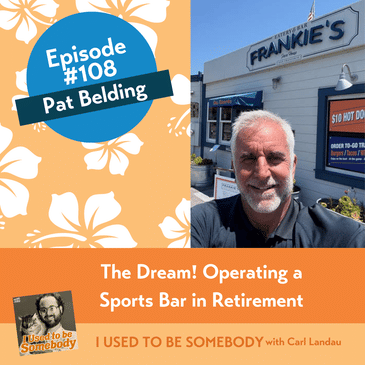
Have you ever thought about your dream second act? Something you enjoy doing and you imagine what it would be like to run a fun business where you'd love to be a customer?
Most of us wake up the next day and forget about that dream or talk ourselves out of it quick. This month's guest, Pat Belding is actually doing it. In his mid-sixties, he's running Frankie's Sports bar in San Francisco. Quite a change from owning and operating his high tech marketing company. Rather than dealing with Fortune 100 companies like 3M, Cisco and Google, he's behind the bar (managing a team of 20 employees, dealing with food and beverage vendors and keeping the bathrooms clean) while serving San Francisco Giants fans beer, cocktails and great food before and after games. And he's loving it!
Pat is pushing way beyond his comfort zone. Three years ago, with no prior experience in the food and beverage industry, he started helping out at Frankie's, a cool sports bar on the South Beach marina. It's located just a stone's throw away from Oracle Park, where the SF Giants play. Frankie's, originally named the "Java Hut", has a special history--it's the Embarcadero's oldest operating eatery for over a century.
His story is inspirational. Told with humor and humility. A true (un)retirement success story!
• More about Pat Belding: https://www.linkedin.com/in/patbelding
• More about Frankie's Sports Bar: https://www.frankiessf.com
• Episode Content: https://pickleballmediahq.com/blog/pat-belding-interview-operating-a-sports-bar-in-retirement
• Sponsored by Capital Advantage: https://capitaladvantage.com/promotion/retirement-planning-guide
• Sponsored by How to Retire and Not Die Video Series: https://howtoretireandnotdie.com
• Subscribe to the the I Used to be Somebody Newsletter: https://pickleballmediahq.com/contact/subscribe
[00:00:05] Pickleball Media presents the I Used to Be Somebody Show, produced live at the Landau Tiki Bar in Sacramento. Here's our host, Carl Landau. Welcome to Landau Tiki Bar and the I Used to Be Somebody Show. We've all considered doing a second act like today's guest, but the next day we come to our senses and ultimately don't do it.
[00:00:32] Well, our guest is doing it and having a blast. I know it sounds a little confusing. I'll explain in a minute. First, I want to thank this month's sponsors. Thank you to our sponsor Capital Advantage Wealth Management. And thank you Gary Sirak, author of How to Retire and Not Die. He just came out with an amazing video series.
[00:00:54] It's 14 videos that cover all the non-financial parts of retirement, purpose, identity, relationships, and totally helps you prepare and enjoy your next chapter in life. Following today's interview, we've got two fun segments. First, we talked to the under-retirement wisdom with the pros guys. We talked about one of the fun things to do in retirement, and that's spending money.
[00:01:21] We examined the old-time spending rules and see if they still apply. That is followed by Pig Ball Chronicles with Traver. Trevor and I talked about something that is near and dear to our hearts, dinking. Which, strangely enough, is the first time we've actually talked about it on the show. So, we just came back from our I Used to Be Somebody world tour to Croatia.
[00:01:46] We had an absolute blast. There were 18 of us on the trip, and I really loved every person that was there. I don't think I've laughed that much for a whole week in my life. It was really fun. Croatia is absolutely stunningly beautiful. What an incredible combination of water and mountains. The people of Croatia couldn't have been more friendly. The food was absolutely out of this world.
[00:02:14] Particularly, if you're a fish lover, you're eating seafood that came out of the water that day. And the wine was surprisingly really good. The history behind that whole region, formerly called Yugoslavia, is fascinating and very complicated. Our tour guide was Dayan, who we all totally loved. As well as our taste vacation escort was Katie.
[00:02:43] And I hope Katie remembers she invited us all to her wedding. At the end of our trip, my wife Diane and I always like to chill out after the tour. And if you end up going to Croatia, I highly recommend you go to Montenegro. Very few tours there are incredibly beautiful. Okay, back to the show today. I guarantee that you will have a super fun time listening to my interview with Pat Belding.
[00:03:11] Now we've all had conversations with ourselves about getting involved in something we have a passion for. Hey, I'm a big sports fan. And admittedly, after a few drinks, I've gotten the idea of starting my own sports bar. We've all had these illusional thoughts about working in a business that we personally enjoy. But we sober up and forget about it. Well, Pat's doing it.
[00:03:36] He runs Frankie's Sports Bar, which is right next to the San Francisco Oracle Park, home of my beloved San Francisco Giants. It's right on the bay. Beautiful location with the South Beach Marina boats docked right there. At 66 years old, Pat, who had no prior experience in the restaurant business, is doing it.
[00:03:59] In fact, Pat's friends tease him that he's failed at retirement because he's really working his ass off, but he really loves it all. He's funny, self-deprecating, but a real inspiration for proving that you can do something totally new later in life in what we call unretirement. Sit back, enjoy my interview with the one and only Pat Belding.
[00:04:31] They asked me if I wanted to take on a little bit more serious role of managing the place. And I, in a weak moment, I said, yeah, how hard can it be? Okay, I can do that. So now my buddies are telling me how I'm failing at retirement because I'm go, go, go. But I'm figuring things out as we go. Hi, Pat. Welcome to the I Used to Be Somebody show. Hey, Carl. It's great to be here. Thank you very much.
[00:04:58] It's always nice to meet after Giants win, which was really nice yesterday afternoon. Boy, they sure needed it. It's a long season, but sure, a lot better environment when the Giants win. Yeah, I can't tell people how different it is. We're in the bar and it's like early on a Thursday morning after a Giants day game. I was there yesterday with my daughter at the bar and it was like crazy.
[00:05:26] And then, oh my God, it's like so nice here. You have the fog and it's just like day and night. I always say to people that come into the bar during a Giants game, they say, oh, I love this place. And I say, well, prove it. Come back in an off day. This is very exciting that I'm in one of my favorite sports bars in the world. And I'm sitting at Frankie's Sports Bar with a view at Pier 40 in San Francisco. And it's a beautiful place to be.
[00:05:54] It's located in the iconic San Francisco South Beach area. Literally a stone throw from Oracle Park, home of the San Francisco Giants. I can see Oracle Park from where we're sitting here. So, Pat, I want to talk about the history of Frankie's where we're at. But first I want to introduce you to the audience. So, Pat Belding is a native San Franciscan. He founded and ran Belding Associates since 1992.
[00:06:19] It's one of the top specialty agencies in the area and served clients like Google, 3Com, Cisco, and many more. But starting three years ago, he decided in retirement he wants to run a sports bar. And he's the general manager of Frankie's Sports Bar and part owner. Now, many of us have had a few cocktails or two and talked about doing something like this. But Pat's actually doing it.
[00:06:49] We're going to talk about that a lot more. But first on I used to be somebody show we'd like to play a little icebreaker game. So, Pat, are you willing to play the game? I am ready. Okay, let's do it. The name of our company is Pickball Media. Pat, what is your Pig Ball experience? My pickleball experience is a little bit limited. I've played several times. Unfortunately, every time I play, there seems to be more waiting involved for a court. And I'm not out there playing regularly.
[00:07:19] So, I get a little bit frustrated and I just stick with tennis and I'm still playing pretty actively. So, I feel like there's a learning curve and I'm still learning the game of tennis. So, we're not sticking with that until the body more falls apart. But one of the ironic things with pickleball is in tennis, I never seem to move my feet or move anywhere. But then, of course, when I play pickleball, I'm always in the kitchen. I shouldn't be. Yeah. I identify this immediately. Pat is a tennis snob.
[00:07:48] Looks down his nose at us Pig Ball players. But you're like one little entry away from like, oh, hey guys, can I play with you? So, I'm going to give you a C plus for honesty. So, Pat, the other question we have is what was the worst job you ever had? Huh. Well, a lot of my jobs was working for myself. I remember back in the day, and it's kind of ironic that I'm here where I am now at Frankie's.
[00:08:15] I do what I'm doing because a job right after college, while I was still working professionally, but I was barbacking at a famous San Francisco bar. And I thought that'd be fun, keep me out of trouble, do a little work, be around all these cool people, one of San Francisco's hottest spots. And I never realized how poorly I was treated until after about the second night working there. It was just ridiculous. It was just working my tail off.
[00:08:45] I just was not treated that well. And it said, this is not for me. So, this is like, I'm guessing like in the 80s or something? Exactly. It was about 83. Oh, okay. So, I was single then and pretty new to San Francisco, and I went to those bars and stuff like that. It was sort of a crazy era then. A lot of things happened in the 80s. Yeah. We were right in the middle of the, they call it the Bermuda Triangle that you never get out of once you start having a drink there.
[00:09:14] I remember, you know, closing up the bar at two o'clock in the morning and I'm still stocking shelves, cleaning things out. And meanwhile, the guys that were barking out all the commands, the bartenders, they've now poured themselves their big cocktail, sitting over at the far table with two large mounds of cash and maybe another mound of white powder. I'm not quite sure. Oh, God. Yeah.
[00:09:42] And, you know, I'm just looking over there and I'm still working away. And then after I finished about 45 minutes later doing all this work, they said, oh, here you go, kid. Nice job. And here comes a $10 bill. And I said, okay, this is ridiculous. I understand. And maybe you want to do something other than being a bar back. So I should actually say being a bar back is okay. You just have to work at a better place. Yes. Yeah, exactly. Yeah.
[00:10:10] It's always fun for the audience to get to know the background of each month's guests. So you grew up right there in San Francisco? Yes. Over by the West Portal neighborhood to west of San Francisco where not a lot of the tourists go. A lot of residents is over there and it's a wonderful, you know, neighborhood. Fun, safe, a variety of people all over the place. I was in public school for a little while, then to parochial school, and we're all playing together at the local playground and riding our bikes everywhere.
[00:10:38] I was used to the fog, grew up in the fog, you didn't know any better. And it was great. So San Francisco is famous for middle summer and it's our coldest time of the year. You know, you see people wearing their down jackets, especially you lived, I mean, not that far from the ocean, which is the worst place to be. And then you go to Fisherman's Wharf and all the tourists are in shorts and freezing their asses off. So anyway, a little hint for people coming this summer to San Francisco.
[00:11:07] Enjoy the month of September. That's our summer. Yeah. So tell us about your family, size of family. Were you rich or poor? What was your family life like or anything you want to share? Yeah. My mom and dad, really nice, loving home. They had me when they were quite young and dad was still in law school, put himself through school. And by the time, you know, he became established, I was now grown up. So my siblings that I have one sister or one brother and they grew up a little bit differently
[00:11:37] because by the time they came around, dad was quite well established as a leading managing partner, leading downtown San Francisco law firm. And meanwhile, when I was growing up, mom was painting the pool apartment building that we were living in to pay for rent. And dad's going to night school and then law school. And so it was a fun upbringing and moved to a few different schools all within the same area. So I really felt a good sense of community and a really nice family environment as well.
[00:12:05] So you were the oldest, so they made all the mistakes on you and they were tough around you and didn't have as much money. And then your siblings got a free ride, right? Oh, exactly. Okay. So I was the opposite. I was the young boy. I had two older sisters and I was the baby brother. So I saw the opposite side of it. I think the younger kid works out better for them. Oh yeah. My brother reminds me of that all the time.
[00:12:33] How would you characterize what a young Pat Baldy was like as an adolescent and teenager? Well, I might've pushed the limits just a few times with my parents and always a curious person, always willing and interested to do something new and different and push the boundaries and rules were always sort of guidelines, always a curious person.
[00:12:58] And I surrounded myself with nice friends that would keep me on track when I would maybe decide to maybe go a little too adventurous. So you've been in the graphics slash creative slash advertising world since 1984 and you ran your own agency for a long time. And like I mentioned at the top, you had some really large clients, some of those huge companies like Google, 3Com Cisco.
[00:13:26] I'm guessing though that they weren't huge when you were first started working with them or maybe I'm wrong. I'm not sure. Yeah. No, I'm obviously dating myself, but back in the day, there was no such thing as routers and switches and hubs and servers. And, you know, I was working with a small company called three com and people would say, Oh, that's great. You're working with the Scotch tape companies. No, that's three M. And, you know, and next thing you know, three com and it took off and they threw their name on the on channel stick park.
[00:13:56] So then started some people started to know them. Then along came Cisco systems and they kind of grew to be the one of the world's leaders. And I kind of moved over and started growing with them. And it was really sort of on the ground floor. So that was an exciting opportunity because the marketing world was really sort of taking off in the technology sector. And we really sort of started to provide a small niche for the on the local agency level. Yeah.
[00:14:25] You know, in 1983, right around the same time you start your business, I started a magazine called computer language, and it was for software developers. Our third issue, we are viewed Bill Gates and Microsoft wasn't all that huge then. And he loved our magazine because he was a programmer. It was a magazine for programmers. It was a simpler, gentler time then for sort of amazing being involved in those days.
[00:14:54] So you were at your agency for a long time. When exactly did you stop running your company? I stopped running my company about five years ago. And, you know, when you have your business and you work for a utility or public sector and you know what your retirement date is, you know the money you're going to have for the rest of your retirement, you know that retirement date. And for me, I really didn't know if I was going to be retiring or what that was going to mean and when it was going to happen.
[00:15:23] But it got to a point where the whole industry was changing considerably. And we were going to a few meetings and had a few clients and there were suggestions from the client side about things that I had really never heard of or had the experience with. And I used to be the smartest person in the room. And now I'm looking around and going, I don't even know what you're talking about. You know what?
[00:15:50] I'm actually working harder to try and catch up right now. I'm making less money. I'm not enjoying it as much. Maybe it's time I step aside. And luckily I was able to sell it, pass it on to employees and the company's still going, you know, going along. And I just kind of stepped away and thought, you know, there's got to be something next. I'm not quite sure, but I'm comfortable enough that the, you know, everything's not going to fall apart and I'll just figure out things as they go along.
[00:16:18] So it was kind of a strange period of time, but yeah, it was about five years ago. Yeah. What was that transition like from fast paced career to post career? We'll be back in a moment after a short break. Choosing a financial advisor is one of the biggest decisions you need to make in retirement. Now it is more important than ever to protect your retirement savings and investments.
[00:16:44] Capital Advantage can help individuals like you develop a personalized investment strategy and retirement plan unique to your life and goals. For over 40 years, Capital Advantage has been a 100% fee only fiduciary advisor. Just go to CapitalAdvantage.com slash podcast. Hundreds of our listeners have bought Gary Strack's book, How to Retire and Not Die. He's come out with a great video series.
[00:17:14] It's ideal for people approaching or entering retirement. It's a 14 video courses that cover it all. Identity beyond work, figuring out your new purpose, give you structure and emotional, social, and cognitive health plan. Check it all out at howtoretireandnotdie.com. Welcome back to the show.
[00:17:42] What was that transition like from fast paced career to post career? The beginning was really sort of surreal that I quickly learned that I wasn't really as relevant as I thought I was. People that I used to interact with all of a sudden maybe didn't have time for that coffee or that lunch. And there was a lot of transactional sort of work and you share information. I share information just kind of casual on basis.
[00:18:09] But then all of a sudden, once I was, quote unquote, retired, I'm like, uh-huh, Pat, I'm a little bit busy right now. Like, oh, okay. I guess I don't have anything to offer here. It was a weird feeling. But then also, you know, one of the things was I looked at my nightstand and I had about 10 books in different magazines that I have never had a chance to read in the last several years because I would read a page and fall asleep. It was like, now's the chance I can go work on this project in the house. I can do some more reading.
[00:18:37] I can go spend more time exercising. So it was a sort of invigorating time, but at the same time, a little bit confusing time as well. I think that's true for almost everyone. For me, the first year, I kept on thinking there was all the stuff I needed to do. I couldn't get that out of my head because, you know, being an entrepreneur of a smaller company where you sort of did everything, you know, there was constant. You never had enough time, you know, to do everything.
[00:19:07] And all of a sudden, you know, things really slowed down. And in the back of my head, I'm like, wait, I should be doing something. And there really wasn't any specific thing. I was just I was so trained. And you probably were in the same situation where you're sort of on all the time. I think you need that year of like transition to like a little slower light. That's a little bit more normal. Yeah, very much so.
[00:19:35] But then as that sort of transition, I took some of my focus away from what used to be the work environment. And then maybe I started bringing that more towards the home. I think my wife might have maybe suggested or hinted that I find something else to do with my energy and interest. You know, a friend of mine, Diane told me, my wife told me that her husband, he made this terrible mistake.
[00:20:02] His first day that he wasn't, you know, working. And he asked her, like, what's for lunch? And she had gone like 40 years without having to worry about his lunch. And it didn't go well. So thank God she told me that. I never asked that question ever. But anyway, it sounds like maybe you struggled a little bit. So what did you do the first time before you ended up with this career, like running a bar?
[00:20:31] You know, as I mentioned at the beginning, you know, always been sort of a curious person. And, you know, one of the things of when I was running my business is I needed to make sure that I was making money and making, to me at the time, serious money in order to just provide for our family, but then also provide for the future. Because, again, there is no annuity at the end of the day.
[00:20:51] So there was not a question of looking at jobs that might have been at the time that I might have thought were more rewarding or interesting, but didn't have the payoff at the same time. So I couldn't really include those at the time. And later on in life, I can look at anything and do anything. And there wasn't really bored or frustrated, but I was just sort of open to things. There was a group that was in need of a trail, a hiking trail lead and some trail repair.
[00:21:18] And I joined up with a couple of different organizations and we repaired hiking trails and then got together on a regular basis. And that was kind of fun. And then I, I don't know, there was the U.S. Census was around and I got involved with the census and then became a hiring person for the census. And I just kind of embraced that. And that was really sort of interesting process and dealing with the federal government and the bureaucracies and actually worked for the San Francisco Giants as one of their guest services.
[00:21:48] We're all over the map, but with no sort of like, I need to fill up my time. It just sort of like things kind of fell into place and I still had my, my free time, but I had some other responsibilities and different things that interested me. Honestly, what you did is exactly what we talked about on the podcast. You know, it began sort of experiment with things because for the first time, if you do something and you don't really like it, you can just quit.
[00:22:15] And like when you're in your thirties and you have the house and the family and the mortgage and you can't quit. No matter how bad a day you have, you know, or whatever, this is a time to experiment. It sounds like you did things right. So let's go into Frankie's, which I'm fascinated by this because when I met you, which was about a month ago or so, you know, and you were working outside. I mean, this, which I was really impressed.
[00:22:44] I mean, it was opening day of the giants. It was a mad house and you were like sort of the MC of the place, you know, just sort of directing people and all that. Cause it needed directing. I mean, there were like way too many people. And I was like really impressed. I'm like, you know, this guy's like, it is, I guess mid sixties or whatever. First thing, did you have any experience in the bar or restaurant business other than being a bar back with these cocaine acts?
[00:23:14] Well, I had one in college. We had an on-campus beer pub and I decided I was going to spend some time there. So it was better to be on the backside of the bar instead of the receiving side. So I did do some beer bartending for a little bit at University of California, San Diego. But then apart from that, that was it. But one of my buddies was one of the investors here at Frankie's Job House. And they had just done a major renovation and I ran into him and he said, hey, we need a bartender. And I just got to remember a bartender.
[00:23:44] But okay, I've got some time on my hand. Like I was mentioning the other jobs. Like, sure, why not? But I'm a little bit nervous. Maybe I'm not going to be able to do it. And he goes, don't worry, you'll be in the top 99 percentile. What do you mean? He said, listen, you're going to show up to work and you're not going to steal from the till because the bar is very low. I said, okay, you know, so I can pour a martini in Manhattan. And sure enough, I started doing that for a couple of years, a couple of days a week.
[00:24:09] And I really enjoyed both the off days with the locals and the tourists and the views of the water. And that was nice. And then the Giants games, there was just chaos and high energy. And so it was a nice balance. But next thing you know, fast forward a couple of years and I went through a few managers and a lot of just sort of changes and iterations. And they asked me if I wanted to take on a little bit more serious role of managing the place.
[00:24:36] And in a weak moment, I said, yeah, how hard can it be? You know, yeah, okay, I can do that. So now my buddies are telling me how I'm failing at retirement because I'm go, go, go. But I'm figuring things out as we go. And some of it's just common sense. You know, I was just thinking about what a complicated business you're in. You're dealing with all the laws and regulations of alcohol and food products. Sometimes you're dealing with drunk people.
[00:25:05] And then like traditionally, particularly in the restaurant bar business, very unreliable employees. And to make things more complicated, you work in an area right by the Giants ballpark, which is like crazy. Like when, you know, this game is packed. And I imagine when it's not, it's not. And how did you end up like in retirement as such a complicated business? Yeah, it was just sort of like, be careful what you say yes to.
[00:25:35] Because I thought, ah, again, you know, I spent a few times in the bar. Like, yeah, this would be really fun. And in fact, I had a funny story. We were cleaning out our house and my wife said, what are those two big bags in the attic? And I said, well, those are filled with my old T-shirts. She goes, what the heck are we doing with old T-shirts in an attic? And I said, well, there's this bar in San Francisco. It used to be called Padoshay's. I used to frequent. There was just a wonderful establishment. And they had this wall filled with all these old T-shirts.
[00:26:04] And I just thought that was going to be my sort of the epitome of my success in life. If I opened up a bar and then put up all my old T-shirts on the wall. And my wife kind of like then had to ask that question in the way that she always will without really starting commenting on it. She goes, let me get something straight. You want to open up a bar and put up your old T-shirts on the wall. And you think people would enjoy seeing that and smelling it? I'm like, well, now that you put it that way, I guess not. So I just thought it would be kind of fun to do this.
[00:26:32] And I realized like when I had my own agency and a lot of it was managing stressful situations, clients' expectations, both independent contractors and employees, and bringing them all together for one final product and having it successful. And then we never had a chance to sort of like, okay, we figured this model out. Now let's repeat it. It was just like, you better create something new. You better come up with another successful, creative new program.
[00:26:59] So it was very similar in that sort of regard to a bar that you just need to make sure those customers are happy, the bar staff's happy. And, you know, to me, it was just last year, you know, it was that cycle where you're saying it's kind of a confusing bar where you have ball games and then no ball games. So these are crowds. And we really had some really good people that luckily, I think they really started to enjoy themselves. And so they stayed on during the off season.
[00:27:28] So when this season came along again, everybody during the off season, you have hardly any shifts or any work, but they stay engaged with Frankie. So that was nice. So when we came back around to baseball, all of a sudden there's these familiar faces, which typically that wouldn't be the case. That would be like, okay, let's get a whole new crew. And it's like a summer, you know, beach club, you know, where you get a whole new crew for this summer. And so when you have a little continuity, that's sort of like that family familiar feel.
[00:27:53] And, you know, people come back to the ballpark, they recognize the same people, the staff can be, you know, more or less the same. So that's sort of a satisfying feeling when you get people that are enjoying where they're working as well. Yeah. So I really want to hear the history behind Frankie's. This is a really cool building. You know, I think I mentioned to you earlier when we were talking before I started a high tech media company in 1983. Just a few blocks away on Townsend Street.
[00:28:20] We were one of a handful of companies with offices south of Market. I mean, people that go there now have no idea what that area was like. And I remember going to Red's Java House, you know, a lot during the day for lunch, which is right down the street from you. And I remember getting a butt and a burger for something like $4. And I vaguely remember this place being here. Yeah. We'd go out for our burger.
[00:28:45] Some of these places would have, you know, $5 for a burger or for a shot and a beer. And it was sort of a little bit sketchy. But, you know, I liked some of those places. And it was Red's was the Irish guy that has red and white colors in the place. And this was the Java House. And this was owned by the Greek person, the blue and white. So they're back about six years ago.
[00:29:08] The Heffernan family ended up buying the place and paying homage to their great grandfather, who was their fourth generation San Franciscans. But their great grandfather came from Ireland and was in the food business and grew up in the mission and wanted to pay homage to him by naming the restaurant after him. So Francis Michael is now it's Frankie's. And that's sort of the background of the naming of the place is.
[00:29:31] And they did a typical San Francisco remodel where they left one two by four and basically guided and redid the whole place to take more advantage of the views of the bay. And really sort of did a really nice job. So you can sit there and stare at the water and the boats and still have access from the road and the parking. So it's a nice setup. Oh, it's awesome. And then you have that like burrito right behind you, you know, and really cool place.
[00:29:57] So I started coming to Frankie's a year ago and absolutely love it. The location, like you said, is amazing. And you're sitting right next to the ballpark. The food and drinks are really good. It costs about a third of the price is in the ballpark. And the food's better at Frankie. And so I do all my eating and drinking before the game and watch the game. I'm just curious. So, you know, and you've been there like three years. How many hours a week do you work?
[00:30:27] Oh, yeah, yeah. You know, I keep thinking that I'm hardly working at all. And, you know, I just pop in and then mixing. You know, you're going to run this rabbit hole and you're got three hours under your belt. So, you know, it's a full time job. It's not just, you know, just walk away. I'm getting to the point now where we've got a good crew and we've got procedures. And you've got to get into a little rhythm of a couple of homestands. And then after a while, then you can start to step away a little bit and get the helicopter view.
[00:30:56] But right now, I feel like I'm in the trenches and just dealing with the San Francisco port and the staff and the vendors and throw everything, repairing the equipment, etc. But soon it'll be a lot less hours, but still managing it in a way that has the appearance where it just happens automatically. Well, I just have to tell you, Pat, it comes through, though, you really manage that place really well.
[00:31:22] Like, as soon as you walk in, and I don't know, maybe I'm more observant than others, but, like, to me, it's really important. Like, you could tell if a staff likes each other, that they're happy working there, that they have the systems there. And, like, as soon as you walk in there, it's like you get that feeling. And everyone's, like, super nice. I mean, everyone works there. So I'm just telling you that while I interview, I was, like, so impressed every time we go there. Thank you.
[00:31:50] Sometimes I just think it should just – of course, that's the way it should always happen. You know, and you realize you go to enough places, and it's just like, oh, my goodness, you know, how did you fix that? And, you know, and it's so weird because you think everything's going perfectly, and then all of a sudden, next thing you know, one person has a bad day, and then they decide, instead of telling us about, you know, whatever the problem is of, you know, there was pickles instead of onions in their burger or something.
[00:32:18] Instead of, you know, saying something to us, then all of a sudden, they decide to go on some social media platform and blast you. And then you have to dig your way out of that hole, and that gets frustrating because that's why I try to be a little bit more of a personal presence there. So if somebody has an issue, you can talk about it. You don't have to go just anonymously blast something out there. Luckily, things are pretty well received, but you realize in this business that you're only just one click away from some type of social disaster, it looks like.
[00:32:47] I swear to God, though, I've never written a Yelp review in my life. I will never write a Yelp review. I do read them. I mean, they're in some ways great entertainment, but it's like, oh, my God, there's like some nuts out there. Anyway, I won't go into it, but I can't imagine me on the other side being a restaurant owner. I have to ask you, Pat, was there an aha moment when you thought, I think I can really do this?
[00:33:13] You know, because you didn't have a lot of experience doing this and all that, and all of a sudden, was there an aha moment? You know, I don't think there was, to be quite honest, because I still don't know if I'm doing it right. And it still sort of drives me to perfection or getting things finely tuned. So I just feel like every time you keep making progress, the bar just keeps moving along, getting a little further. They're like, okay, you know, this is good. This is fixed. We have the employee issues. We have the food issues fixed.
[00:33:42] Now, how do we get more people in here? Okay, now we have more people in here. How do we fix this and improve this? And it's just, so the bar keeps moving. But I need sort of moments like this where you kind of said, yeah, it's a great experience. I'm really enjoying myself. You're doing okay. Like, I step back for a second and say, wow, that's great to hear. I haven't really thought of that. Because otherwise, I always just kind of think the glass is half full and you better just keep working harder and doing a better job to make it a better experience.
[00:34:08] So I think it's one of those things that I'll look back when it's all over or I'm sitting there as a customer and just sipping a drink and kind of looking around going nodding my head going, wow, either I did this or I could do better. But right now I'm in the trenches still. So there isn't sort of an aha moment. But I did realize that it's an aha moment of I really enjoy this and I like the high energy. But it's not a moment where I can say, okay, I have this dialed in. I feel like I'm always on my toes to try and get a little bit better.
[00:34:37] I have to say, like, I started a conference, the niche media conference, and it's all special interest magazine. They used to be magazines. I'm obviously dang myself. Some of the people still printed magazines, but it's, you know, mostly online and all that. But anyway, I did that for 20 years, built it up, sold it. And then I went three years after it was owned by someone else that I'd sold to and just went there to attend it.
[00:35:05] And, oh, my God, it was a wonderful experience. It really was. And I wasn't critical. I mean, you know, you look around, oh, they changed this or that or whatever. I didn't give a shit. I'm, like, happy doing this and just hanging out with the attendees and stuff and just having a good time. So you'll have that. I mean, you still have been at a relatively short amount of time. So, yeah, it has been.
[00:35:31] And sometimes I can be on the other side and, you know, maybe I get to go to a ball game and I join some buddies or, you know, family. And we sit down and have a burger and a beer. I look around and go, wow, there's a lot of people just enjoying themselves. But otherwise, when I'm working, it's like, okay, there's a napkin on the ground. There's this. Okay. Let's talk about unretirement. We've got 20 unretirement strategies on the Pickball Media website. I picked out two for you.
[00:35:58] Number five on our list is pushing beyond your comfort zone. What do you have to say about that? Well, I think that it's really easy to do what you are comfortable doing, especially when you get older. You know, we don't get into usually more open-minded the older we get. So it's why not mentality of, yeah, I've never been in the restaurant, food, bar business. Yes.
[00:36:23] I've never been, you know, the hiring manager for the census or I've never been a trail lead in outdoor. Like, why not? And you don't have to pass yourself off as the expert. You can still keep learning, which is wonderful. And I want to keep that mind fresh. So it's just the why not? And keeping your eyes open is my sort of take on it. I agree. It's like, you know, what do you have to lose? And we talk about it on the podcast quite a bit, sort of embracing yourself as a beginner.
[00:36:51] And for some people, I think particularly for kinds of people that were the straight A students, it's really hard to do or perfectionist. And I'm like, I guess in some ways lucky in the fact that I growing up was dyslectic and still am. Although they had a different word for it in the 60s, it was called stupid. I did not do well in school.
[00:37:19] So you had to figure out workarounds and stuff like that. I personally sort of feel like a beginner, like all the time. But some people that grew up a little differently and like I said, the straight A students, they really have a tough time. Like, you know, we wrote the book, Pickball for Dummies and all that. And I taught a lot of people how to play pickball. And some people are so frustrated on the first day that they're learning that they're not the greatest pickball player in the world.
[00:37:46] It's like, why did you think you were going to be good? I mean, you know, you know, you think about your career when you were like 22 years old and like you knew nothing and all that. And then you end up like with all this experience and all that. And that didn't happen overnight, you know, that you did that. So people need to give themselves more breaks. Another unretirement financial plan. What do you have to say about that? Yeah, the financial plan is a tricky thing because you can be a type of person that,
[00:38:15] you know, really wants to have everything dialed in. You know exactly the amount of money you're going to get from Social Security or this and what your set retirement date is. But when you have your own business, there is no sort of retirement program. So you put away money and then you have to figure out, are you going to have enough money to live on for the rest of your life? And oh, the other sort of unknown is how long are you going to live?
[00:38:41] So that's kind of a frustrating thing because if you've done really well, you hit the genetic lottery or you've taken care of yourself and you live a really long life. Well, now you're going to get penalized financially for living so long because your money's starting to run low there. I had a financial advisor years ago and luckily I stuck with him because I had made some financial mistakes very early on. And I was working with him for many years and still do. And I remember I was getting a little bit frustrated a couple of times when everything's going up
[00:39:10] and ours is just going up a few percent instead of skyrocketing like everybody else. And he'd always just tell me to stay calm, stay calm, which I wouldn't stay calm, but at least I never did anything with my money, which was, thank goodness, he was the person in charge. And finally, after our yearly sort of recap of everything, he said, you know, the thing you keep saying every year is how worried you are about growing too old and then running out of money. So why don't we get an annuity that kicks in when you're 80 years old?
[00:39:40] So if you do live that long and you live a longer and longer life than your spouse does, at least you'll have something that's going to kick in later on in life that will absorb some of those additional costs. Pat, what advice do you have for our audience? Our audience have had successful careers. They want to do something new, something more fun, something more meaningful. Do you have any final words of advice for them? Don't be afraid to take chances.
[00:40:06] And I really think you should get engaged as much as possible because there's so much that we can still add value to our community, our world and our knowledge. And it can be frustrating and things can be new and you can not be as fast as the next person. And it'd take a little bit longer than it used to take to adapt to something new. But take those chances and keep engaging with the younger people.
[00:40:31] It keeps you younger and it's just more interesting for you and your family. That's the best way to look at things. Stay curious. You know what? Those are all really good words of advice. I love the being engaged with younger people part. I wrote a blog post about a month ago about that. And I think that's really important. We have friends that are way younger than us. We have friends that are way older than us.
[00:40:58] And you end up learning a lot from those people and they learn from you. The idea, honestly, of like moving to a place where everyone's old sounds like terrible to me. I don't know. I don't know why I'd ever want to do it. So I love living in a neighborhood where, you know, those people have like just, you know, their first kid and everything. So, you know, variety is what you need to, you know, to me, that senior living place or the what place. And it's, you know, it's wonderful.
[00:41:27] And it has the golf courses and the wonderful eating. And like, you know what? I'd like to go to the city or the town and try this new place in this new area. And I think variety is a good spice of life here. I'm with you, brother. So if you're in San Francisco anytime, I'd recommend you come to Frankie's. It's got the best view in the world. Pat Belding, I can't thank you enough for being our guest this month on the I Used to Be Somebody show. Carl, it's been my pleasure. Thank you so much.
[00:41:57] Look forward to seeing you at Frankie's job house again soon. Un-retirement wisdom from the pros. Today, we've got Ian Castile from Capital Advance and Gary Serac from Serac Financial Services. Today, I want to talk about spending money in retirement. Ah, that sounds good to me. So I'm just wondering if the 4% withdrawal rule still applies these days. If not, what's a better guide to spending in retirement?
[00:42:26] Because I know it's been around for a long time. And I looked up rules on spending. And there's a lot of them that you can pick from. The 80% rule, besides the 4% rule, the 8% rule for income replacement, the 25 times rule for savings, the 4-year cash rule. Lots of rules. So let's start with the most common rule that's been around forever, the 4% rule, which I understand
[00:42:53] is you withdraw 4% of your total portfolio in the first year. And then adjust that total amount for inflation each following year. So Ian, did I get that right? I think that's right. The golden rule, as us financial planners call it, going back, if you do a deep dive into where this comes from, under a diversified portfolio over any historical rolling 25-year period,
[00:43:21] you say if you limit your distributions to 4% or less, you won't run out of money, which is a pretty good rule of thumb. So for the average retiree, let's say they retire at 65 with a diversified portfolio 25 years with no historical failures, would take you all the way to age 90. That's very, very high confidence. It's pretty conservative numbers, depending on the age and depending on if you're okay with
[00:43:48] accepting even a very small potential for failure, knowing that you can adjust along the way, could really adjust that. So 4% is really, I think, one of the more conservative rules. It's good if you want to just take the eyeball test. Do you think you have enough to retire? A good starting point to just let you know if you're in the ballpark. But most of the time, I think there's customizations and modifications that people can make that would allow them to have a sustainable distribution rate noticeably above 4%.
[00:44:17] And that's where the personalized aspect of financial planning would help you. Yeah, that all sounds right. Right. I mean, what I've read is, for the most part, that it's an old rule and you can spend more than 4%. Because the whole idea, I'm a big believer in the book Dying With Zero, in that I don't want to leave tons of money. I want to spend it. I'm not saying I'm not going to give money to kids or
[00:44:45] whatever, or grandkids. But that's something that we're going to build into what we're doing. Gary, what are your thoughts about the 4% rule? And what are your ideas in general on spending and retirement? Well, I have a little different view because the 4% rule doesn't give you too much to spend. And what I find with my clients, I have, and I got this from someone else. I didn't create it, but I like it a lot. The guy's name is Tom Hagna and it's Paychecks and Playchecks is a book he wrote.
[00:45:13] But what he talked about was go-go years being from 65 to 75. And I think they're more like 65 to 80. And then slow-go years, 80 to 90 and no-goes, 90 to whatever. Right. And what I find is my clients really live that. I had lunch with someone today and he's told me all the trips he's taken, all the golf he's played in all these different places. And he said, Gary,
[00:45:37] I'm just going like crazy. And again, we're pulling more than 4% because you couldn't do that on four. But the reality of it is he'll only be able to do that for so long. And then he'll start slowing down. Yeah. When you slow down, you don't need as much cash. So I'm a big fan of spending it while you're healthy. And when you aren't healthy, you can't do anything anyway. And it's like he said, yeah, my dad's 90. He doesn't go anywhere. And I said, well, my mom was 95 and the only place she wanted to go was dinner and the casino.
[00:46:07] Yeah. Right. Right. I totally agree with you, Gary. I mean, in our go-go years right now, I know we're spending more than that, but we're taking some money that's not in the portfolio too that we're using. So Ian, any more thoughts about savings or? I think 4% is really the starting point and it just goes up from there. Yeah. As far as like, I was just wondering if you think people in general are saving too much
[00:46:32] or too little. And the thing is, I think the people you see, both you guys see, it's a little skewed in the fact that if someone's smart enough and has enough money to see a financial advisor, they're probably pretty good savers and probably more conservative, or they've given it more thought than the average person. Cause I can't believe it. I just looked today and you guys would know
[00:46:56] better than me, but like the average person is saved less than $200,000 in retirement, which is shocking, but that's the reality, right? And it's not going to go very far. That's all I can say. You know, 4% on 200 to eight grand a year, pretty hard to retire on that. It is sad. And the trend, unfortunately we're seeing, again, we have a little different skewed because we're seeing people that are coming to us and hopefully
[00:47:22] they're better off. And, but it's surprising. I had a lady the other day, I talked to her, she's a nurse and she's putting away 30% of her pay, which is a lot. And I asked her why? Yeah. And I said, why? And she said, well, I didn't put anything away for like 10 years. And I realized I'm so far behind. I'm trying to catch up. Yeah. So I give her a lot of credit. That's a pretty gutsy and she's doing it and she's putting away
[00:47:49] serious money. Yeah. It does make sense because she's catching up because the average person wouldn't have to do that. So Ian and Gary, thank you so much for another great segment of Unretirement Wisdom with the Pros. The previous response does not serve as the receipt of or a substitute for personalized investment advice from Capital Advantage. Rather, you should seek advice from the investment professional of your choosing. Different types of investments involve varying degrees of risk, and it should not be assumed that future performance on any specific investment or investment strategy or any non-investment related or
[00:48:18] planning services, discussion or content will be profitable, be suitable for your portfolio or your individual situation or prove successful. Pickleball Chronicles with Traver. We've been doing this Pickleball segment for several years, and I don't think we've specifically talked about dinking very much at all or am I crazy. Have we done it? Well, you might be crazy for other reasons, but no, I don't think we've talked about dinking yet.
[00:48:44] Okay. So let's do some dinking talk. People love slamming, smashing the ball. In fact, probably my biggest pet peeve is these people that just do that and they just love it and they're hitting the ball in the net or out constantly.
[00:49:00] And I don't know. These are very nice people, but I just don't think it's very nice to your partner to like in the rally because you like to hit the ball hard and it's only got work at the time or whatever. So I don't know. What are your feelings on that? Are they still good people? Sure. There's well, probably they're probably still good people. Most of the people I play with are good people.
[00:49:23] But yeah, I mean, if what you really love to do is put the ball away because there's a high shot that you can smash, then being a good dinker is probably the best way to set yourself up for more of those opportunities. Yeah. But to be any good, you really need to be a good dinker. If you have any real dinking skills, it's such a high percent shot once you have it down.
[00:49:48] Yeah. With a low risk, unless you, like you said, pop it up. So Trevor, let's start with the basics of dinking success. So if you were talking to someone, maybe not beginner, but intermediate, what are some of the things they may not be doing?
[00:50:05] Sure. So the one thing they're not doing is moving their feet. And that's the number one thing they should be doing. And, you know, any, any decent pickleball coach or, you know, pickleball for dummies book, for example, is probably going to tell you, you know, get your feet in position first.
[00:50:21] And this is good for any shot, but particularly for dinking because you're, you're doing a lot of lateral sliding back and forth. And if you don't have a good solid base under you, then, you know, reaching to your side to grab a ball and, and dink it back over the net is, uh, is going to be 10 times more difficult.
[00:50:37] So, yeah, that's a good point. The one thing I want to tell people is I learned early on, you know, when you're warming up, people do what's called a dink and talk where they're mostly talking a ball, hitting it right to the opponent. Perfect. Like he's a shot that's doing absolutely nothing as far as warming up. So I learned practice moving the ball around and close to people's feet, even when you're just warming up.
[00:51:06] Yeah, for sure. And that's the way to, to get in some good dink practice too, right? One, move your feet back and forth, bend at the knees, all that good stuff, right? Get yourself in position to hit a good shot. And then even when you're warming up, yes, vary the placement and the depth and the speed of your dinks, you know, keep it low to the net, but not so low that you risk hitting the net. You know, I would say somewhere between two and 12 inches over the net is probably a good window of opportunity for a dink.
[00:51:35] While you're warming up and you're getting those lateral movements in to warm up the hips and the knees and the shoulders and all that good stuff, you know, vary the depth of the dinks and vary the placement. Yeah. You know, once it comes time to play, one of the best possible targets for a good, low, deep dink is the opposite foot or the weak side foot of the opposing player. If they're a righty, then hit to their left toe, for example. And, you know, that's a tough one for them to get back.
[00:52:04] Yeah. And the one rule I've just observed is, you know, when you get a little dinking war where you're just hitting it back and forth using cross court is the person that's the most patient and doesn't try to speed it up and just like forces the other person to over after about seven or eight dinks to try to do something tricky, which happens a lot. They win. I mean, to me, it's like, if you can be patient, you're going to be a good dinker.
[00:52:34] Oh, definitely. And, you know, there are a lot of cliches that go along with this too, that come out of coaches mouths. Oh, we love cliches on this. Placement over power, patience over power, down the middle solves the riddle, you know, all those good things. Yeah. I mean, have you ever watched a pro match where they'll get into these cross court dink rallies and it seems like it's, you know, 20, 30, 40 shots back and forth?
[00:52:58] Yeah. You know what? I don't watch a ton of the pros, but like, I remember early on dinking. I would see that where they would do it like 20 times or whatever. Maybe it's just me, but it seems like on the pro level, it's really gone to like just smashing ball at the kitchen rather than as many dinking or am I wrong? No, you're not wrong. There's certainly a lot more of that than there used to be.
[00:53:23] But I think that's because every pro at that level has become so proficient at dinking. Yeah. And the Johns brothers, you know, Ben and Colin, they're probably at the top of the game doing that. You know, if you can at the pro level, if you can stand up to 20, 30, 40 dinks in a row and not miss one, then you got to figure something else out.
[00:53:44] But if you're out there on the rec court and you can hit, you know, three, four, five in a row that are good, then chances are your opponent is either going to pop one up that you can put away, put one into the net instead. And you win the point anyway, based on your consistency and your patience, or they're going to try and speed it up at the wrong moment. They're going to run out of patience first and try to speed it up and then net it or hit it long or hit it wide or what have you. So I think you're hitting the nail on the head there, Carl.
[00:54:13] You know, patience is key. And, you know, get the swing mechanics down, get your feet in place, short backswing, you know, all of those things that make a good dink the right shot to hit. You know, aim for the opposite toe. Yeah, I swear to God, Trevor, every time I really speed it up and try to hit it hard, it's like I fail every time. But what I've learned is just hit it right at the person, but don't hit it hard.
[00:54:39] You don't have to hit it hard because just if you've been in this dinking thing and all of a sudden you just hit this ball, even, you know, medium speed. It's like they're all wound up. I mean, they're all anyway, that's the only thing I've sort of experimented and seems to work. Sure. I see that over and over as well. And you're talking about going to the person that's directly across from you, right? Yeah. Well, then you could always go for that person who gets bored watching it, you know, their partner, you know, just to make sure they're alive and breathing.
[00:55:09] So that's always fun. Sure. As a matter of fact, when I was playing with a couple of good friends last weekend, that's exactly what happened. Our female partners were in this cross-court dink battle and I just kind of dropped my hands and waiting for somebody to do something else. The woman directly across the net from me at the last second changed her paddle position and flicked it right at my chest. And I wasn't, it was like I was daydreaming or something. It hit me square in the middle of the chest. I thought, oh, that's a, that's a great reminder to keep my paddle up. Thanks for that.
[00:55:41] Anyway, thank you, Trevor, for another great segment on Pickball Chronicles with Trevor. Thanks, Carl. Thank you so much for listening to today's show. I really love Pat Belding and his story. A big thank you to our sponsors, Capital Advantage Wealth Management and to the new How to Retire and Not Die video series.
[00:56:06] Thank you, Ian and Gary, the Unretirement Wisdom Pros and Trevor West, my pickball guy. A big thanks to the star of today's show, Pat Belding. As you probably picked up, I'm a huge fan of Frankie's Sports Bar. Of course, the San Francisco Giants. If you live in the Bay Area or just visiting, make sure you visit Frankie's. They have great food and drinks and a super friendly staff. And what a view of Oracle Park and the beautiful San Francisco Bay.
[00:56:36] And a final thank you to my bosses, Diana and Becca. Thank you for letting me keep my job one more month. We'll see you all next month at the Landau Tiki Bar for another new episode of I Used to Be Somebody. Mahalo.