
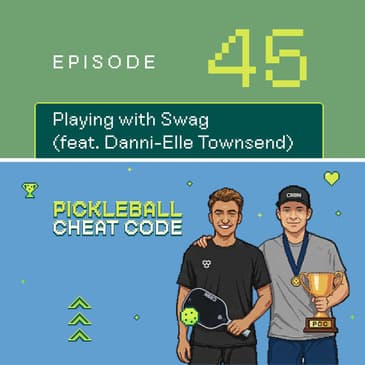
What does it take to play pickleball with real swag—and actually back it up? In this episode, Brodie sits down with CRBN pro Danni-Elle Townsend to talk about her journey from table tennis to becoming one of the most exciting players in the game. They get into her training routines, how she builds mental toughness and confidence on the court, and what it actually means to develop weapons and layer skills over time. Danni-Elle shares what she's learned from playing alongside top pros like CJ and Andrei, how she adapts her game against different opponents, and why cross-training and physical fitness are non-negotiable at the highest level. Plus, a look at the cultural differences between the Australian and American sports worlds that shape how she approaches the game.
🤑 Get 10% off any CRBN product at crbnpickleball.com. Use code PCC
❓Got questions? Send us a voicemail: memo.fm/pcc
🌐 More info & listen anywhere: https://www.pickleballcheatcode.com
[00:00:00] Hey everyone, welcome to Pickleball Cheat Code, the show for competitive pickleball players who are looking to level up their game. We focus on advanced strategies for experienced players, stuff only the pros know. I'm Brodie Smith, I'm a 5'5 plus player and a coach, and I'm here with another very, very special guest, CRBN-sponsored athlete, Danni-Elle Townsend. Today, Danni and I are going to be breaking down Danni's recent success in Rise and Pickleball, along with the importance of playing with some swag.
[00:00:28] At the end of the episode, we'll be breaking down and ranking what's better and who's better between the U.S. and Danni's hometown, home country, Australia. And if we've done anything to improve your game, share the show with your Pickleball community. Pickleball Cheat Code Danni, Danni, you ready to roll? How are you doing?
[00:00:59] I'm pretty good, just played today. We got a 4-0 sweep on Columbus, and it was pretty fun. Really good energy today. Who did you guys play? We played Carolina Hawks. I feel bad for not watching, but I apologize. That's okay. Congrats on the sweep. I'm sure you had other stuff to be doing. Maybe, maybe. Anyway, let's get started. For people that don't know you, I would love for you to give a quick background about yourself, how you found Pickleball out in Australia and your recent success.
[00:01:27] Everyone's been loving watching you, it's been fun rooting you on, so any breakdown would be great. Okay, so I'm Danni-Elle Townsend from Australia. People probably know by now. I didn't come from tennis or a background like that. I actually came from table tennis, a high-level table tennis player my whole life. But Australia, Pickleball's starting to take off, man. And all through Asia, it's spreading.
[00:01:56] And I don't know, it's been a pretty big whirlwind since I've started playing Pickleball. It really changed my life up. But I'm excited to see where it can take me and share my journey along the way. Because I think I have a pretty unique story coming from a different background to most Pickleball players. What was your detailed background in table tennis? How long did you play for? And how many years have you been playing Pickleball? How long has it been?
[00:02:24] So I picked up a table tennis at about six months old. So my mom and dad both played table tennis. My brothers have competed and played for Australia as well. I was in the national team since 13, 12, 13, competing all around the world, actually. So I'm not really new to the traveling life and being on tour. But this is definitely a lot different.
[00:02:52] I actually hadn't been to America previous to Pickleball, mostly in Asia and stuff like that. And then I only stopped playing table tennis 2024. And I was still coaching in 2024. And 2025 is where I stopped everything, went full into Pickleball. So that was only last year. And tried to make it work for the year. And it was pretty rough. I won't say that it wasn't. It was hard.
[00:03:20] I didn't really have much backing at the time. And luckily, I got some breakthroughs when I came over last year. And since then, I haven't really stopped. It's become a lot more fun. I haven't had to just kill what I eat so much. I literally was living day by day, just hoping I'd win so I could be able to go to the next event. Let's go. Well, clearly it's paying off.
[00:03:47] And you're absolutely killing it right now and becoming a huge face in the sport, which is so cool to see. But for that transition, for you going from table tennis to Pickleball, what was that like? If you were to give one piece of advice for somebody that were to switch from table tennis and they want to go to Pickleball, what would that be if you could pin it down to one thing? Fall in love with it. That's probably what I would say. I don't think it's easy.
[00:04:14] I actually think if you're going to choose a sport to come from, tennis is actually the best way to come from. Like, it's going to be a smoother transition. I was shocking at Pickleball when I started. I might be one of the worst players that have come across from, like, I actually sucked. I wasn't very good. And I just, I kind of fell in love with it and was like, wow, maybe I could make this a career. And I obviously played a lot of different sports growing up, which I think also helped.
[00:04:42] I don't think table tennis is actually what got me here. Obviously, my skills in that sport have translated over eventually. But I think that took a very long time and a lot of, like, adapting. How long did that take for you? What was that path like? Did you start at, like, a 2-5, a 3-0? Like, where did you begin at? Probably around a 3-0 I probably started at, which I feel like tennis players come in and they're just, like, automatically a 4-5. Yeah, 4-5 bare minimum for sure, 100%. Yeah.
[00:05:10] Whereas, like, I wasn't great and actually took quite a while because I didn't take Pickleball seriously when I first started playing. Like, I was still playing table tennis. I thought that it was just a fun thing to do with my family. I just played with some old people. And then it took me about, like, a year and a half for me to be like, hmm, maybe I should switch my head on a little bit. And I find myself a bit of, like, a sporting nerd. And I think, like, Pickleball kind of encourages that.
[00:05:36] Because I don't think it's all just physicality, but I think the sport is going that way a little bit more, which is also good for me. In what way do you think it's going more towards physicality? What do you mean by that? Well, I think that you're going to have to put more time and effort into the sport and not just play Pickleball. Like, if you want to get to that level, I think you need to think about how to get better. Also put in the work on the gym side movement.
[00:06:01] And also, I don't know, I think it's going to become more important all of the little one percenters. So, like, diet, training, actually breaking it down. Yeah, I mean, just simply because there's just more talent coming into the sport and it's becoming a deeper sport. Yeah, I mean, I was talking to this, his episode is going to air after this, I believe. But I talked to Andre yesterday and he was talking about so many of the little nuances of cross-training and all the details that go into it now.
[00:06:29] Since it's becoming more and more competitive and expansive. Like, he's training and other players as well are training table tennis to cross-train for Pickleball, which I thought was really interesting. That is interesting. Yeah, so I guess my question for you is, what's your breakdown of your cross-training? Like, what effort are you putting in physically at the gym? You know, plyometrics? Like, what are you working on to make sure that you're as well-rounded as possible on the Pickleball Corp?
[00:06:58] Yeah, so back home, I had a pretty, like, well-thought-out schedule. I had a conditioning coach that I'd work with three to four times a week. And then I would have one to two sessions on court, usually one drilling and then games or something. And then I would also do my own strength training three times a week. So that's more like powerlifting based and just overall body strength.
[00:07:27] But my conditioning coach, a lot of it, two of the sessions were on court training. The other two was in the gym working on plyometrics and some rehab for your joints and ligaments and stuff like that. That's amazing. So if you were to give, I mean, this is such a general statement, but if our listeners were to be able to take something in terms of, like, a weekly schedule that they could tackle of maybe X amount of days allocated to weightlifting
[00:07:56] and X allocated to drilling and X to Pickleball or maybe from, like, an hour's breakdown. If you were to help kind of give advice in that realm, what would you say? I'd say try and do some type of strength training three times a week. And then I don't know how much time these people are going to have. Like, if they're working and stuff like that, it's hard. I mean, I was doing it for a while. I was still coaching, like, quite a few hours a day. Table tennis coaching, that is.
[00:08:26] I don't know if I want to fully get into the Pickleball coaching until way later into my career because I put a lot of time into that. But I'd say three times a week, get strength training done. It protects your body. It will stop you from getting injured. You don't have to do a huge load or anything like that. And then I would also have, like, conditioning sessions. And so you can work on that agility and speed. That's something that's improved my game a lot because I used to do the strength training.
[00:08:55] But then bringing that side of it has helped so much, especially with the way I want to play Pickleball. And that's very, like, powerful. And I'd try and get on court, like, four times a week at least. Four to five times a week. So the strength training is less so to generate power in Pickleball. It's more so for, like, longevity of yourself in the sport and not staying injured. Is that fair to say? Yeah, well, I'm pretty lucky I haven't been injured yet. Like, I've never been injured in my career in anything that I've done.
[00:09:26] Obviously, you're going to have a few niggles here and there. Like, you're an athlete. That's pretty normal. But, yeah, I think strength training. I don't get DOMS, like, delayed muscle soreness at all because my body is used to the amount that I do. So that's the other thing. Most injuries are from overuse. Like, very, like, you're like, oh, damn, I want to be the best in the world. And then you go in there and just rapidly do a whole bunch. It's, like, slowly increase, like, your load.
[00:09:53] You don't want to just go in there and just do a bunch because I said to do this. Yeah. I mean, clearly it's obviously paying off with the, you know, from the agility training that you're doing, the strength training. Because what makes you so unique and so special on the court and so fun to watch is you play really aggressive. You play dominant. You play, like, you play big. Like, you're out there covering a lot of court and you're moving around so fast laterally. So, I mean, how much of that was something that was early in your game when you first started playing?
[00:10:23] Like, were you always that aggressive style player? Or did you kind of build your game off of consistency and then layer on the aggression later? You know what I mean? When I first started playing, I was majority a right side player. I was actually better at mixed. And I had a very simple job when I played women in the start of my career as well. So, I always had, like, quite a good counter. And, like, me playing right was, like, my job was just to hit forehand things.
[00:10:52] And look, I didn't have any off-the-bound speedups. I had one good speedup out of the air on my forehand and I just hit forehand, backhand counters. That's all I did. And it, like, it worked up to, like, a really high level as long as I had, like, a strong partner on my left. And that's why I did really well in mixed in Australia early on. And then I had to kind of develop what type of game I wanted to have in women's. And I actually developed having, like, quite an aggressive game from the right side. Interesting.
[00:11:21] And then as I continued, I wanted to get better at left and try and use that forehand I have out of the air as a weapon from the left side. And then also on the left, I guess, it's harder to drop to me because there's so many options I have with the out-of-the-air backhand as well. Yeah. Just have that extra reach. So, it's just kind of slowly adding one weapon at a time into my game. Because I already had, I had so much funk, you could say, from table tennis.
[00:11:51] And table tennis, you always want to attack. Like, you have to put pressure on every single ball. Like, you can't just put the ball in the court, like, on the table and hope that it will work out. Yeah, you can't just... No, like, you actually have to hit the ball with the most quality nearly every single shot. That makes sense, though. So, that's, so a lot of where that, you know, that offense comes from then is clearly from table tennis. Like, you're always aiming to make pressure on every single ball. You can't, like, play defensive.
[00:12:20] So, that's really, that's really interesting. So, that's probably where that mindset comes from. Are you most often looking to apply pressure out of the air or off the bounce when you're playing left side? Left side, mostly out of the air, I would say, is my weapon. I'm slowly having to, like... Because I look for out of the air so much, it actually makes it quite difficult to attack off the bounce. Because then I'm not getting to the apex of the ball when it does bounce. Like, I'm short hopping a lot.
[00:12:49] So, something that even I'm working on is, like, almost changing my modes of how I play. If someone's being able to push him back and I'm not being able to attack out of the air so I can create more pressure, I'm actually taking a step back off the line. So, I can either roll my dink more aggressively and look for the two-handed bounce. If they're sitting quite, two-handed backhand off the bounce or something like this. If they're sitting further back, as women do that sometimes.
[00:13:16] So, it's just, like, kind of adapting and changing my modes of play. Give me an example of a player where you'd want to play a little bit more off the line. And then maybe a player where you'd want to play a little bit more off the line, depending on their play style. Because that can help put in perspective for people, including myself. Like, because it's so hard to figure out when to do that in the middle of a match and changing strategies. Because at any moment, you could be like, you know what? I want to take everything out of the air. Shrink the kitchen. Or, like you said, play off the line and kind of change the pacing and the angles.
[00:13:46] I've never really thought of it about, like, what players. Because usually it's like, I go into every match looking from, it's like I have, like, three game plans. Like, A, B, C. My A game plan is look to be aggressive out of the air. But if that's not working. Gotcha. And they're sitting further back. That's where a lot of people get in trouble with, like, the back end roll or back end flick out of the air when they're playing women. It's like they're doing it off a ball that's too low.
[00:14:13] And the person in front of you is sitting further off the line. And attacking out of the air when they're sitting off the line, it means that they have, like, a lot of time and they can get the ball down first. So that's when you kind of need to distinguish, I'm going to let the ball bounce and attack them or try and get the first ball down more towards their knee. Because you have that space to move them off the line even more. You can be more aggressive with your dinks. Yeah, that makes sense.
[00:14:40] And something you pointed out earlier that I thought was a really noteworthy point is that you said when you were a right side player, you took a lot of balls in terms of just consistent dinking and countering. You know, you're leveraging your forehand speed ups, consistency, and then your counters. And then when you're transitioning to the left side, you're able to add layer in more weapons as you progress in the game.
[00:15:02] So would you say for people that are working their way up from 4-0 to 5-0, 5-0 to 6-0, it's about building from consistency and then layering on weapons versus the other way around? Like, how do you look at that in terms of your progress from when you first started to where you are today? For me especially, I had a lot of weapons, but not all of them were good yet.
[00:15:25] So we decided to stop me from doing everything else and I wasn't going to look for that and get the basics right first. But you can make it a very long way if you have all the basics right as long as you have one weapon. If you can be so good at dinking and you're only looking for that one thing, it almost makes your dinking improve even more. And that's kind of where I grew a lot.
[00:15:52] I would sit dinking forehand dinks all day and see if they could beat me that way or until I got that forehand out of the air. So I'd say weapons are hard to build for most people. I think they're very hard to build a very good weapon because it has to be your own and it's very unique.
[00:16:12] But if you can get one good weapon and make your game around that, it makes things a lot more simple for you as well. Because it's like, I'm not going to do anything else until I get this ball. And they have to almost beat you. Do you think it's become more complex of a game for you now that you've been able to layer on so many different weapons and ways to attack? Do you find it at times where you're kind of overwhelmed from your own skill set per se? Yes.
[00:16:42] I would say that it is more complicated now. On the left side, you need to be complete. Especially at the level I'm competing now, you need to be a complete player. You need to have everything. Especially, I think for males, it's harder to get to that top male because you need to have every single shot. I think women can be a little bit more... I don't know. I just have the basics right and they do their job.
[00:17:09] Especially as a right side woman and mixed. You have a few very simple things and you just need to be good at that. But my aim in my career is not to be there. I want to be almost as good as the men or at least have all the weapons like the men do. Let's go. So what are some of the drills that you're working on right now? Or not even drills. Maybe it's things that you're learning from CJ and Andre, for example. And obviously Paris too.
[00:17:35] You have such great talent that you're playing with these days being here in the US and with MLP. What are you doing to level up your game with the talent around you and then just the time you're spending on your own? Yeah, I mean, I've spent quite a bit of time with Andre and Paris' coach the last week. I was staying in Florida. And it's kind of nice just having things come from a different voice for a while. Because obviously I have my own coach, Ben Costin. But it's nice getting someone else's perspective.
[00:18:05] And sometimes it's easier to listen to things from a different voice. And it doesn't mean that you have to take every single thing on board. As you kind of develop your own game, you become a little bit protective of it. Of what you want to do. But I think something like I've been working on lately is just developing my two-handed back end a little bit more for like the first counter and stuff like that.
[00:18:34] Just so I'm a little bit more solid on the wings. And then also then it just helps like everything. Once you get that side like more in play, then it gives you reps on everything else with the back end. Because I never use it, then I don't get reps at everything. So it's like bringing that in helps not only the back end two-handed counter. It helps the back end dink. It helps my back end volley out of the air with two hands.
[00:19:01] Like it's just an extension of everything else technically. So drilling in on that further, the practice side of that, one of the biggest issues I have is a two-week counter. And so many people are struggling with that area in their game as well. What are some drills that you're working on and ways to really enhance that part of your game? For me, like something that I did with almost strengthening, because I don't use this left arm. Never did in table tennis. So it just feels like I could cut this limb off and I could live without it almost.
[00:19:30] So I almost had to like build up some strength in it. And my coach would hit balls from mid-court like hard. And I would practice just countering those from the right side, because that's quite an important shot as a woman. Like protecting the man when he's getting attacked from that spot. And just really repping that and building up strength in that shot. And then another thing is like I would play one-handed, trying to get feeling and coordination in the arm.
[00:19:59] Because like it's – if you haven't played tennis, like you haven't got coordination in your left arm or your right arm if you're left-handed. So like just kind of getting reps and trusting the process, even if you feel a little silly doing it. But I'd find someone that's okay with just feeding you balls and letting you swing with your left hand. Yeah, I'm sure that will help a lot. I remember I finally started doing just left-hand only drills for working on my two-way backhand dink roll.
[00:20:28] And it helped so much. It just like something just clicks in your mind when you do it. But even for picking up short hops, if people struggle picking up short hops on the left side, if you just use your left hand and like learn how to just kind of shovel and roll off of that side, it's insane. So that's definitely good advice.
[00:20:44] Another really good thing for your backhand dinks is like if you get your coach, your girlfriend, your boyfriend that sucks at pickleball or something like that, anyone, your mom, your dad, get them to stand in the kitchen so that they don't have to move around too much. They stand in the kitchen near the net and just hit volleys into your backhand. And also it makes you have to like, one, it's easy to get reps. The ball comes faster. They don't need to like hit it hard. They're just putting their paddle there and hitting it back over. Gets you reps.
[00:21:15] The ball comes back quicker. So you have to focus on the movement. And like it's just kind of getting the ball up and down and short. So you're not hitting it deep because you have to hit it to them in there in the kitchen. That's something that I do. And so you're just doing that for cross-court dinks? Yeah, cross-court dinks. And they just kind of angle you and like they can. That's what I kind of do with my coach, Ben, a lot if I feel like I need some quick reps because sometimes we don't have enough time to like warm up properly.
[00:21:42] And I'm just like, if I feel comfortable doing that, then my whole backhand feels like better. I love it. Okay, that's a good way to get more people out in the cart. That's the pickleball cheat code. That's the cheat code of the episode. There's a cheat code. Yeah. There's a cheat. Another thing that's so key and crucial about your game and part of the reason why it's the title of the episode is for the swag and confidence that you play with. It's why so many people love watching you, myself included.
[00:22:11] But I think the mental game of pickleball, it's so important, right? It's like it's more than half of the importance or at least 40% of the value of pickleball is the mental side. Were you always that level of a confident player in table tennis? Is that where it came from? Tell me more about that in terms of how you kind of developed that swag on the court. Yeah. In table tennis, I was almost... It was too much for the sport. That's one of the reasons that I swapped over. It wasn't appreciated where I originally started.
[00:22:42] No way. I was told that I wasn't taking it seriously. Yeah, I used to get shamed for the way I was in table tennis. So it didn't really stop me from doing it. I would say that I was a player that could go out there and beat anyone. I didn't care who I was playing. I've had some really good wins in table tennis from early ages competing internationally.
[00:23:08] I remember a core memory of mine was going out there and seeing one of these girls beat up a whole bunch of my teammates. And she just had a really annoying come on. For some reason, it hurt my ears. It was something about it. And I was just like, I've had enough of this. And she was a really good player, lovely girl. But just something about her come on really pissed me off. And I just remember saying to the other girls, I was like, I'm going to shut her up for you.
[00:23:37] I was just like, I'm going to shut her up for you. She's not going to get to say, come on. And I went out there. I beat her 3-0. And I think she won like four points. But when you're getting beaten that hard in table tennis, it's just like you can't. If you can still chirp and you're losing or be super energetic while you're losing, I give you props. But I think I've always had it. Since I've played, I used to love team events when I played table tennis. Loved them.
[00:24:04] I always played really well at nationals and teams events. If there was heaps of pressure, we were down. And I needed to win the match. I don't think I ever lost. Please tell me you were shouting, come on, back at her during those points. Oh, yeah. She didn't say a word. I was ripping come ons the whole match. In table tennis, it's fine to rip come ons. But you're not allowed to look at your opponent because you get yellow carded.
[00:24:33] And when you say, come on, you can only do it to the bench or to yourself because it's like, what's the word? Intimidation is not allowed in table tennis. Or eradicate for the sport? Yeah. I see what you mean. Yeah. Anything like that, it's just not allowed. It was just so strict. You could get in trouble for doing anything in table tennis. It's ridiculous. I'm glad pickleball is not heading in that direction because I think pickleball is going to be thriving off that MLP environment.
[00:24:59] It's where people are really drawn to it right now is the ability to talk shit, look people in the eye, and just cause some drama. That's what the sport needs. So that's what's so fun about watching you. You're not afraid to chirp. No. Nothing's personal for me on the court as long as you don't say something about my mom or dad. We're fine. I don't really mind.
[00:25:25] Honestly, if a friend called me seriously, had a go at me on the court, then I might be a little upset. But honestly, I wouldn't even care if someone was like, oh, you're a bitch. Yeah. That's fine. I was like, yeah, maybe on the court I am. But I was like, yeah. We may get off the court. That's fine. Who cares? I don't think anything's super personal. Who cares about getting loud? No one actually cares about ripping come ons. Everyone wants to win. Does it really matter? You want to do whatever you can to win.
[00:25:55] And I think I like that banter. None of it's ever aggressive or mean, I don't think, at least. Everyone's got a pretty good attitude in pickleball. Obviously, some people have a problem with it. But I don't see this. There's no problems. Yeah. It makes it 20 times more exciting. So please keep doing it. And please keep chirping respectfully and disrespectfully. All of the above. It's all fun to watch in every way. So I love it. But back to the confidence side of it, though.
[00:26:24] What's your mindset specifically on the court to stay in the zone? Maybe you're down a little bit. And maybe you're making mistakes. How do you stay dialed in? And how do you stay in the zone? Especially in MLP, too. Because you're coming out very first match. The women are starting right off the bat. So being able to go in and just kick things off, that's so hard to do. So what's going through your head during a lot of that? And how do you stay dialed? Something that I just... Well, one, I just stay loose. And I'm usually dancing.
[00:26:52] But the biggest thing for me is just... I've done all of this before. Like, I've made that drop in training so many times. I've made that dink in training so many times. Like, I've got the reps under my belt. And I think that's something that helps me a lot. Like, because I wasn't good at pickleball, I've trained probably way more than the person that's played as much as me. Like, for the amount of years I've played, I think the amount of training I have done is, like, really up there.
[00:27:22] And so I trust myself that I'm going to make the ball. Like, I tell myself, like, it's normal for me to make the shot. It's always normal for me. And also, like, I wouldn't say that I'm cocky, but, like, I am confident. Like, I know what I can do. And a lot of the things I can do, I haven't seen other women be able to do. And sometimes I think even some of the stuff I do is better than some of the men. And, like, men are so much bigger and stronger and taller, generally. So it's just, like, I just trust myself that I'm going to be able to do it.
[00:27:52] And generally, I like to, like, hype up my partners. Like, if they're doing well, like, it makes me happy. Like, they hit a great shot. I'm like, damn, like, that was sexy. That was hot. Like, what do you, like, I wish I could do that. Like, I'm just having a good time. And, like, I trust that, like, everything's going to work out for me. Because I've put in the work previously. Well, I mean, I'm glad you're taking it with that mindset. Because some people can get so in their head and turn things into a negative light.
[00:28:21] But the way you make things so positive and exciting, clearly the crowd loves it. But it's also helping you get better. It's, like, just the biggest win-win mindset. So it's great to see. Yeah, you're going to miss. Like, don't get me wrong. Like, missing is normal. But, like, making the ball is normal as well. Like, you just kind of got to remind yourself that. When do you miss? And maybe you miss three drops in a row. Like, what do you tell yourself? It's just, like, who gives a shit next play? Like, what's your mindset? How are you self-coaching out on the court? I try to acknowledge it.
[00:28:51] Like, that isn't good enough. Like, I do get mad sometimes, like, at myself. Like, you're going to. Like, no one's perfect. I try to acknowledge it. And, like, but not repeat it after that. So even if I get angry or, like, something. Like, it's acknowledged. It's done. And then what are you going to do about it? Like, what are you going to just keep missing? Like, try and, like, change something.
[00:29:17] I'm not really for the whole, like, pretend like it didn't exist kind of thing. That doesn't work for me. It does work for some people. But, like, I do like to acknowledge that that isn't good enough or, like, I'm not happy with it. As long as I don't continue to dwell on it. Acknowledge it. Get over it. Or, like, think about what you're meant to be doing instead of what you didn't do. Love it. That's huge. That's good advice.
[00:29:44] And I think a lot of people, you know, are going to need to write that down because that's clutch. So, a few more questions before we get to the end of the episode transition. One of our team members, before we hopped on, wanted me to ask you from, we chatted out this earlier, playing with, like, you know, CJ, Andre Paris, you have some legends on your team. What are the biggest things that you've learned from playing with that squad so far now that you've been getting a lot of reps with them over the past couple months? Oh, it's pretty tough.
[00:30:11] Like, I would say, like, the team culture that they've brought to me honestly has, like, leveled up my game the most. I know we haven't actually talked too much pickleball, like, the four of us. A lot of, like, I actually was staying at CJ's house and we watched some film together and stuff like that. But a lot of it was just kind of, like, laughs and, like, I'm pretty opinionated when it comes to pickleball.
[00:30:39] Um, and I feel like I have, like, a lot of views and, like, thoughts around the game and stuff like that. And I actually think I almost might be, like, ahead of people when it comes to that. They might have had all of the reps and, like, got to play against everyone. But I actually think that my knowledge of the game is, like, quite up there. Um, so I almost feel like we've been just all sharing and, like, collaborating and thinking of different ideas.
[00:31:07] Um, and it's been kind of, like, I've learned from them. They've learned from me. And I've kind of brought, like, a new style of how things are done. But their team culture and, like, uh, especially Andre, like, his, his, like, determination, like, I kind of really admire. The other thing is, so you watch a lot of film with CJ and you play with CJ. What are some tips that you have for playing with a lefty? You're on the left side. He's on the right. And a lot of people struggle on, like, who takes middle and stuff.
[00:31:37] So what would you say the biggest piece of advice would be for people playing with a lefty on the right? If you're playing with a lefty male, I've had to, like, actually encourage CJ to be, like, like, you're the fucking dude. Like, you are that guy. Like, you take whatever you want to take. Um, but then, like, if I'm getting squeezed, like, I had to, like, really develop, like, an Ernie. Like, that's something that I still want to keep getting better at. I think that's very important. And then just protecting, protecting your body a lot.
[00:32:07] Kind of being really solid and also really trusting the cross-court pattern and keeping the guy honest. Um, especially in mixed. Because, like, the guy that you're playing with, like, CJ, has such great hands. So it's, like, okay putting the ball in front of him and letting, uh, that male deal with, like, that threat of they can't attack. Or feeling like they can't attack. Because in mixed, generally, men feel quite comfortable because there's a woman in front of them.
[00:32:35] And they feel like they can be quite aggressive. Whereas if they want to be aggressive to CJ, that's happy days for us. Like, going and trying to attack him. Um. Yeah. Another, another big point, though, I'd say. Yeah, CJ's a wall. Yeah. He's, he's pretty damn solid when it comes to defending. But the other thing I'd say is, like, instead of moving out of the way for the lefty male. Like, thinking about moving in and out so he comes in front.
[00:33:05] Because, like, that's what women do on the right side. And I've kind of had to emulate that, too. Instead of moving out of his way and pushing over even further on the left. Moving out. And then being able to cover the same amount of court. Because if you move out of the way to the left, then you're just stuck in this little box.
[00:33:38] Yeah. Which, you know, it seems like you guys have clearly figured out really well, which is great. Yeah. Definitely need to talk a lot. Talking helps. I figured.
[00:34:12] Weird. What's better food? Australia. 100%. Like, the Vegemite? Like, what's better there? All of the quality of food is way better in Oz. Way, like, not even, there's not one thing that you've had or cuisine that you've had that's better in the U.S. Like, Mexican food, for example, or Italian food. I don't know. Anything? Okay. Mexican might be better in the States. But I feel like we still do, like, I just feel like a quality of food.
[00:34:41] I'm, like, big on, like, cooking my own food, like, back home. And, like, I just feel like the food is so much fresher. That's fair. That's fair. Okay. Next. This one's probably. We also do breakfast way better. Wait. Why? What's an Australian breakfast look like? It's not that it's, like, looks any differently. We just do it way better. It tastes so much better. And we have such good cafes. Like, cafe by the beach, really fresh food, good meals, cheaper, way cheaper. Your food's expensive as.
[00:35:11] So expensive. And, like, for some reason your breakfasts are tiny. Unless you go to a diner, but then it's greasy. Well, I'm going to answer the next one, next two for you, because the next one was better beaches, which is obviously, I know you're going to say Australia and deservingly so. Yeah. And then third one was. I live by the beach. Third one was. Wait. Are you in Brisbane, Melbourne? Where are you at again? I'm Gold Coast. Oh, Gold Coast. That's right. Okay. Third one was better coffee. And I heard Australia does coffee better. So that one seems easy.
[00:35:41] Dude, it's day and night. Okay. Fair, fair. Aussie coffee is. I don't think they actually know how to, like, do the beans right here. I feel like they'd be burning the beans. They're burning the beans. Okay. That's good to know. All right. Next. Friendlier people. Oh, Australia. Okay. Better accents. Although, no, no, but Americans are really friendly to me. Good. Good, good, good, good. But you think overall Australia? I think they're only friendly to me because I'm Australian.
[00:36:10] They hear the accent and they're like, oh my God, exotic. You're so, your accent is so cool. Oh, I love it. Better drivers. Depends where you are in America and where you are in Australia. So it's like, it's like we drive the same. Although I feel like you guys are just like be swerving all over the road sometimes because everyone's looking at their phones. In Australia, no one be on their phone. Like if you're on your phone while you drive in Australia, there's so many cameras. They like catch, catch you and it's a thousand dollar fine.
[00:36:40] Yeah. So here's a heads up for everyone. Here's coaching on driving in Australia. Don't go on your phones. You will get an thousand dollar fine. Don't go through red lights. Don't go on your phone at lights and don't speed because there's cameras everywhere too. I mean, I feel like that should be implemented here. I mean, the amount of accidents that happen when people are on their phone are just insane. So that's a good thing that Australia does that. I'm glad. So hopefully we can build a system like that. Better nightlife? I haven't experienced too much.
[00:37:11] I did go. I haven't drank since I've been here. You're just locked in. I've been out. I did go out twice, but I was a sober driver. Nice. And I would say that like Australian like bars and clubs are very dim lit compared to America. And I would say there's more dancing in Australia than there is in America. But like, I like that there's like the sports on the TVs and like that vibe is like kind of cool.
[00:37:38] And it's like fun being Australian in America because everyone's like, oh, accent. It's literally the same thing. I just. Okay. A couple more and then we're wrapping up. Funnier people? Australia. Damn it. Better. We're hilarious. I think. I'll give you that. Better overall? Dude, Australia's the best. Okay. That's fair. I'm going to get kicked out of your country now because of that Q&A. You're allowed to. That's great. You're allowed to support your own country. I've heard the best things about Australia. I want to go.
[00:38:07] Oh, if I were to go next week and spend a week there, what city should I go to? And or what would your itinerary be for somebody visiting? Go to the Gold Coast and you can go to Brisbane at the same time. It's only an hour drive. Gold Coast has the best amusement parks kind of close to where I live. And then there's the art gallery and. Like better than Disneyland or what? Disneyland's kind of like not as good rides, but we have like movie world. And.
[00:38:37] Wet and wild and dream world. And we also have sea world, which is different in Australia to America. We have like endangered animal that have been hurt in that place and they're looking after them. And we have rides at sea world. Um, and then I'd go beaches and stuff in Gold Coast and then Brisbane go to the art gallery. And if you go even more north than that, which you can drive is the Australian Zoo. So there's my itinerary for you guys. If you're going to spend a week, you can kind of do that coast. I love it.
[00:39:06] Um, and then the very last one, uh, we've said it a lot there, but I think this is going to give us the edge here as better pickleball players. Yeah, I have to give, I feel like there's just more pickleball players. More and better. Come on. I mean, it's both. Okay. You guys have been playing a lot longer than us. Oh God, the excuses. Jeez. Um, give us, give us a few, give us a few years. And you think you're going to catch up? I think Asia is going to catch up for sure.
[00:39:35] If you like, that's for sure. They're, they're popping off over there. I think it's going to be different though. I think like playing in, in the different like places, like one playing in the, in the States is like kind of like playing on hardcore tennis. Whereas like playing in Asia is like playing on clay. Is it because of the humidity? Like with humidity, ball, the way people play, it's just very different. Very interesting. It just feels like it's going to be more like that. Yeah.
[00:40:04] That's yeah. I'm excited to see the growth over there. We've done, um, we don't, we've already done an episode on that too, diving into it and Vietnam, especially. And you know, Philippines, Malaysia, China, it's crazy. What's, what's going on there. So I'm excited to see where the sport will be in five, 10 years from now. It's going to be completely different and world cup pickleball 10 years from now. Who's winning? Yeah. I don't know. It's going to be fun to watch though. It's going to be big. They love it. It's like crazy how many people play and like the facilities they have.
[00:40:33] And it's just, everyone's on a court. Okay. My very last question for you that I need to know is, can you please explain your name and or the spelling of your name? Where did Danny L Townsend, Danny, Danny L, please explain Danny L. Ah, my mom had a dream. Ah, okay. That's so, I was like, this is going to be great. My mom had a dream.
[00:40:59] A little girl walked up to her and she was like, uh, pregnant, uh, with me apparently. And she was like, hi, my name is Danny L. And it came up in speech bubbles with how it was spelled. I think the dream came from the fact my dad wanted to call me Ellie and my mom wanted to call me Denny and put that together. And it's Denny L because Ellie spelled E L L E. So they just hyphenated it. You got to really put that pause in there. Denny L. Thank you so much for, for coming on here.
[00:41:29] Um, the carbon team loves you. Your fans love you. So we're excited to keep watching you. And I love the carbon team. So the love is reciprocated. Let's go, go team, go team carbon, go team Danny. Um, we'll see you soon and, um, hopefully you come to Cali soon. Appreciate it. Bye. Thanks for having me. It's been great. Bye. Bye.