
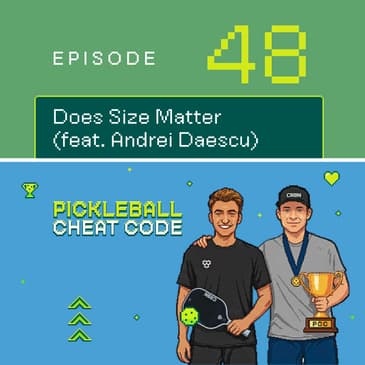
Does size matter in pickleball? It's complicated. In this episode, Brodie sits down with CRBN sponsored pro Andrei Daescu—one of the most athletic and dynamic players on tour—to explore how physical attributes shape the way you play and compete. Andrei shares his journey from tennis to pickleball in 2017, why size can be an early-point advantage but a liability in extended rallies, and how he's adapted his game to compete at the highest level. They get into the evolution of paddles, why developing real weapons is non-negotiable in modern pickleball, and how ping pong can actually sharpen your fast-hand exchanges on the court. Andrei also opens up about his physical preparation—dynamic stretching, hydration, staying loose—and what it takes mentally to compete in the fast-paced world of MLP. Plus, team chemistry, paddle selection, and a few laughs along the way.
🤑 Get 10% off any CRBN product at crbnpickleball.com. Use code PCC
❓Got questions? Send us a voicemail: memo.fm/pcc
🌐 More info & listen anywhere: https://www.pickleballcheatcode.com
[00:00:00] Hey everyone, welcome to Pickleball Cheat Code, the show for competitive pickleball players who are looking to level up their game. We focus on advanced strategies for experienced players, stuff only the pros really know. I'm Brodie Smith, I'm a 5'5 plus level player and a coach, and I'm here with a very special guest, carbon-sponsored athlete, the pickleball legend himself, Mr. Andrei Daescu. Hello everyone, happy to be here. Brody, thanks for the invitation. I'm looking forward to our discussion. We've got to touch upon some really cool subjects.
[00:00:30] Absolutely, and today Andrei and I are going to be breaking down his pro journey, how he became one of the greats in pickleball, and the importance of being as big as he is on the court per the title that you can see here. And then at the end of the episode, I have some hilarious jokes to tell Andrei, which he has no idea what's coming, they're not that funny, but he's going to be rating them 1 through 10. And then lastly, if you've done anything to improve your game, share the show with your pickleball community.
[00:01:08] Pickleball Cheat Code All right, Andrei, thank you so much for joining here. We appreciate you having on, representing Carbon and representing the Columbus Sliders. It's great to have you here. So before we get into any details in terms of the pickleball cheat code side of things, I'd love to hear more about your background, telling the people how you got into pickleball, your transition from tennis, everything in between. I'd love to get a good overview of you and who you are.
[00:01:34] Yeah, it's my pleasure being here. I started playing pickleball late 2017. Before that, I played college tennis for the University of Oklahoma. And then I played professional tennis for about five years, had some shoulder issues, had a shoulder surgery in 2015, didn't go as good as we thought it would. So that was kind of it with tennis.
[00:01:57] And then, yeah, I was working in Florida at this beautiful club called Balnais Country Club in Palm Beach Gardens. And we had a couple of members that played the game, I think, on cruise ships before. And they kept bringing that annoying tape, you know, and put it on the tennis court. You know what I'm talking about. And they've been bugging us long enough to bring in some pros and do kind of like a learn and let it play clinic.
[00:02:24] And that's what we did. We gave into it eventually and we brought those guys on board. And one of the pros actually was Kyle Yates, who was number one in the world back then, great ambassador of the game. He came in, did a great job, explained the rules. Nobody was familiar with it back then. So he explained the rules. He showed us how you can play it. And then it was him and a senior pro. And at the end, they asked for two of our pros to play in just so they can showcase a little bit of doubles as well. So I jumped in.
[00:02:52] I still remember we had wooden paddles and we had like this robe that goes around your wrist. So really vintage stuff. And yeah, I jumped in and I played a little bit. And I was like, man, this is a lot more fun than I thought it would be. You know, I was initially a tennis snob and, you know, thought, OK, wiffable. It's not that good. And, you know, the same process that everybody went through. And then as soon as I started playing, I was like, this game is a lot of fun.
[00:03:19] And yeah, after that night, I played a couple more times with my friends who were tennis pros in the area. And then I went online. I was like, do they have a tour? Is there any competition, any tournaments, any of that? And back then there were no tours. What year was this again? Late 2017. I think it was December 2017. So, yeah, there were no tours, but there were tournaments. So they had a website. You go over there and there were tournaments in Florida. That's where I started. It's like Ben Tyson and Riley playing? Like that's it, right? Exactly right. Yeah.
[00:03:49] Yeah. Some of the OGs. Yeah. For sure. Yeah. And yeah, I still remember it's probably 2018 when I started flying a little bit to play some tournaments. I played some in Atlanta. That was one of the big tournaments at that time. Played one in North Carolina. Went over for nationals at Indian Wells. So, yeah, that was the start of it.
[00:04:12] And then, you know, fast forward to 2026 and here I am in Austin, Texas, where we're playing this weekend in Major League Pickleball. We're presenting the Columbus Sliders. So our first match is tomorrow. Let's go Sliders. You ready to go? You locked in? I'm ready to go. Locked in. We had a solid session this morning. Good practice. Got a good workout in. So, yeah, I'm ready to go for tomorrow. I love it. Well, let's dive in. I appreciate the background there.
[00:04:39] And a lot of questions that I'm sure you get asked all the time. And my girlfriend asks me this all the time. Or I ask my girlfriend this all the time. Does size really matter? And my question to you is, how tall are you? How tall are you? What's your wingspan? And how much does this help you or hinder you in the sport of pickleball? Like what kind of impact does that have on the game for you? Yeah, I'm 6'4". Wingspan is 6'3". Size does matter. So, yeah, I've got news for you.
[00:05:09] Look, I think, you know, on a more serious note, I think it is very helpful to be as tall as I am at the start of the point because I can reach into the kitchen and really make the transition as difficult as possible for the opposing team. So, at the start of the point, I'll say within the first five to seven shots, I think it's a big advantage to be tall. And then after shot number seven, for sure, it's a big disadvantage
[00:05:37] because especially at our level in the pros, most of the game is played low. You know, the most important ability in the game of pickleball is keeping the ball low. So those guys are very good at it. And then when you're this tall, playing those balls low to the ground, having to always reach bend, you know, playing more weight than some of the other players. It's probably not as flexible as limber as someone that's maybe a little shorter. So, yeah, it's a balance over there. And you have to know how to, you know,
[00:06:08] take advantage of the stuff that you've been given. You don't get to choose your size. But that's the beauty of pickleball. You know, you can play in all sorts of different body types. And you can see that in the pros as well. There's guys below six foot that can still play and be extremely, extremely competitive. And there's guys might hide that play and they're competitive as well. So it's all about, like I said, knowing your strengths and your weaknesses and trying to kind of make sure your game matches that. Yeah, I feel like you need to get your legs so much more engaged to get low
[00:06:36] because getting low is such a key piece of the game and such a key fundamental for, you know, working your way into the kitchen with resets getting low. But then you said what's interesting. I never thought about this. You said the sixth and seventh shot and working your way towards further into points. So you mean when you're getting extended out wide and dink rallies and getting pulled wide? Is that kind of what you're referring to? Oh, yeah. Once it gets to, once it's settled down and it becomes a kitchen game, obviously being short is a much bigger advantage because you can change direction quicker. Your center of gravity is lower, like you said.
[00:07:05] I mean, I can, it's a lot harder for me to drop my pad all the way down to the ground to be able to flick. It'll be for somebody who's a little bit shorter, you know. So that's, once the game is settled, I think that's where the disadvantage is. But with that being said, just like I mentioned before, the first five to seven shots when I'm up at the kitchen, they're trying to drop in or drive by me. You know, it helps to have the reach to cover the court, to be able to reach into the kitchen and flick and just make that transition as difficult as possible for the opposing team.
[00:07:33] So my counterpoint, because for, sometimes when I'm playing people that are roughly your size too, and it's not even necessarily a counterpoint, it's just something that I say too, even in extended rallies, are you just looking to fish dinks out of the air and just kind of reset and neutralize all day long? I mean, I see you take a lot off the balance too. What's your strategy and your mindset in general versus dinks out of the air versus letting it balance and kind of like how you're looking to dictate points? Well, in today's pickable world with the equipment that we have available,
[00:08:02] it's very important that if you take the dink out of the air, you have to do something fairly aggressive with it. Otherwise, you're much better off stepping back, letting the ball bounce, getting your legs behind and your body behind it and just rolling that one and putting a lot of spin on the ball and forcing the other team to lift the ball, you know. So I tend to try to hit a good aggressive dink before I look for something out of the air. It's not as easy as it was maybe two or three, four years ago where you can play a lot of dead dinks and get away with it.
[00:08:32] Every time you play a dead dink, if the other team has some good offense off the bounce, they could be speeding up, so you're putting yourself in a little bit of a disadvantage, a little trouble. But with that being said, I think it's important to be able to have the ability to take the ball out of the air as well. It's just a matter of you just can't overdo it because at that point you're not going to put any pressure on it. Do you think that's changed a lot with the lifetime ball? Because I know it bounces a little higher and then there's more pace you can put on it as well. So the difference between a dead dink of a Franklin versus a lifetime, has that kind of changed your strategy and your outlook?
[00:09:02] I'm sure the ball plays a role, but I think it's extremely significant compared to the paddles. I think the paddles have changed that. I think you can put a lot more spin on the ball. You can put a lot more rotations per minute, RPMs on the ball. You can put a lot more pace as well. So now, off the bounce, you can be a lot more aggressive than you were, like I said, even, I don't know, 18 months ago, let's say. And compared that to 2017 when I started, there was no offense off the bounce. Every time you had to put a little bit of pace on that ball from the kitchen line as a speed up off the bounce, that thing was going out.
[00:09:31] So it was just a matter of getting out of the way. And what's interesting about your game and very unique about your game, actually, and you're mentioning hitting more aggressive dinks, is you're a big slice guy. You're cutting that ball. And I feel like so much of what the pickleball meta and younger players are shifting to is like a two-hand roll. And even you see Ben kind of adjusting that as well coming from his slice game. But you stay heavy in that slice. Why do you prefer that slice? And why haven't you tested? I'm sure you've tested. But I guess my question is, why do you prefer that style of play at the kitchen
[00:10:00] versus rolling? I don't prefer overrolling. I try to roll when the ball is there as well. I definitely, as a tall guy, my movement is not as good as someone like Hayden, for example. So I will be reaching a lot more. And then when you reach, you have to slice. To be able to roll, you have to get your body all the way behind it. So it just has to do with movement, how much you're reaching, how much you're looking for flicks out of the air, and that kind of stuff. I think in today's game, it's important to have both. You can't get away. If you can only slice, then you're not going to be aggressive enough.
[00:10:30] That's not enough anymore. But if you only roll, it's pretty easy for the other team to get you out of position and get you in trouble. So ideally, you prefer to roll if you can. And then slicing is kind of your backup. So you're looking to roll. And then if you can't, that's when the ball is outside of your body. That's when we're slicing. Is that fair to say? Usually. That's kind of how it works. Yeah. A hundred percent. Yeah. I mean, the roll, it goes without saying that you have to be behind the ball and you have to hit that ball at the apex of the bounce. You don't want to be rolling half-ballies because you run the risk of popping that ball up. So as long as you're behind the ball
[00:11:00] and you found that apex, you have a decent little height on that bounce, then you can roll it for sure. Some players, when it looks like they're going to get pulled out wide, that want to play really aggressive because some players aren't slicing that much at all. And instead of letting that ball come behind their body and taking a chopped in cross court, they'll be short-hopping it instead. Do you have, are you avoiding short-hop dinks like that? Because like Tama, for example, he doesn't slice that much cross court, but he'll take it, he'll scoop it, and he'll bunt it back kind of aggressively. And that's something that
[00:11:30] I'm looking to do as well because I have a really weird grip. So I have trouble having a good consistent slice like anything. If I could slice like you, I would do it as much as I could, but I just can't. So I don't know what your thoughts are there in regards to a short-hop cross court. I think you got to figure out whatever works for you. If you're controlling it well enough, the short-hop, you know, you continue to use that. I think it saves you a lot of movement and it saves you a lot of legs, especially for those long matches or long tournament days. But with that being said, if, you know,
[00:11:59] you could be playing on rollout courts, you could be playing on courts that maybe you haven't played that much before, and the half-volley is the shot that usually gets popped up the most. So that's the one you have to be very careful with, you know, when you're taking it. I tend to prefer to stay away from the half-volley. I only use it if I absolutely have to as a last resort. I think there's a lot more things you can do with the ball when it's higher. But once in a while, you get caught. I mean, the other team is going to hit a pretty good aggressive dink. And then at that point, it's important to be able to keep that ball nice and shallow. Yeah, that's a good point. You're working,
[00:12:34] shallow is the only thing that should be on your mind. I think trying to place it by the person on a half-volley could be pretty difficult, especially with those guys that can fly around the kitchen line and Ernie and all that. So usually you see half-volley is just being played shallow middle. So you're saying I need to be slicing more instead of relying on my half-volley is probably a fair point. Not really. You can roll. You just got to get your body behind the ball. So I'm not saying you should slice it. Well, I guess it's so hard to roll though when somebody gives you an aggressive dink, like being able to roll back, that's where I struggle.
[00:13:03] It's like that's the point where I'm looking just to kind of neutralize and reset and trying to shift things back in my favor. But yeah, that's a good point. That's where people, I feel like, have the most trouble is kind of dictating and getting into which rhythms and which habits you need to go through for these shot making. I mean, that's where pickleball's so hard. It's just like the little nuances of the pace, the angle, everything changes how you need to hit that ball and what decision you need to make. They're all such different shots, so it's tough. For sure.
[00:13:33] For sure. There's all sorts of scenarios going on over there and there's a lot of things you've got to consider. There's a lot. That's what's so good about the sport too. It's a chess game that's moving 100 miles an hour. It's tough. But another thing that's interesting about your game too, stylistically, is including going off the slices as well as your thirds. A lot of people too go pretty aggressive in their thirds, but I feel like you just go for the consistent route and you're looking to slice, chop, work in, and then you're like, you know what, test my hands.
[00:14:03] Because it's kind of a dead third, not completely dead. It's not plummeting at your feet, but you're making it all day long. So how did you get into that style of coming in around and just scooping it? And a lot of people on the courts that I play with too, they call it the Andre third and I love it. It works so well. I think it's a little bit of the old school pickleball when we didn't have the grit, so you kind of had to learn it that way. You couldn't use that much risk and you had to be really good at slowing the ball down. But with that being said, there's not to roll
[00:14:32] with a roll dink. I try to roll, sorry, roll drops. I try to roll my drops as well when I have time. I think what's extremely tough these days is the return comes in a lot faster than it used to. The serve is bigger, but so is the return. So when somebody rips it back, I find it pretty hard to roll and be consistent with it. Obviously, the roll is a high risk reward shot. But if you get the right shape on it and it lands at their fit, that roll is extremely helpful because it dips really quick so it allows you to crash behind it
[00:15:02] and it's got a lot of junk on so it's hard for the other person to roll back at you. With that being said, you walk into some fine margins because when you are rolling, your shape is obviously much higher. So if you don't land it on a dime, you're going to pay the price for it. So you see it different with all the pros as well. I mean, there's people like Hayden who roll a lot of the drops. And then you'll see people like a J-Dob or a Ben that will pretty much dead drop it and get him behind it. At the end of the day,
[00:15:33] the whole purpose of the drop is to allow you to advance probably to the midcourt area or somewhere in there and transition and force the other team to play up. So as long as you accomplish your goal with that, that's all the drop should be doing. I don't think there's anything fancy about a drop. I don't think you want to make it that fancy. I think I agree. And that's something that I've been working on with my own game and realizing is I used to be favoring a little bit more of an aggressive roll drop. But the more I've been playing, the more I realize when people can just
[00:16:03] you know, if I'm going to hit a roll drop 80% of the time versus a little bit more of a dead one 95% of the time, it's like I would take the 95% all day long. It's just about getting to the kitchen as consistently as possible. 100%. So I'm on board with that. And I'm doing a lot of just push thirds as well. So some slice thirds and then just some simple just like just a bun, like just a bunt forward. It's like if that's going to get it over the line and make it. From the midcourt area, that's probably the go-to shot. Yeah. I think it's a lot easier. So there's things
[00:16:32] you got to factor in when you decide which way you're going to drop and what kind of spin you're going to put on. I think the most important is definitely depth. So I think the deeper the return comes, the more you're probably going to be inclined to roll it. But then speed, like I said, I think the faster the return comes, the more you probably just want to kind of like I said, bunt it, just use their pace and lift a little bit off the back of the ball and just absorb all that pace and get into the kitchen. And then it goes without saying if somebody slices returns it's much easier to roll the turn than it is to go with that one.
[00:17:02] Yeah, because the spin is already there. And then what about driving returns? You're not driving too often, but what is your decision-making process of when to drive versus when to drop for you? Is it when you're getting pushed back really deep? Obviously the short returns, you get a shitty return, yeah, you're going to pummel that. But outside of that situation, more so I'm referring to when you're getting pulled back in a tougher situation. Yeah, so there's two very different scenarios when you're going to use a drive. One, like you already said, you're going to use it to do damage. So if you feel like you can do some damage
[00:17:31] and maybe the person is not all the way up at the net, maybe they're unwind in the stack, whatever, you can see a gap over there and you're getting some damage, then use a drive. But the second scenario is when it's just too hard to drop off that return. It's a deep return, it's coming in very fast. So then at that point, instead of trying to get that ball into seven feet of kitchen on a really tough ball, you just got to drive one around the belly button, get a flat punch back, and then that fifth shot is going to be a much easier drop. So this is something that's changed probably within the last
[00:18:00] three years or so where you're driving your third to just enhance your fifth. So it just makes it a lot easier to drop the fifth and then get into it. So like I said, you don't always have to drive to win the point. Sometimes you just drive it to get an easier drop. Exactly. You made a really good point earlier that was interesting of the stylistic changes that have happened from when you started in 2018 versus 2026. I mean, eight years later, like what's changed in pickleball? So many different things. What have you worked on in your game?
[00:18:30] Like where have you been spending the most time in the past, let's say year even, to not necessarily catch up with the times, but to adapt to where the paddle power is coming from, to adapt with the modern pace of the game. Like what are you drilling? What are you working on specifically? So look, I mean, today's game is definitely about developing weapons. But at the same time, the core of the game, the main fundamentals are the same that you had, you know, five,
[00:19:00] seven, 10 years ago. Yeah, I was just not missing. Being able to counter, not making up for servers, you know, using the metal of the core wisely because it's hard to attack from there. So the fundamentals are somewhat the same. It's just easier to attack because of the equipment this day. So now you have to develop weapons and make sure that, you know, spots that maybe were no go to two, three, four years ago, now they're available and you have to be able to get the bolt there. So I've worked a lot of just taking balls out of the air, being able to do something with it.
[00:19:30] Even if I'm not speeding up, just dinking to tough spots. And then I've also worked a lot on just being able to play off the bounce a lot more just because you can put so much more spin now. So stepping back is not as bad as it used to be. You can just step back right now and speed up or you can step back and it's much easier to angle the ball because the spin you can put on. So there's a lot of damage you can do off the bounce. So yeah, it's a constant work in progress in terms of developing weapons. But like I said, at the same time, understanding counters
[00:20:00] and how the whole thing works, I think because of the pedals, it's easier to counter these days, especially if you can get the first initial counter down, then it's pretty simple after that because if they come back hard and just get out of the way, the paddles are so powerful that the ball is not going to stay in anymore. So yeah, those are kind of the things that I've been working on and those are the kind of the things that I think they're huge when it comes to the game today. Yeah, I mean, so it just comes down
[00:20:29] to applying pressure. And then the issue that I have myself and even for what I'm coaching is determining when to be a steady rock and make balls and counter versus when to take risks. How do you determine when you're speeding up those balls? Are there certain signals that you're looking for? Is it based off court positioning or simply just like height of the bounce of a dead dink? What are some of those factors that you're identifying? I think people make such a big deal about the height that you're attacking from and obviously the height is helpful
[00:20:59] but the most important thing when you attack is who's in front of you and how good they can counter. So what do you do when you're playing against JW, for example? Then you have to dink a lot more and get the right look to where you can get that ball to the spot where you know that even if he counters he'll have to play a little bit up or he's going to be jammed up so you've got to be mindful and I think that's really the big difference in terms of levels. I think at the pro level the counters are just that much better. That's why and you see that all the time with pro tournaments
[00:21:27] when you get a qualifier, the local player or just a qualifier coming through qualities and you play them in the first few rounds and they can absolutely smash that ball and destroy that ball but they have no soft game and that can only take you that far because the top pros even though I mean the pros in general they just have good counter so it's not just about hitting hard like it works at a top level where you just blast your weight to people and it's a lot of fun.
[00:21:57] With the pros you're going to have to hit the right spot you're going to have to keep it at the right height otherwise you're just going to eat it on the counter or they'll just get out of the way they'll sniff it early enough and move out of the way so that's the frustrating part. With your size is it hard to stay out of the way because people probably go for bags for you I mean that's I'd say one of your disadvantages like you and Deco for example it's probably easy to just rip a ball and you're covering so much space 100%. We're bigger targets and definitely I think we get bagged a lot but that's part of the game
[00:22:26] again with today's equipment you're only 14 feet apart from your opponent so it's going to happen when you get bagged but the one thing that's important for people to keep in mind is the decision of getting out of the way it doesn't really happen as that person is hitting the ball it kind of starts that process starts a little before that so if I know I put the ball in the right spot or I keep it low enough or I see like a big tape back I mean I see something that's off I'm already shifting my weight a little bit one way or the other to kind of be ready to make room for that ball to hit the back fence
[00:22:55] so it's not something that you really do as the ball is coming at you I think it's just too fast this day for that kind of stuff to happen so like I said earlier if I can get a good first counter down then I'm already kind of halfway ready to get out of the way unless they reset that thing then I know it's going to go out if I hit a good drop and it knows it's right at their feet you know I can stop at midcourt and if they overcook it I know it's going to go out so there's scenarios
[00:23:23] where you already have it in the back of the mind this is the time where they might overcook it and the ball's going out and then there's times obviously if you didn't hit a good enough shot and the ball is hip high on the other side you can't really be looking to get out of the way because you know they can hit it hard and keep it in so then at that point I think that's what people get back and yeah like I said that's just part of the game I know it's exciting for the fans and I know it's exciting for the players when they do it but yeah at the end of the day it's just part of the game and yeah
[00:23:53] I mean you've managed it well in terms of finding a way to get out of the way and your counters are so good what steps did you take to develop those level of counters are there specific drills that you're working on to work on that or is it as simple as just drilling hands with higher level players and just going back and forth for hours like what do you no actually just to improve the biomechanics and I still think I can improve a lot coming from tennis I had to play quite a bit of ping pong actually to improve the biomechanics because just tennis in general
[00:24:23] your swings are bigger you follow through a lot more it's not as much risk as it should be which is great for the baseline game but when you talk about the kitchen game especially when you talk about counters fast hands you need ping pong there so I've been playing quite a bit more ping pong trying to change Are you playing with Danny? Muscle memory I haven't played with Danny yet and Danny's an incredible ping pong player so I have no business playing with Danny but I find it very helpful for like I said for biomechanics I think it's cleaned up a little bit of my technique and then after that
[00:24:52] it's just practice I mean there's just no there's no shortcuts and no way around just thousands and thousands and thousands of reps because at that speed it's all instinctive so you don't really have time to think so you want your mind to kind of know what's going to happen and send that message to your body as it's happening so it's one of those things whether you let the ball go out whether you know what part of the body you're going to cover with what part of the paddle for in your back and all these things you kind of develop
[00:25:21] as you're practicing so just reps I mean I know a lot of players especially at the you know amateur level or just local clubs you see players that show up they don't even warm up they just jump straight in and play and I know it's a lot of fun I mean I play pickle for a living and playing is way more fun than drilling but you kind of plateau and then once you get to that plateau you know your physical ability your natural talents then after that the drilling has to start otherwise you're not going to get any better
[00:25:51] you got to get stuck there and that's got to be your career you're actively using ping pong to develop your pickleball game that's the strategy of yours 100% I mean like I said I think I think baseline is all tennis so return drives everything is just tennis there and then at the net it's all ping pong yeah so you're doing it for your biomechanics that's crazy I haven't heard anyone talk about that are there any other pickleball players that are doing that to train their pickleball game I'm sure there's plenty of them I know J-Dob and Dylan were playing ping pong I don't know four or five years ago obviously Ben has had an extensive
[00:26:20] ping pong background and you can see in the way he he hits the ball during the fast hands exchanges he's so clean through those and you see with all the ping pong players you mentioned Danny I mean anybody that's played ping pong you see right away that they're very compact very snappy yeah and that's where I think it helps yeah that's crazy who do you think has a better chance of going pro in pickleball would it be if you were to take the top 10 tennis players in the world or the top 10 ping pong players in the world who would have the better chance
[00:26:49] of landing in the number one spot well singles for sure there's no question ignore singles we know singles tennis for sure let's go doubles let's go doubles that's a good point down singles you know it's tough you can't really put it that way because if you're not able to hit a good aggressive return or if you don't have a good drive or a big aggressive serve this thing you're not gonna make it so I think it's a hybrid there I think somebody who's played both could go a very long way I really don't think one is better than the other for doubles I think you have to have both
[00:27:20] so yeah like I said a little bit of a hybrid it could go a really long way yeah okay that's good to know I need to go play more ping pong then I go play and I've played like six months ago or something and it felt so weird the transition my shots were so off I used to be really really good at ping pong when I was younger just playing in the garage just a solid ping pong player but I haven't played in forever but that's so that's just blowing my mind right now well you can use
[00:27:49] tennis as well for it again it depends on your background the reason I'm not using tennis is because I've been playing tennis since I was six years old so my muscle memory is obviously all tennis so that's why I'm using the ping pong but if you're somebody who comes from ping pong for example then you should definitely play tennis yeah are you choking up on your paddle at all have you tested that because I know a lot of players sometimes I do it unconsciously yeah I think it obviously helps with pronation and getting the paddle in certain spots yeah people say it takes away your reach which is true but I think you're good on that that little bit over there
[00:28:19] especially I think if you can really close the paddle and get that kind of risk for nation I think it's worth it interesting that's mind blowing right there okay so another segue something else I wanted to talk about is not a lot of people know that some people do for sure obviously you coach a lot you coach all over the world you do clinics everywhere from all the coaching that you're doing especially for some of the higher level players that you're teaching not obviously the beginners or the mid-level players what are some of the most common mistakes that you see maybe the top
[00:28:49] three most common mistakes that you see from your coaching experience that you have for the higher level players yeah and when I say higher level I'm referring to more of like that 4-0 to 5-0 bucket that you're coaching yeah transition for sure that's the biggest hole for everyone I mean killing pros that's a tough bar too you gotta be able to slow the ball down in transition just like mid-court resets mainly just being able to own that transition zone mid-court resets mid-court counters all that kind of stuff but you gotta have it down to a science in terms of what you're doing over there and then at the end of the day at the higher
[00:29:18] level you gotta be able to slow the ball down and transition and gets off to the kitchen line and then it's okay if you get attacked to answer it but you can't really beat anybody at that level head-to-head if you're mid-court and they're already at the kitchen line it's just not gonna go to people so again that's something that you see you know at the club level especially if it's somebody athletic or fast maybe a tennis player they'll just blast their way from there and be successful and then they get to the PPA tour and yeah it's a different world out there so and then you have to kind of recalibrate the whole thing and learn the game the right way
[00:29:48] so it's that's definitely the biggest thing I think with these paddles and you know it's a lot of young players coming in right now some of them didn't even you know play college sports some that have played college sports I think everybody can hit it hard I think hitting it hard is easy it's yeah how can you how can you keep the ball low so I would say transition ability to keep the ball low and then decision making you know and decision making is always tricky because if you don't play
[00:30:18] at the right level and if you don't play with the right people you get away with stuff so and if you get away with stuff you should rightfully do it again if I can get away just blasting my way through you then I'm never going to hit a dink or a drop I shouldn't it's much easier to play fast but if I don't then I have to have a plan B otherwise it's going to be a pretty awful day out there so that's really where I think the difference could be made and that's where decision making comes into play instead of attacking from your shoelaces in transition pressure and power that's a card you can pull at any time
[00:30:47] but it can't be your foundation that's what I tell people when I'm teaching no matter what background you have and how athletic you are maybe you can just hit the absolute shit out of the ball but if you're not building your fundamentals off of a calm effective transition game that has to be your foundation that you need to rely on because a match can go in any which way of direction but you need to have that plan A just to be able to set back on and rely on
[00:31:18] otherwise you're going to have some great results but you're going to be flashy it's going to be a rollercoaster right speaking of flashy something that you do all the time in your matches and people are asking about this too I'm sure you've got this question many times as you're out there it looks like you're swatting a fly before you're hitting your points can you tell me about that is that a mental focus thing that you do your shadow swinging before a point it's not so much mental a lot of people ask if it's a mental focus maybe it is it's definitely look it's
[00:31:48] the timeouts are getting bigger and bigger you know you get matches on TV now we play on national television and those guys they have to play their commercials and the timeouts you might not realize it when you watch it on TV but it's like 2, 3, 4 even 5 minutes sometimes and at 38 years old it's important to stay loose so that's that's kind of why I try to stay loose over there and just keep the wrist snappy and keep my legs going as well and just keep the body temperature up and the heart rate going
[00:32:17] so it's yeah that's the primary reason of doing it and yeah I think I mean I do it quite a bit during the timeouts and when they bring the transmission back you probably see me doing that so just trying to stay loose there yeah and part of staying loose too and like you said you're 38 and you gotta stay flexible and you gotta there's so many young kids in the sport there too I've heard your stretching routine is the best stretching routine in all of pickleball I'd love to hear about that for myself and a little bit more about your off-court prep that you do
[00:32:46] either right before a match just to get dialed in for game one of an MLP because that's so difficult to do and then just your general stretching routine and off-court routine in general would be amazing to hear people love to hear that yeah I mean in terms of stretching alone I try to stretch three four times a day I think it goes without saying that being flexible being limber at the kitchen line and just in the game of fakeable in general is huge you stretch three to four times a day yeah how many how long is each
[00:33:16] stretching session walk me through that 10 to 15 minutes max I mean yeah it's not yeah it's just one of those things where because you can step into the kitchen you're going to be going through quite a few unnatural movements twists and turns and if you're not limber not only you might not hit the shot that you want to but you could also get injured so I think it's just extremely important for especially for somebody my height to to be limber and to be able to be balanced as we're reaching you know at the edge of our bubble there and barely get into that ball so
[00:33:47] I find it extremely important I think that's probably the main reason why my career has been able to go strong at this age and then in terms of match preparation nothing fancy there I think it's you know you got to go through dynamic stretching and obviously hydration is huge make sure you're fueled up so you've had some good food 90 minutes or two hours before that you're properly hydrated and then you go into dynamic stretching and then you go into your warm-up head you got to make sure you break a really good sweat before
[00:34:16] you actually play a match and then you should be fine you should be able to go in and play the match you mentioned major league pickleball I think that makes it a little more challenging especially if you have to stay on the bench as the captain I think it's yeah I think it's hard to kind of get going and stop get going and stop I find that pretty pretty difficult I think the PPA is a lot easier because once you get going you're going the whole time until the match is over so as long as you did a good job warming up into your match you're good to go but that's just the nature of the beast
[00:34:46] and you know sometimes you see people going to the side court and kind of hitting a little bit when the score is let's say I don't know 7-7-8-8 in the match before them so they're trying to get a few reps in before they play everybody's got different routines but it's important to make sure your heart rate is going you already broke a side like I said you went through dynamic stretching and your body's great I think the mental side of it too the physical side that's great insight but the mental side of it too you're coming in there's a lot of fans there's a lot of hype with MLP like you said you've been sitting for a while and then you go out there and you're expected to make that first third
[00:35:16] shot drop like what is your thought process mentally going into those matches right away just to make sure that you're locked and loaded are you getting super pumped and psyched up or are you kind of calming yourself down and just treating it like wreck like what's your thought process I think it's I think you have to have a lot of energy for MLP just it's just one game to 11 a lot of the tournaments are indoors where he plays faster so I mean things can happen really quick so it's so important to have good energy which is very different than the PPA where I think it's so important to make sure that you're steady with your energy and you're good to go for the whole two three
[00:35:46] games of that match and the whole day that you're competing so it's different approaches to it yeah you don't really want to make too big of a deal of the fact that you have a lot less margin for error in a game to 11 MLP you can go to a PPA and lose game one you'll have a no for example a game to 11 but as long as you win the other two then it's pointless it doesn't matter what happened that game obviously you can't afford that with MLP so the approach is a little different in terms of the energy but you can't think of playing
[00:36:16] not to make mistakes because then you're just going to play too safe and you're not going to be aggressive enough so you just want to play a game keep a high energy there play a game try to execute a game plan and yeah accept the fact that you know sometimes you could be going on a lucky run or your opponent can be going on a lucky run there's nothing you can do about it so it's a game of runs it's a game of runs and stacking plays it's just crazy how you can be at 9-1 and things just completely shift and momentum it's actually a huge role in pickleball it's like it's really it's crazy
[00:36:45] I feel like the game is how much okay I'm curious what you would say what percentage of the game do you think is mental versus physical and how would you compare that to tennis I think it depends from player to player I think the more mature you are the more experienced you are it's a more physical game but if you're young if you don't really have a lot of experience playing sports and those nerves and that pressure gets to you then it could become pretty
[00:37:15] mental as well I mean it's hard to really break it down to a certain percentage but I would say I don't know probably 75% physical 25% mental but compared to tennis it's different because in tennis especially for men's tennis it's a game of holding serve so you can have that I don't know 90 seconds of absolute lapse in your concentration if the other guy is serving and just play a shocker of a game but as long as you hold serve in the
[00:37:45] next game then you're back to even pickable is a lot harder because it still doesn't play that kind of role so you really have to be locked in the whole time so it's a little bit different in that regard I think like you said I think momentum is huge and pickable and you have to make your runs tennis I think is more by just sustaining that prolonged good focus the whole time and then giving yourself some slack when you play a bad game on your return just because again you can make up for it
[00:38:13] that next player mentality and something we talked about too it's like the famous Federer quote that I always forget he's winning 51-52% of his points but he's winning all the time in terms of time it was 54% of the points and yes you see with Djokovic as well the year when he went 84-5 he won 54% of the points he played and that's enough to have that kind of record that's crazy yeah again it's different
[00:38:45] another question too that I had before we transition to the end of the episode is for your carbon paddle that you're using for the barrage I'm curious on what shape because you've done some different shape testing and I'm going through a little shape transition right now as well is you were on the two for a while which is the square shape but are you back on the one or the three which one are you locking I'm on the three now okay so I started with a two I still really like the two the three felt a little bit better for
[00:39:15] the net game recently I have been actually experimenting I always do it in practice with the one as well I really like it so it's there's no exact science I think it's just a matter of what feels the best at the moment and kind of going with it I do think you need enough practice so I will need at least two three weeks before I change the shape again it's tough changing shapes because the sweet spot is in a completely different spot it's like sweet spot I think the balance is a little bit
[00:39:45] different as well I think your shot selection has to adjust to it but that's why I think you need at least two three weeks when you do it but there's stuff you can unlock in practice so that's the whole point of drilling and practicing in general is if you find something that you feel like it gives you an edge I'm definitely not afraid to take that step so I would be surprised if you're going to see me with a one as well have you spent time with a four? I spent some time with a four as well not your thing sorry? not your thing though? it's not like it's not my thing it's the
[00:40:15] one that I felt like I was least accustomed to and I'm asking because that's the one that I'm leaning towards that's what I've been liking the most and it's so interesting people like Annalie Waters would play with that shape and a lot of other players I mean it's similar shape I mean it's yeah it's again this is not an exact science I really don't think there's one shape you can say oh this is the shape you gotta be you gotta be playing with I yeah I think it's you gotta do some trial and error and find out what works for you I think balance is important
[00:40:44] and that's that's different from player to player and obviously weight is the biggest thing you have to make sure for a certain level you have to make sure you have enough weight on your battle where are you weighting yours up are you doing the typical bottom corners you know loading like what's your what's your setup because paddle's coming in roughly eight ounces and what are you bringing it up to roughly I bring it up to 9.3 and then I yeah big guy well you gotta need it for counters there's no way around it 9.3 is crazy especially in Florida yeah but
[00:41:14] anywhere I mean anywhere you play and that ball gets mushy and stays on your paddle you gotta need some weight on it so yeah 9.3 I definitely have some in the grip I always put some in the grip and the mushroom part of the grip and then I've been experimenting I've been playing a lot on the three and nine o'clock spots on the sides of the paddle but I've enjoyed now recently just the last month or so the weight a little bit lower on the throes of the paddle so yeah I'll keep
[00:41:43] moving around until I find a sweet spot and yeah I keep messing around with it that's the beauty of it there's no exact signs I mean there's some players have it all the way at the top in the head over there I'm not a fan of that I feel like it's hard to whip but some players love it there and they're having success with it so like I said it's not like a lot of times people reach out to me on Instagram and they're like hey you know what's the paddle set up and I think people pay way too much attention to that I think you gotta find whatever works for you there's one thing you need for sure is wait
[00:42:13] that's 100% you can only play up to a certain level without any weight on it but once you figure out the weight then the balance is purely up to you I mean it's just whatever it's good in hand what's so funny is Viv David never put weight on her paddle until the very end of her career and it's so interesting some players just don't do it and I don't understand it I think it just night and day changes the dwell time the feel the sweet spot everything so I'm on your side for that conversation but it's interesting it's a fine balance you're working with
[00:42:43] because the heavier you make it it goes without saying it's going to slow down your hands but at the same time the heavier you make it you're going to have more leverage a good hard sweet spot that you can counter from so it's you just got to find out whatever works best for you but no weight at our level it's very hard 100% last thing before we go into my awful jokes is looking forward to that Columbus sliders are you guys winning it all this year what's what are you thinking if you have to put money on it
[00:43:13] there's 20 teams in the major league pickable and if all 20 teams have to think that they're going to win this year otherwise there's no point of being in the competition so you have to believe that that's the case we're off to a much better start for the regular season than we were last year but with that being said the only thing that matters in the regular season is getting yourself to the playoffs and then really that's when it all matters because that's when you play for it all so yeah we definitely believe we can do it I think we have the roster adding Danny
[00:43:43] was a huge step forward for us in doubles for sure I mean she's just a great teammate as well it's a good team chemistry we've added Judith and Alex Crum as well which are extremely good for singles but not only that they're playing some really good doubles as well so it's a team that's definitely capable of winning it but at the same time there's a bunch of teams that are capable of winning so to be able to put together runs like that and win it it's not just the things that you can control there's some things outside of your control as well and yeah like every team that's won in the past
[00:44:13] you're trying to go twice in a row it's a very difficult thing to do but we have the wrestling to do it for sure yeah you guys got a squad you guys got so many fans and it's so fun watching you guys so our team's rooting you guys on along with the other carbon athletes on the other squads but we like seeing you we have a great community behind us we played in Columbus two weeks ago people are so nice people
[00:44:43] very supportive whether you win the match you lose the match you're extremely positive they embrace you as one of their own super happy we got to win a title for them that would be amazing if we got two of them that's the fun of playing for Columbus time for the jokes and we'll say goodbye I 10 they could both be ones and they might be 10 is really good ones
[00:45:13] awful these might be ones I'm not proud of them because I came up with them but I'm not proud of what you're trying to do there I'll give you a 4 just for the creativity but that's definitely a dad joke maybe a grandpa joke
[00:45:44] this is the next one I see what you're trying to do there what does somebody need to do if they want to play a tournament with you simple they ask you yeah I like simple humor like that that was good I'll give that an 8 yes let's go that was solid creative straight to the point I love it I appreciate it I appreciate you enduring that
[00:46:17] there's a rumor that you played the flute in college if we can dive into that that'd be amazing but if you don't want to dive into it that's fine that's for private conversations I did take an experience in music class in college and yeah I had to practice a lot and let's just say that a dorm full of athletes from all sorts of sports at the University
[00:47:06] I would love to do it let's go baby I gotta make it happen see you Andre thanks man see you bro thank you