
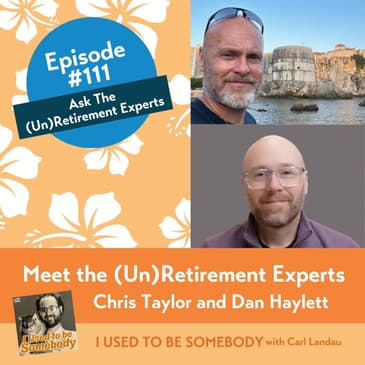
You're in for a real treat! It's the "Ask the Experts" bonus episode. We feature two (un)retirement experts who know a lot about what's really important. What you are actually going to do in retirement that will be new, super fun, intellectually stimulating and meaningful?
This year, we give you the best of both worlds by tapping into retirement wisdom on both sides, the financial strategy and planning but also the equally important emotional side. In both interviews, the experts give us some solid practical advice. Far from boring, this episode will also give you some new perspectives to ponder for your second half of life.
First, we have Chris Taylor, an experienced journalist who has written financial articles for Reuters, NBCNews, Kiplinger, Fortune, Money , AARP, Wall Street Journal and more.
Chris and Carl play a fun game of Family Feud about MONEY!
Carl then talks with Dan Haylett, our second expert and Carl's new friend across the pond (in England). Dan delves into the human side of "What's next after retirement?"
He is the host of the widely recognized "Humans vs Retirement" podcast, author of book, "The Retirement You Didn't See Coming" and he also advocates inverting traditional retirement advising by focusing on an individual's personal purpose and desired lifestyle before mapping out the math.
Carl gets there's an emotional side to retirement. It's big! Dan says many people tend to make the common mistake of what's "enough" to retire. He also encourages you to think about who you are without that job title, (you're not the boss any more) plus more top-tier advice!
(04:16) Chris Taylor interview
(36:30) Dan Haylett interview
• More About Chris Taylor: https://www.linkedin.com/in/christaylornyc/
• More About Dan Haylett: https://www.linkedin.com/in/dan-haylett-retirement-coach/
• Episode Content: https://pickleballmediahq.com/blog/chris-taylor-dan-haylett-interviews-3rd-annual-meet-the-un-retirement-experts
• Sponsored by How to Retire and Not Die: https://garysirak.com/how-to-retire-and-not-die/
• Sponsored by Capital Advantage: https://capitaladvantage.com/promotion/retirement-planning-guide/
• I Used to be Somebody World Tour 2027 Bordeaux, France: https://pickleballmediahq.com/tour/
• Subscribe to the the I Used to be Somebody Newsletter: https://pickleballmediahq.com/contact/subscribe
[00:00:04] Pickleball Media presents the I Used to Be Somebody show produced live at the Landau Tiki Bar in Sacramento. Here's our host Carl Landau. Carl Landau Welcome to Landau Tiki Bar and the I Used to Be Somebody show. You are in for a treat today. It's our third annual UnRetirement Ask the Experts bonus episode. I'll explain in a minute.
[00:00:33] First, I want to thank this month's sponsors. Thank you to our book sponsor, How to Retire and Not Die. Hundreds of our listeners have bought Gary Shrack's book. He offers great life advice for anyone thinking about retiring, gives great insights into what that successful retirement life can really look like. And thank you so much to our loyal sponsor, Capital Advantage Wealth Management.
[00:00:59] Following today's interview, we've got two fun segments. First, we talk to the UnRetirement with the Wisdom guys. Today, we talk about the crazy dynamics when it comes to retirement within a family business. This is a lively discussion, sort of has a little family feud vibe to it. You'll be entertained for sure. That's followed by Pickleball Chronicles with Trevor. Trevor and I talk about Pickleball
[00:01:28] personality types. Yes, Trevor and I play family therapists and in the kindest, nicest way poke fun at the stereotype Pickleball personalities. Okay, sometimes we're not that kind. We start out with, of course, the tennis player slash new Pickleball player. It reminds me a bit about the theme of the new hit movie that just came out on Apple. Have you seen the movie The Dank?
[00:01:57] Which I highly recommend. Okay, you're in for a real treat today. As I mentioned earlier, this is our third annual Ask the Experts bonus episode. If you're a regular I used to be somebody listener, you know that I find fairly obscure guests who have had really interesting careers.
[00:02:15] And we explore now what they started as a really cool second act. We don't normally talk about the money part of retirement. There are literally over 100 podcasts that just talk about retirement and money. Most are really boring and we don't do that stuff.
[00:02:34] And we talk about what's really important. What are you actually going to do in these like 20, 30, 40 years in retirement that will be new, super fun, fulfilling, intellectually stimulating and meaningful. Three years ago, I took a chance. I dedicated an episode to expert questions. I was a little surprised. People absolutely loved it. It's usually one of our most popular episodes of the year.
[00:03:02] This year will not disappoint. I've got two experts you're going to love and they are far from boring. They give great practical advice and will give you some ideas you probably haven't thought about yet. First, we've got Chris Taylor from the East Coast who has written money articles, financial articles and columns for all the big name media outlets.
[00:03:26] He had a long career at writers, has written for NBC News, Kiplinger, AARP, American Banker, Fortune, Wall Street Journal and a whole lot of other biggies.
[00:03:40] Second, I went across the bond to England to get a chance to talk to Dan Halen in England. Dan is an expert on the non-financial part of retirement. He's got a great podcast. I really enjoy the Humans vs. Retirement Podcast. He's author of a book I really like, The Retirement You Didn't See Coming.
[00:04:03] Please sit back and join my interview with the very talented Chris Taylor. But don't forget, this interview will be followed immediately by my new best friend from England, Dan Halen. Don't put it off. If you have something in your heart that you've always wanted to do, I think there's no point in delaying it to some future date.
[00:04:27] Because if people are waiting for the perfect time to do something, there is no perfect time to do it. You kind of have to just jump into it unprepared. Because time is short. As you learn more and more in this life, we do not have a lot of time to do everything we want to do. So whatever it is in your head, in your heart that you want to create a second act around, get started. If it works, great. If it doesn't, that's okay. You can try something else.
[00:04:58] Hi, Chris. Welcome to the I Used To Be Somebody Show special Ask The Experts episode. Hi there. I'm happy to be here and I'm a big fan of the podcast. Oh, awesome. So are you in New Jersey right now? I am in New Jersey. Are you in South Orange? That's correct. Yeah. Right near Newark. I've been there a couple of times, but I was there in the 70s. My brother-in-law is from South Orange. And as I recall, it's a very nice area.
[00:05:28] Yeah. In fact, I was in Brooklyn for like 20 years. And typically what happens when people start growing their family, having kids and need a house, you know, you can't really afford a house in New York. So they come out to New Jersey and that's what happened to us. So I've been here five or six years now and I would say 80% of my town is from Brooklyn originally. Yeah. Okay, cool. So Chris, let me introduce you to the audience.
[00:05:56] Chris Taylor is the award-winning personal financial writer. He is currently a money columnist for NBC News and many others. Also writes features and cover stories for Kiplinger's AARP and American Banker. He was formerly senior correspondent at Royerts, writing money columns for one of the world's largest news organizations for 15 years.
[00:06:21] His world focuses on the kitchen table investment topics facing every American family, budgeting, borrowing, spending, saving, investing, and retiring. And as a side note, Chris became a runner in his 40s and currently has run 13 marathons and 25 half marathons, which is totally amazing. So it's always fun for the audience to get to know the background of our guest. Chris, where did you grow up?
[00:06:50] So I grew up in Vancouver, Canada, and I lived there until about 2000. So I came down in 2000 when I got a job offer in New York City. But I am still Canadian and I grew up in a lovely part of the world. People always ask me why I left Vancouver, which is such a beautiful town. Good question. I don't really know the answer to that except that the publishing industry is really centered in New York.
[00:07:18] So to make it in this business, I had to come here. But I do miss Vancouver and I go back there quite a bit because my mom's still there. Yeah, it's awesome. I've been there. I'm on the West Coast, so it's actually a very easy trip for us. So how would you characterize what young Chris Taylor was like as an adolescent teenager? I was pretty bookish as a kid. I was very into books and reading.
[00:07:44] I was a little introverted at that time, which in retrospect, I guess, was good because it led to my current career of being a writer. You know, this is what I do. This is what I'm good at. So it prepared me for that. And I would say that even back then, I had a sports interest, which has eventually led to my current career of being a runner. Wow.
[00:08:12] So did you always know you wanted to be a writer? I think so. Kind of by process of elimination, you know, I wasn't particularly good at anything else. But I was good at writing. So I ended up getting an English lit degree at McGill University in Montreal, which a lot of Americans know because a lot of Americans go there. And then I got my master's in journalism at Carleton University in Ottawa.
[00:08:40] And after that, you know, I got into the journalism business and I've just been writing ever since. So it's been about 25, 30 years at this point. So you were people know you best, I would imagine, because you're a writer and correspondent at Reuters for 15 years. And I know it's a really large and prestigious organization, but I don't really know much about them. Or I mean, also, why can't they have a name that's easy to pronounce?
[00:09:09] So you want to tell us a little bit more about Reuters? Sure. Well, they're one of the world's premier wire services. So they're like, you know, Associated Press or United Press in the old days or Bloomberg, you know. So they don't have their own publication, per se. But they produce stories that are then picked up by newspapers and magazines and other websites around the world. So they're pretty enormous.
[00:09:36] And as for the name, it comes from the name of the Dutch fellow who originally founded it back in the day. So I apologize for the pronunciation issues, but it was his name. Well, you know, people that listen to my podcast a lot know I'm dyslexic. So, you know, I actually knew sort of how to pronounce it. I mean, reading so many stories from it over the years.
[00:10:02] And now I'm glad I know a little bit more about Reuters and why it has this screwed up spelling. I worked there for about 15 years as one of their primary money columnists, working for the great Lauren Young, who is still there as their money editor. And then just about a couple of years ago, I struck out on my own and have been writing for a lot of different publications instead of just that one.
[00:10:28] It sounded like in reading your stuff and your bio that you really enjoyed working there. Is there any particular one highlight from it that people would be interested in? Well, we did some fun series there that kind of stick out in my mind, and one of which was First Jobs, where we would talk to famous people about the first job they ever had. I saw that. And that was your column, right? Yeah, yeah. So I got to talk to a lot of pretty well-known people.
[00:10:58] But when it comes to their first job, they always open up. And, you know, the barriers get broken down. And it takes them back in their mind to when they were a kid just starting out. So they're usually very happy to talk about that moment in their life. Yeah. You know, that's one of my icebreakers.
[00:11:16] You know, and I do the icebreakers just to make people, like you said, feel at ease because it's like something that they know well about or made some big impression in their life. You know, it is amazing. And what I have found out is particularly really successful people, they usually did, well, start working out early in life. And it's usually some goofy first job.
[00:11:45] And it's usually some lesson where, oh, I never want to do that again. So based on that, they're like, oh, I'm going to go to college and I'm going to, like, I don't want to do this for a living. Yeah. No, I mean, no one ever starts out at the top, right? So even if you're a big shot, you started out at the bottom of the totem pole, whether it's working at McDonald's or delivering newspapers or whatever. So that's where we all start out.
[00:12:13] And usually people, you know, have fond memories of that time, even if it was a very difficult job because it taught them a lot about life. Exactly. So after 15 years, it sounds like you're a full-time employee and you'd really sort of worked your way up and all that. And all of a sudden, you branched out to be an independent journalist. So how old were you when that happened? Also, you're like, you're what, mid-50s now? 54, yes. Yeah, okay.
[00:12:42] How old were you when that transition happened? So this was a couple years ago. So I was 52. And just to be clear, I was always a freelancer there. I was never full-time. Oh, okay, okay. But they were my main client and, you know, 90% of my workload. So at a certain point, as publications sometimes do, they decided to not use freelancers, which obviously impacted me directly.
[00:13:09] So all of a sudden, my major client was gone and I had to go find others. So as a result, as any independent worker knows, I had to hustle my way into creating my own business. And so eventually, I started working for places like Card Rates, for places like Bad Credit, for places like Current. As you mentioned at the top, Kiplinger, AARP, American Banker.
[00:13:35] And then just recently, a couple months ago, I got the call from NBC News to start writing money stories for them. So it was a difficult transition at the beginning because you never like to be let go like that. But it did make me definitely take my own business to the next level and has taught me a whole lot and has got me a whole bunch of new clients. So looking back on it now in the last couple years, I think it's probably been a good experience. Yeah. Yeah.
[00:14:05] Any missteps from that transition? Because, you know, the podcast is all about making that transition. In your case, I mean, you're obviously still in the middle of your career and all that. Although I have to say, in this day and age, and I was in the media business for a long time, so getting a job like in your 50s, particularly a journalist thing, probably not that easy.
[00:14:30] No, especially since, you know, there are a million journalists out there, all of whom are very talented and most of whom by this point are younger than me. So it's a very competitive environment and not a lot of newspapers or magazines left anymore. So you really have to be good at what you do. You have to be confident in what you do. You have to know a lot of people. You know, it's mainly about your network. You asked about missteps.
[00:14:56] I think at the beginning, you know, I was a little embarrassed to have lost that client. So I didn't really want to talk about that or broadcast it or let people know that that happened. In retrospect, I think I should have let people know because that would have led to more opportunities. Because, you know, when people hear news like that, they're willing to help you out. And if they don't know what's happened, they can't help you out.
[00:15:21] So I think I would have been more forthright and honest that, look, this has happened to me and this is going to be the next step in my career. And I'd love to work with whoever else wants to work with me. Yeah. I appreciate you sharing that. And Chris is all over the place. I've seen his articles everywhere. So, I mean, that's how I ended up wanting you to be on the expert thing because I'm like, wow, this is a great writer. And a lot of it is retirement-oriented.
[00:15:49] But you cover all sorts of subjects, money-oriented, which leads me, you know, I figure before we go into unretirement, I've got one of the world's top financial writers in the world. So why wouldn't I ask you some financial or money question? So, Chris, let's do something fun. How about doing a rapid-fire question session for the best sort of general financial advice you have by generations or whatever pops in your head?
[00:16:19] And there's this game in the U.S. I don't know if you've ever heard of it. It's called Family Feud. And we can sort of play like that. So let's start with the topic. Well, before I do the rapid-fire, this is something I think is helpful for anyone to know. You know, a lot of people listening are grandparents or they're probably people that listen. I get actually amazing amount of people that are younger that listen to the podcast.
[00:16:49] Because today, a lot of people are sort of what you're doing, where it's the idea of having this employer and you're going to be employed for the next, like, 40 years and get the gold watch. Like, it doesn't happen anymore. A lot of people are interested in the second act. But I was just thinking, like, way back, my parents really didn't give me any practical money advice as a kid except don't get into debt. They mentioned that many times.
[00:17:18] And, I mean, apparently it helped because I never have. So since many people listening have kids or grandparents, what do you say to kids growing up? What's some good advice to tell them about money? We'll be back in a moment after a short break. I want to give a shout out to Gary Surak, a friend of the podcast. Gary's written an inspiring and entertaining book called How to Retire and Not Die.
[00:17:47] People think retirement is all about the money, but it's so much more. Gary teaches you the three Ps that are the key to successful retirement. Passion, purpose, and planning. You can buy this book on Amazon or for I Used to Be Somebody listeners. Contact Gary directly at GarySerac.com. That's Gary, S-I-R-A-K.com. And he will personally sign your copy of How to Retire and Not Die.
[00:18:15] Choosing a financial advisor is one of the biggest decisions you need to make in retirement. Now it is more important than ever to protect your retirement savings and investments. Capital Advantage can help individuals like you develop a personalized investment strategy and retirement plan unique to your life and goals. For over 40 years, Capital Advantage has been a 100% fee-only fiduciary advisor.
[00:18:41] Just go to CapitalAdvantage.com slash podcast. Welcome back to the show. Since many people listening have kids or grandparents, what do you say to kids growing up? What's some good advice to tell them about money? When you say kids, you're talking about like teens or younger, that kind of age? Yeah, I'd say maybe it's around 12 or 13 that kids are more interested in money.
[00:19:10] I would say the main advice would be to talk about it because it's really the last taboo for a lot of people. They don't like talking about it. Maybe they don't think they're good at it and they don't know what to say to their kids. But I think transparency is important. I think it's important to get kids thinking about these issues even at a young age, which will prepare them for later in life. So I would say get over your hang-ups about talking about it
[00:19:37] and maybe let them know a little bit about what's going on in your family's financial life. Maybe include them in some stuff so they can help you make family decisions about money. And that will kind of prime the pump for getting them to think about these sort of issues. Yeah, I think it's great advice. Getting them involved or if somehow setting up like a little bit of stocks for them and having them watch it.
[00:20:04] I had a class when I was like in junior high that we did that. That was really fun. You know, that as a class we bought stocks and watched how it did. And it was a good way to get involved. Yeah, and I will point out that you can create custodial accounts as a parent, even when your kids are pretty young. So they can watch it grow over time. And then, you know, when they're 18, they can assume control of it themselves.
[00:20:32] But until that age, you can run it as a custodial account. Yeah. So here's the family feud part. So let's play money advice for $100 here. For someone in their 20s or 40s, what pops into your mind as far as like the key financial advice? So as the saying goes, it's not about timing the markets. It's about time in the market.
[00:20:58] So you want to make sure that you start as soon as you can. Most people, I would say, maybe get around to investing in their 30s or 40s. If you can do it starting in your 20s, that is going to make a massive difference to your eventual total later on. Because you want your money in the market as long as possible for it to benefit from compound interest over time. So I would say, you know, set up those retirement accounts as soon as you start working.
[00:21:29] Start automatic contributions to them. And then just generally during that period of your life, I would say don't live beyond your means. Kind of like your parents advising you not to get into debt. That's advice that works for any income level, whether you're making just a little, whether you're making a lot. Just make sure you don't live beyond your means. Because it's high interest debt that is what can spiral out of control and really hamper you for the rest of your life.
[00:21:58] Yeah, great advice. And so true. And I remember my very first real job out of college. I lasted one year in the corporate world. But they said to me, you could open up this IRA and we do matching funds for, you know, whatever the first $5,000 or something like that. I don't remember. And I'm like, I told the person telling this, I don't even know what you're even talking about. And the person said, that's great. Just do it.
[00:22:29] And I did. And it's so funny, like that, even for that one year, just leaving it there and totally forgetting I had it, we ended up being this, you know, decent chunk of money. Yeah, absolutely. I mean, at, say, 7% annual returns, a portfolio will double roughly over seven years, right? So if you can give yourself an extra seven years of saving at the start of your career, you've doubled your lifetime total.
[00:22:58] Yeah. Okay, let's play money advice for $100,000. The stakes are way higher now, Chris. Oh, boy. For someone in their 50s. In fact, I just did an article on this for NBC News for folks in their 50s, like myself, because Gen X, generally speaking, is behind where they need to be in terms of savings. And not only that, but they have kids who might be in college at this point, like I do.
[00:23:25] They might have elderly parents that are starting to need care. So they're really between a rock and a hard place. It's a tough place to be. So what I suggested in this article was to take full advantage of what are called catch-up contributions. Because over the age of 50, you're allowed to contribute even more to your retirement accounts than anyone else is. So if you do that every year, it will make a huge material difference to your eventual retirement.
[00:23:54] So catch-up contributions every year, whether it's your 401k or whether it's your IRA. And then also don't be a hero and sacrifice your own retirement so that you can pay for all your kids' college. It's a nice thought. If you can do it, that's great. But if you are paying for your kids' college and then leaving yourself destitute, that's not going to help anybody. And eventually, it's going to land on your kids anyways.
[00:24:21] So you have to have balance of helping them out and helping yourself out. And then also you have to think about your elderly parents and their care, whether it's getting long-term care insurance, whether it's planning out what's going to happen to the house, how they're going to fund those years. That is something that's hitting all sorts of people in my demographic right now. And it's better to deal with it sooner rather than later. That's all great. I never even heard of that catch-up account. Wow, that's awesome. Okay.
[00:24:51] God, I'm learning something from the podcast. Happy to help. Okay, let's play money advice for now we're going $500,000 for someone in their 60s. Hmm. So this is the time of life when you have to pull the trigger on some very important decisions, including when exactly you're going to retire. And that has a fall on effect on numerous other decisions, like when do you start taking Social Security?
[00:25:21] When does Medicare kick in? Which Medigap plan are you going to take? So these are very big decisions that are going to affect the rest of your life. And I would say that's the main focus of this particular phase. I would suggest if you're able, if you're still enjoying working, I would suggest continuing to work, not only for the financial benefits, which will be very large, but also for the social benefits.
[00:25:49] You know, if you still have something to contribute, you want to keep up those social networks. One strategy that has really worked for people as far as going into what we do on retirement, which we'll talk about soon, is if you can somehow do it on a part-time basis too. Because trust me, there's not a lot of people in their 60s that it's like the greatest time of their life as far as working.
[00:26:16] You know, I mean, because a lot of people just hang in there because they don't know what else to do and haven't figured it out. So if somehow you can maneuver it to like, you know, doing some sort of part-time thing, you still have that stream going, you still have social connections and all that, but then maybe give me your opportunity to branch out and do some new stuff. Yeah, I would say that's fantastic advice. And it's what a lot of people are doing.
[00:26:44] And I would also point out that if you have a partner, you and your partner may have different retirement paths. You may want to keep going, she may not, or she may want to keep going, you may not. And that's perfectly okay. It really depends on the couple, what is right for you. But as you say, having some part-time work and then also being able to try out, say, mini retirements in different locations, even maybe, will let you ease into it.
[00:27:12] Because going from full speed to full stop is a huge transition and not a lot of people are able to handle that well emotionally or financially. So a more gradual path, I think, is the right way to go. I love that. Okay, let's play money advice for $1 million for someone 70 or 70 plus. So this is a phase of life that, ironically, a lot of us are not good at, which is spending rather than saving.
[00:27:42] You know, our whole lives we've been conditioned to save, save, save. So once you're in your 70s, maybe you've retired at this point, all of a sudden you have to think of your portfolio in a different way. So you have to think about how much you want to draw down every year, what you want to spend it on. That is a very different dynamic from what we're used to. And it's a learning curve, a steep learning curve.
[00:28:08] Generally speaking, you know, people say you want to take out maybe 4% a year to make sure you don't run out of money. A lot of people look at it in a more dynamic way. Maybe you need more at the start of retirement because you want to do a lot of traveling while you still can. That's perfectly fine. You want to make sure you have enough funds for medical costs because those health issues are going to come up.
[00:28:31] And I think Fidelity is estimated out-of-pocket medical costs in retirement are around $250,000. So you want to be ready for that when it comes. And then you've got to start thinking about estate planning. Have your documents in order, your will, your power of attorney, your health care directive. And you want to think about your legacy and giving, you know, whether you want to give while you're still around to your family, whether you want to set something up for after you pass away,
[00:28:59] if you want to set up a fund where family members can all work together and decide which philanthropic causes are most important to you. Seventies are a time to think about your legacy and getting everything in place. Okay, Chris, I was on such a high and now we're talking about death and all that. It comes eventually. There's no escaping that. Okay, okay.
[00:29:24] I was expecting something amazing at the end, like, you know, you had some cure for it all. Well, no, you didn't be in touch. If you find a cure for everything, let me know, please. Chris Taylor, you're our winner. Chris, how are you going to spend all the money you just won? Oh, boy. Well, I got two kids in college. So how about that? I'm facing some very large bills for the next four years. I'll spend it on that.
[00:29:53] I just went back to your advice in the 50s. It's going straight to UMass. Okay. Okay, so let's talk about unretirement. We've got 20 unretirement strategies on the Pickleball Media website. So I picked out two for you. Number one, developing a routine in unretirement. Routine equals getting things done. What say you?
[00:30:16] Yes, I think it's very important because this is something I've learned from the freelance life, actually, since I've been a freelancer for 25 years. The reality of that lifestyle is sometimes you're busy and sometimes you're not. And you don't want your life and your mood to depend on whether or not you happen to have an assignment.
[00:30:38] So personally, what I find helpful is to have enough routine that no matter what is happening with your work, you will still be able to have a happy and productive day. So for me, for instance, that might be walking and taking care of the dog. It might be playing soccer with my friend group, which I do a couple times a week. It might be going to church. It might be going to the gym. It might be doing chores around the house. It might be calling friends or family.
[00:31:08] But put all those routines together and you have a positive, productive day. And then whatever else that comes on top of that is cherry on top of the sundae. So I like having enough routine that I have the basic framework of a good, happy day. And then whatever else life will brings me is gravy. Yeah. And it doesn't have to be any huge thing or whatever. We human beings need it.
[00:31:36] And the biggest struggles I've seen are people that like really give no thought into that. That's usually in the first year or two. And they're like, oh, this is great. I don't have to wake up early. And oh, you know, I always was interested in like everything. And go on the air net and all that. And then honestly, after like a year, they're like, God, I hate retirement.
[00:32:04] Because they never established any sort of routine, which we've been, you know, the person's been doing their entire life. And all of a sudden they didn't have the structure. And it can fall apart very quickly. I can see that 100%. Yeah. Yeah. So number 20, keep moving. It's the key. So your thoughts. Yes. This is something that I started relatively late in life. I began running it in my early 40s.
[00:32:32] And it started at a very basic level, just very short runs, just to get my fitness level up where it needed to be. And I kept building on it and building on it. And since then, I ended up running 13 marathons and 25 half marathons. So this, I think, is an issue that trips a lot of people up at this age. Because once you get out of shape, it's very hard to get back into shape.
[00:32:59] You know, the nature of age is it just gets tougher and tougher. And so if you let yourself go, it's hard to get back in. And that then affects a lot of different areas of your life, whether it's mood, whether it's, you know, health issues, whether it's your enjoyment, whether it's your eventual life expectancy. A lot of it stems from health, from movement.
[00:33:22] I think every scientist will tell you that movement is the key to, you know, a long lasting and productive life. And it can be whatever resonates with you. You know, it could be running. It could be something else. It could be gardening. It could be soccer. We even talked about pickleball, which I know you don't do. Yes, pickleball. Absolutely. And I know that's hugely popular with folks in this demographic.
[00:33:50] And it's not just the sport itself. It's also the community around the sport. Because those social connections are going to be very important for you in the years ahead. Any book that's been done on happiness, they always say it comes down to the quality of your relationships. So having not only the sport, which keeps you physically healthy, but the community around the sport, I think, is a double whammy that's going to set you up nicely for the years ahead.
[00:34:19] I totally agree. You know, for me, it's big ball. But whatever it is, it's just unbelievable. And like you said, it's a double whammy as far as like the fact that keeps you in shape and also social. Because A, number one, if you are not healthy, I mean, you have nothing. So, Chris, what final advice do you have for our audience? Our audience have had successful careers. They want to do something new, something more fun, and something more meaningful. Do you have any final words of advice for them?
[00:34:50] Oh, boy. I would say don't put it off. You know, if you have something in your heart that you've always wanted to do, I think there's no point in delaying it to some future date because if people are waiting for the perfect time to do something, there is no perfect time to do it. You kind of have to just jump into it unprepared because time is short. As you learn more and more in this life, we do not have a lot of time to do everything we want to do.
[00:35:19] So whatever it is in your head, in your heart that you want to create a second act around, get started. If it works, great. If it doesn't, that's okay. And you can try something else. But the point is to give yourself that chance so you don't end up regretting it later on. I absolutely love that. You give us amazing advice and you're our winner. Hooray. Of the game. It's so funny. I don't even know if I've ever seen Family Feud.
[00:35:48] So I probably had the worst rendition of it. But anyways. I remember the original one with Richard Dawson back in the day. Oh, yeah. That's how old I am. See, Chris, you're old. I didn't realize that. You know Richard Dawson. Okay. Yes. We can talk for 20 minutes about Richard Dawson, but we're not going to. He kissed every female guest, which you couldn't do these days. I'd forgotten that fact. And sadly enough, I remember now.
[00:36:16] So Chris Taylor, I can't thank you enough for being our guest on the I Used to Be Somebody special Ask the Experts episode. Thank you so much for having me. It was a lot of fun. And I hope to come to your tiki bar one day. Here's my interview with Dan Haylett. I went through a few things that I think a lot of people go through when they hit retirement. And this was, what actually am I doing? Does this fulfill me? And it simply didn't.
[00:36:46] I remember getting home a number of times and my wife would go to me, how was your day? And I wouldn't have anything to say to her. I'd be like, I've been in my car for seven hours. I've met a couple of people. The meetings were pretty pointless. And it was just getting really mundane. And I didn't feel like I was having any impact. My purpose was going. My identity was struggling. We had a young family at the time. And I didn't feel like I was spending enough time with them because I was always traveling.
[00:37:12] And so I made a decision at 33 to kind of take back control and retire from corporate world. Hi, Dan. Welcome to the I Used to Be Somebody show. Hi, Carl. It's an absolute pleasure to join you today. Can't wait for this conversation. Great. So nice to talk to a friendly voice across the pond. Where exactly are you in England? I think everybody references England to where London is. So I'm not far from London.
[00:37:40] I'm about 45 minutes to an hour's train journey into London. But if you look at London on the map, I am to the right-hand side, to the east of London in a county called Essex in a beautiful little kind of fishing town of Malden. So, yeah, we're in a nice part of the world. Let me introduce you to the audience. Dan Haylett is a financial planner, author of a terrific book, The Retirement You Didn't
[00:38:09] See Coming, and hosts the popular podcast, Humans vs. Retirement. He specializes in life planning for individuals over 50 plus, focuses on psychological, emotional, non-financial aspects of retirement transition. So it's always fun for the audience to get to know the background of our guests. So, Dan, where did you actually grow up? Yeah.
[00:38:34] So I grew up in a very, very sleepy little village that had more pubs than houses at one point, I think. It was like it had about four pubs and only about kind of 100 houses. It was very tiny. Yeah. I'm exaggerating a bit. It did have four pubs at one point and not a lot of people in it. But yeah, sleepy little village. And I had a really cool childhood.
[00:39:00] I kind of spent a lot outdoors and played lots of sports. That was my first passion. The wonderful English sport of cricket, Carl, I know you obviously, you know that. I've seen it. Yeah. It's trying to get in the States, isn't it? They've got Major League Cricket now in the States. But I used to play that. And that was my first kind of, that's what I wanted to be. I wanted to be a cricketer. I was pretty good. I traveled to Australia to play. But yeah, it never really worked out.
[00:39:30] And when I realized I wasn't going to be, I thought I'd try and play golf. I was never nowhere near as good at golf as I should be to do anything with it. And then I decided I better get a proper job. And that's when I started into kind of the road of financial services back in the late 90s. Yeah. Well, let's quick go there. Did you have any clue what you wanted to do when you grew up? So when you're like 13, 14, I'm like, I want to go into financial services. Yeah, that wasn't the dream. That was not the dream.
[00:39:59] So was it being a cricket star? Yeah, I think playing sport, right? I mean, that kind of playing cricket, golf and cricket were my two big things growing up. And as I've got older, slightly more overweight and with a family, the cricket has gone to one side. So I play a lot of golf now. But yeah, that was the dream. And actually, it was a dream until I was about 19.
[00:40:23] I decided at 19 after a few different kind of situations around where I was playing and stuff that it wasn't going to be for me. So it was a dream I pursued. It was something that could have been on the cards if maybe luck or something was a little bit different for me. But yeah, it all got kind of squashed at about 19. Okay. So you're only 43 years old right now, right? Yep. Okay. So you began your career. And by the way, that's a little early.
[00:40:53] And you're only on this because you're on the Ask the Experts. Although I have had two guests, like legitimate second act people that have been younger than you. So you began your career in the early 2000s in financial services. So did you start out with a large firm? No. So I actually, I started out not in the financial advice or planning part of the industry. I started off in the asset management, the investment management side.
[00:41:23] And that's where I spent the bulk, you know, a big chunk of my career. I left that part of the financial service industry 10 years ago nearly to do this. So I spent a big chunk of it doing that and working my way up and being in the big corporate world. So yeah, I worked on helping financial advisors put together their retirement income kind of propositions. That's kind of where I ended up and managing sales teams across the country.
[00:41:53] And so, yeah, I started financial planning about 10 years ago. One thing I do want to say, actually, it's really interesting when you talk about my age and, you know, second life and retirement. I do say to people that I did retire at 33.
[00:42:08] And I went through a retirement because I left a career that I'd spent, you know, 13, 14 years building myself up, becoming pretty successful, earning decent money, heading up sales team, reporting to boards. I was pretty young. I was one of the youngest heads of sales in the country. And I built a decent reputation. I was good at the thing and it was part of me and all of that stuff. All of my friends that I, you know, were in the industry and I had some great social connections.
[00:42:38] And I went through a few things that I think a lot of people go through when they hit retirement. And this was, what actually am I doing? Does this fulfill me? And it simply didn't. I remember getting home a number of times and my wife would go to me, how was your day? And I wouldn't have anything to say to her. I'd be like, I've been in my car for seven hours. I've met a couple of people. The meetings were pretty pointless. And it was just getting really mundane. And I didn't feel like I was having any impact. My purpose was going.
[00:43:07] My identity was struggling. You know, we had a young family at the time and I was, you know, I didn't feel like I was spending enough time with them because I was always traveling. And so I made a decision at 33 to kind of take back control and retire from corporate world. I didn't want to do the big corporate thing anymore. I wanted to take control of my time. I wanted something that gave me more purpose, more impact, and maybe going to smile a bit more about the daily stuff that I was doing.
[00:43:34] So, and everything that I've learned about how people retire with the emotional element, I see myself in it. Whether they're 60, 55, 70, the emotions that I went through at 33 were very, very similar. So, yeah, I think it was a really interesting transition for me at the time. I think even more interesting for my wife when I told her exactly what I was going to leave behind and try and do, which was quite funny. But, yeah, I'm sure she doesn't see it as funny. But, yeah. I'm sure it was scary.
[00:44:03] It was a scary time, right? It was absolutely scary. But, you know, I went through some mental health challenges that really manifested themselves to quite a big degree at one point. And, yeah, I needed to take back control of, you know, of me, really. And it was a big part of doing that. So it's a pretty big transition, it sounds like, for you. Any missteps along the way? Yeah, I think my kind of eagerness was quite a misstep. I'm a feet first kind of think second kind of person.
[00:44:33] And I probably didn't quite understand the ramifications of that attitude, particularly on my wife. You know, this kind of like, I'm going in and I'm doing this and everything will be fine. And she's cool. She supported that. But I think that kind of, you know, I think understanding her nervousness around kind of that attitude rather than just being a bit cautious. And going, well, you know, why don't you just take your time and think about this and do that? But I'm a very much kind of quite impulsive kind of person.
[00:45:02] There's been too many missteps. I think, you know, the communication around that was one. But I think when you go through and without kind of going into it in detail, well, I don't mind. I talk openly about my mental health stuff. I've nothing to hide about it. But with the stuff that I did go through for about an 18-month period, everything else is only upside, if that makes sense.
[00:45:24] So I was coming from such a low place that really took me and my family by surprise because there was no signs of anything of, you know, any kind of mental illness or anything like that at all. And I went through a real troublesome time for kind of 12, 18 months that coming out the other side and having more vigor and being more happy and finding more purpose and really enjoying my time.
[00:45:50] Like it felt like, you know, the upside was just so much upside that I wasn't looking and regretting anything. I was going, well, this just feels better and I want to keep this feeling and keep doing it. And so, yeah, I think that's where I land with that one. Yeah. Yeah. You know, and I really applaud you for being public about mental illness problems within my family. Some people suffer from mental illness and in probably every family.
[00:46:18] And boy, I bet that really means a lot to people listening that are struggling. And, you know, when someone's public about it, it just really helps them step forward and or think about it at the very minimum. And anyway, I'm sure you've changed a lot of lives. Yeah. And that massively impacts me, right? I was looking for kind of work that made me feel good. You know, speaking about this and the work I do now, it's just, it's a massive part of my mental well-being. Yeah.
[00:46:49] Before we go into under retirement, you know, I mean, you're a financial expert. I mean, you've been on, it sounds like both sides of the ledger there as far as selling financial services and also financial planning. So I should ask you at least a financial question. So don't test me too much on this. All right. Well, we'll see. Anyway, this is an easy one.
[00:47:12] I would think what's the biggest financial mistake people when they're planning and thinking about retirement make? The number one financial mistake I see them make is that they're unrealistic on their enough number. So they haven't, I think, planned properly for what they want to do in their retirement. So therefore, the default is to save more money. And when I say their enough number, I think people aim too high.
[00:47:40] Typically, when I start working with people, when you get to the nuts and bolts and you get down to the kind of exactly what makes them tick and what's important to them and the kind of things they want to do on an everyday basis, typically that retirement costs less or they need less than what they originally thought. And you see people that work a bit longer, save a bit more and kind of have this aim that, you know, their mate down the pub said they needed to or they read on some chat for them.
[00:48:09] And they've never really dug into the personal element of the finances and what they need to be able to live the life they want. Yeah, I totally agree. In fact, I listened to, you had a whole podcast maybe three or four months ago. And it was just about that, that people, well, yours was, I think it was mostly people retired too late. And I totally agree with you. And I've interviewed over 110 people.
[00:48:36] I have not had one person that said they wish they had retired later. And most of them say earlier. And I would say earlier too. I mean, I retired when I was 64 and I'm 69 right now. So, and having an absolute blast doing it. Although, I mean, I had a great career. I mean, I don't regret that, but well, you know what? If I had ended it maybe two, three years earlier, I would have been very happy doing that. So, okay, let's talk about our retirement.
[00:49:07] We've got 20 on retirement strategies on the Pigwall Media website. So I picked out two for you. And first, financial planning for retirement. And you mentioned this before. It's just not math. We say get the facts without fear. What say you about that subject? Yeah, I agree. I think this is, you know, financial planning in retirement is obviously a crucial element to it. You know, let's go back to the golf thing that I love doing.
[00:49:36] You know, it's a crucial club in the bag, right? You absolutely need the financial planning. But I suppose there's just too much focus on it because I think it's the easiest thing to focus or the easier thing to focus on. If I said to you, do you want to run another spreadsheet or do you want to kind of really look internally about who you are without a job title? I think the easier thing to do is go and run another spreadsheet. To look internally and start doing that human work, I think is a real challenge for people.
[00:50:05] So I think it's so important to get the numbers correct. But once they're there, I think what people end up doing is that they just keep optimizing and optimizing and over-optimizing and over-focusing. When in fact, you know, you can, it's a bit like cutting hair, I think, right? My wife's a hairdresser. I think people can get scissor happy, can't they, when they cut hair? It's like, oh, should I tuck a bit more off or until you're like me and you've got no hair left. I'm with you, brother. Yeah, I know.
[00:50:35] Yeah, yeah, yeah, absolutely. And my wife done this to me, but not with intentionally. I tell her all the time. You know, she's made me go bald. And so is my kids. I love them dearly. But I think that that's my, you know, my point is that the numbers are easy to focus on. Financial planning is crucial. But I think financial planning needs to actually, people listening to this that are trying to plan their numbers,
[00:50:58] it's really hard to do because you're planning your numbers based on an accumulation mindset. You have for 20, 30, 40 years, diligently saved, created a bunch of habits and behaviors around saving and being cautious and, you know, surviving and putting away money and all of that stuff. And the behaviors that led you to that point are the wrong behaviors to make you live going forward.
[00:51:27] And so when you start the financial planning element to live the second half of your life, it is totally different. It's almost like a different profession. Financial planning in retirement is totally different to financial planning to get you to retirement. And this mindset around planning to spend your money is a real challenge for people to do correctly. And that's the bit I think that needs much more focus.
[00:51:55] The financial planning to set up structure and income and tax planning, all of that really good stuff. But in a way that makes you comfortable and confident and free to spend the thing you've worked 40 years so hard to build, to actually go and use it. Give yourself permission, feel allowed to go and use that money. And I think that's the bit where it needs to shift. I agree.
[00:52:21] It's like, it's funny, my financial planner, he always tells me his biggest problem is getting his clients to spend their money. And he's telling them all the time that you have plenty of money and all that. And I tell him that people that are his clients were, like you said, the really good savers. And that's a really good point that you made, that it's really two different skills.
[00:52:48] And the people that, I mean, unfortunately, that weren't good at that, that's not their problem. They didn't save enough and they're struggling for that. So second strategy on our list, which, you know, our list is a little goofy. It's you're not the boss anymore. And particularly if you were a boss and all of a sudden you're retired, say you have a partner, they sometimes have a difficult time.
[00:53:16] Because, you know, with that whole thing. So what do you have to say about you're not the boss anymore? I mean, I work with a lot of these people, right? People, as I said, that have been successful. They've worked their way up. They're kind of leading departments or managing teams or they're on boards or whatever, right? And, you know, they have people reporting to them. They're writing appraisals. They're giving people pay rises. And, you know, we talked about identity a little bit. That is all part of them.
[00:53:46] And people in that, you know, they typically might have some sort of personal assistant. Their diary is filled for them. Their travel is done for them and these kind of things. And when you're kind of let loose on life, if you stop having that anymore and you're not the boss, you haven't got someone emailing you and your email inbox is, you know, not pinging. And you're not having to sit down and write these appraisals. You're having to book your own stuff in. And, you know, no one's asking you.
[00:54:15] And the biggest thing for me is no one's asking you to kind of use your wisdom, right? This sense of I'm using my wisdom. I'm using my knowledge to give back, even though I'm the boss. I'm giving back. I'm counseling people. I'm helping build stuff. I'm seeing results. I'm delivering on KPIs. I'm delivering to the board. I'm getting rewarded and all that stuff. I mean, that's a real hard challenge.
[00:54:39] And like you said, you go home and the only people or things that you are now potentially trying to be the boss of is your partner and your dog, right? It's a real challenge. It's kind of like, you know, and I think, you know, that's why it's really, really important for people in that situation to feel like they have the ability to give back beyond full-time work.
[00:55:04] People often in those positions where you are the boss often retire at what I would say somewhere near like peak wisdom. You might be in your late 50s, early 60s, mid 60s. You've got a lifetime of accumulated wisdom and knowledge. You feel like you're probably doing some great work. And then you kind of just stop. So I think it's really important to understand that you're not the boss of anyone anymore, but you can use all of those skills.
[00:55:28] You can use all of that knowledge, all of that wisdom to actually continue being a leader, continue being a thought leader, continue giving back and continue in mentoring. And I see too many people cold turkey it and they should un-retire, in your words, to kind of go and keep going. It doesn't mean it's a financial decision. It just means it's a decision that you are, you know, you're using your skills. You're using that wisdom to be able to feel like you can continue to help lead and give back.
[00:55:57] Because I think it's the people I've worked with, those people, they've had the biggest challenge when they don't do that kind of stuff in terms of an emotional challenge. Yeah, we talk about that on the podcast quite a bit. You really create great content about the non-financial parts of retirement. You've got a great podcast, Human vs. Retirement. And you wrote a really interesting book called The Retirement You Didn't See Coming. What is The Retirement People Didn't See Coming?
[00:56:26] Yeah, quite simply, it's the emotional side of it. I think that, like I said before, right, people are obsessed with planning for the numbers. I see retirement as more of a human challenge than a maths challenge. And the retirement they didn't see coming is the retirement that is beyond the numbers. So these people, you know, and a lot of people will typically figure out the numbers, think they're okay, hit retirement, start living.
[00:56:53] And then six months later, they go, oh my God, what have I done? You know, they're looking for inspiration. They didn't see it coming. They didn't see the emotional side. They didn't figure out, you know, who they were beyond the job title. What was going to give them motivation to pull back the duvet? Their relationships have maybe somewhat changed with their spouse and maybe their children or whatever. Their well-being is a little bit going a little bit downhill.
[00:57:19] And, you know, without trying to paint a really bad picture, these are real kind of scenarios that I've come across a hell of a lot. And that's the retirement that people didn't see coming. The one that involves purpose and identity and relationships and structure and well-being. It's a really practical book and easy read. And congratulations on that. Appreciate it. Dan, what final advice do you have for our audience? Our audience have had successful careers.
[00:57:49] They want to do something new, something more fun, something more meaningful. Do you have any final words of advice for them? Yeah, I've got one word that I think everyone should be. And that's curious, right? I think the best, in fact, no, I know the people that live their best retirements that I've observed, that I've come across, that I've worked with, that I've spoken to, they have a growth mindset and they are curious.
[00:58:17] And they explore and they're not afraid to try. They're not afraid to fail. And I applaud that mindset because you could get to a point where you think, I don't want to be the dumbest person in the room or I don't want to be the beginner again. And, you know, I'm 60 and, you know, I need to have all my shit figured out. What you need to do is have that curious beginner's mindset. And I think people that have that massively flourish in their second half of life.
[00:58:45] So, yeah, be curious, go exploring, have a beginner's mindset and try things that you're bad at. Because I think it just helps us continue to grow and learn. Yeah, that's really great advice. Dan Halet, my new friend from across the pond. I can't thank you enough for being our guest on. I used to be somebody special. Ask the experts episode. Thank you, Kyle. Really appreciate being on. Thanks for having us.
[00:59:13] Unretirement wisdom from the pros. Today, we've got Gary Serac from Serac Financial Services and Ian Castillo from Capital Advanced. Today, we're going to talk about family businesses and retirement. So what are the dynamics with people in family businesses when it comes to retirement? And I was just wondering, do you guys have any clients or personal examples you can share success or disaster stories?
[00:59:42] So, Gary, let's start with you. And did you actually start your business taking it over from your dad originally? Well, it was my father, my uncle, my brother, and myself. Yeah. It was really interesting because the dynamics are real. And it wasn't all ice cream and whipped cream. It wasn't so good. It was tricky because you have people that didn't want to be here but were still working. And then you had people that wanted to work but they weren't very good anymore.
[01:00:11] And yeah, I mean, it's a really complex situation. It's touchy. And what I found is that in my own family, you really had to navigate it so you still talk to each other when they do retire. Yeah. So it's not an easy game to play. And I've had lots of clients. I got one right now. He retired. All he does now is philanthropy. His son runs a business. They get along great. And the father comes in. He says, hello.
[01:00:40] He has an office there but he doesn't really interrupt. He knows what's going on. He knows the numbers. And the son runs the business. And the son said, listen, my dad turned it over to me. He said, here, run it. And if you need help, call me. And that's kind of how it worked. Great story. They've done wonderful. But it's a tough game, Carl. Yeah. It sounds like, I mean, you really need to have defined rules, define structure to the
[01:01:07] business and who's doing what and really just try not to step on each other's toes and stuff like that. But Ian, any family feud stories, success or failure stories? The exception to the rule is the success, the successful transition of the business within the family, at least in my experiences. Right. So I could kind of think of a handful of examples where the son, daughter, nephew of the business
[01:01:34] owner was to be installed as the next leader, but it didn't work out for some reason. And I think usually this is because the older generation has some overwillingness to be involved or even the economics really aren't as rewarding for someone to kind of take over what has been built. And that even leads to sort of the next generation perhaps being unqualified. But no, usually I think the dynamics are typically unsuccessful.
[01:02:03] So any successful succession in that regard usually has some elements of there being like a new structure in place where the incoming next generation would have guardrails, so to speak, and would work as an employee for a larger entity. That is a setup that I've seen repeated several times with success.
[01:02:27] The more traditional next generation takeover, I think has a high likelihood of being unsuccessful for a variety of reasons. Yeah. Yeah. I mean, it's hard enough operating a family business, but then having that additional transition and obviously you have whoever started it, especially they have views on how it should be done. And then you have the newer generation.
[01:02:53] It does sound like a nightmare, but I mean, like you said, occasionally it works. So Gary and Ian, thank you so much for another great segment of Unretirement Wisdom with the Pros. The previous response does not serve as the receipt of or a substitute for personalized investment advice from Capital Advantage. Rather, you should seek advice from the investment professional of your choosing. Different types of investments involve varying degrees of risk, and it should not be assumed that future performance on any specific investment or investment strategy or any non-investment related or planning services.
[01:03:22] Discussion or content will be profitable, be suitable for your portfolio or your individual situation, or prove successful. Pickleball Chronicles with Trevor. Hey Traver, I don't like to stereotype people, but I think it's fair in Pickleball, when you play enough Pickleball, some of the people, at least their traits seem to be, you know, fit in a certain category. But I do want to throw in a warning.
[01:03:51] You need to be careful, Bill, because people can change. And in many of these cases, we hope they do. Or you can misjudge them initially, but it's still fun to make fun of them, right? Of course. Never miss an opportunity to mock your opponent. Well, no, we never say this to them, just behind their back. Oh, even better. Okay, so I'll kick it off with the most common type, and I'm going to go with tennis players.
[01:04:21] Tennis players, and I'm not going to change. To me, this is the most frustrating person, because a lot of them have the skills, but they don't embrace Pickleball, which is a different game. Yeah, for sure. So when you say it's a tennis player, and they play like a tennis player, define that for me. In your mind, what does that mean? That, hey, they're a tennis player who's made the transition to Pickleball, and they're not embracing the differences between the sports. They just want to play mini tennis. What does that mean? Yeah, yeah.
[01:04:50] So you can spot this person a mile away. They're at the baseline. They don't go up to the line. They take a big swing far away from the ball, and it goes into the net a high percent of the time. Part of a club, and we play on a Tuesday, Thursday in the morning. So it's all retired people.
[01:05:18] So it's basically the same 15, 16 people that are there. And there's like two or three of them that I don't want to play with. They're actually really nice people and all that, but that's all they do. And they don't want to change. Anyway, so... I'm going to take the other side of that bet. I love playing with those people because to me, they're one-dimensional. I know exactly what to expect from them. I know exactly how to counter what they're going to do.
[01:05:47] And they never surprise me, right? If they're going to stay back at the baseline and just crack drives all day long, then I know all I need to do is get a paddle on the ball and softly drop it over the net, and they will never be in position to get that ball. Yeah, but that's not my point. I want to have fun. I'm not there for like... Yeah, I know I'm going to beat them. Okay. But it's like, Trevor, maybe we should go over like... Maybe our motivations are different here. I'm like 100% there for fun. Well, no, 90% for fun.
[01:06:17] 10% like... For winning. Well, it's more fun to win. Okay. So yeah, let's get there. So any other stereotypes you want to talk about? Yeah. One that comes to mind for me is the guy in rec play who always wants to argue over line calls. And, you know, hey, maybe there's some overlap with the tennis people who like to call in balls out all the time. But then there's the guy who thinks every one of his shots is in as well. How do you like that guy? Yeah.
[01:06:46] Well, and just for people listening that, you know, maybe are new to pickleball, like the rule of thumb is if something's close, first thing is the team that's receiving that is 100% your call. And that if it's close, you call it in. I mean, that's... You give it to them. Yeah. Yeah. So yeah, that person never does. In fact, they start making the call before the balls even hit the line.
[01:07:16] Have you never done that? I've done that a few times. Well, yeah, yeah, you do. And then it's like, oh shit, it's in. And then that screws up the game. And then I don't know, whatever you do. Yeah. You're all in your head about it. Like, okay, I guess I'll keep my mouth shut until the ball lands next time. Yeah. You have to give it to them. So the flip side is the person, you know, they're a beginner and then they're sort of intermediate in the fact that they can hit the ball over and they know how to keep a score
[01:07:45] and they have absolutely no interest whatsoever in ever getting better. Because, you know, as far as I'm, once again, looking for, you know, fun games, not win games. And yeah, that person sort of drives me crazy. Yeah. There's a good friend of mine who comes to mind when you describe that type of player and she's been playing for years. And every time I cross paths with her, you know, my skill level, even as low as it is,
[01:08:15] I left her in the dust years ago. Yeah. And now I don't even like call her up to go play anymore. And every time we cross paths at the public court, I kind of avoid her because she's still terrible. And she's, I mean, the nicest lady in the world. Yeah. But I don't even want to step on a court with her anymore because it's like it's her first time every time. And it's been that way for four years or something. Yeah. Yeah. So that's fine. They just need to keep amongst themselves.
[01:08:45] Keep amongst themselves. Love it. Well, I mean, inevitably, like in our group, there's like, you know, four or five people. They're sort of like that. And that's really all they want. And they end up fighting each other and quite happy. Well, like all of us, you want to seek out players that are of a similar skill level because you have more competitive games that way. It's way more fun. So for them, it's fun and it's competitive and they're doing what they want to do. So all the power in the world to them.
[01:09:14] So thanks, Trevor, for another great segment of Pig Ball Chronicles with Trevor. Thanks, Carl. Thank you so much for listening to today's show. I thought the combo of Chris Taylor and Dan Halet was awesome. And a big thank you to our book sponsor, How to Retire and Not Die. And thank you, Capital Advantage Wealth Management for sponsoring us.
[01:09:43] A big thanks to the co-stars for this year's Ask the Unretirement Experts episode, Chris Taylor and Dan Haylett. Please sign up for Chris Taylor's newsletter. You can find the newsletter on LinkedIn. It's called Cutting Room Floor. It's really excellent. And buy Dan Halet's new book, The Retirement You Didn't See Coming. Thank you, Ian and Gary, the Unretirement Wisdom with the Pros Guys.
[01:10:12] And Trevor West, my Pig Ball Guy. And a final thank you to my bosses, Diana and Becca. Thank you for letting me keep my job one more month. We'll see you all back in a month at the Land O' Tiki Bar for another new episode of I Used to Be Somebody. Mahalo.