
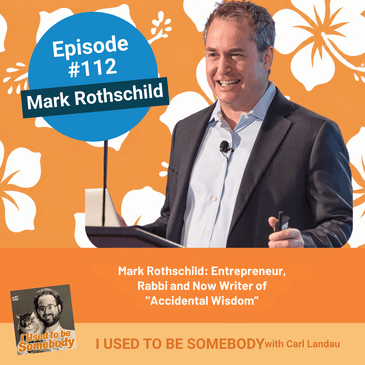
Mark has done it all. He had a successful career or two and then became a first-time entrepreneur in his 40's. He created and developed one of the most successful afterschool programs in the country. Today, "Right at School" serves 70,000 students in 1,200 schools nationwide. Mark's germ of an idea he turned into a $100 million dollar business. He sold it just a few year years ago.
Today he is equally successful as a writer. His "Accidental Wisdom"essays on Substack are read by over 30,000 subscribers. He's been featured in AARP, on the Today Show, The Moth, National Radio and more.
Fun fact: Always curious and open to new paths and careers, Mark's wife once challenged him to become a Rabbi, so he's done that too!
He's full of self-deprecating humor and wisdom. We're not so sure it's accidental. Mark Rothschild is a true (UN)Retirement Success Story!
• More About Mark Rothschild: https://www.linkedin.com/in/christaylornyc
• Mark's Substack "Accidental Wisdom": https://www.accidentalwisdom.com
• Feature Mentioned in the episode "What do you do?: https://www.accidentalwisdom.com/p/what-do-you-do
• Episode Content: https://pickleballmediahq.com/mark-rothschild-interview-entrepreneur-rabbi-and-now-writer-of-accidental-wisdom
• Sponsored by Capital Advantage: https://capitaladvantage.com/promotion/retirement-planning-guide
• Sponsored by How to Retire and Not Die: https://garysirak.com/how-to-retire-and-not-die
• I Used to be Somebody World Tour 2027 Bordeaux, France: https://pickleballmediahq.com/tour
• Subscribe to the the I Used to be Somebody Newsletter: https://pickleballmediahq.com/contact/subscribe
[00:00:04] Pickleball Media presents the I Used to Be Somebody show produced live at the Landau Tiki Bar in Sacramento. Here's our host, Carl Landau. Welcome to Landau Tiki Bar and the I Used to Be Somebody show who builds a hundred million dollar business, becomes a part time rabbi, and now is a professional writer in unretirement. I'll explain in a minute.
[00:00:33] First, I want to thank this month's sponsors. Thank you so much to our loyal sponsor, Capital Advantage Wealth Management. And please check out Gary Surak's very cool new How to Retire and Not Die video series. Following today's interview, we've got two super fun segments. First, we talked to the Unretirement Wisdom with Pros Guys. Today, we talked about the secret key to unretirement success. It's not about the money.
[00:01:02] It's about building a great social connections and how you can do it really easy and fun. That is followed by Pickleball Chronicles with Traver. Traver and I talked about the big M in Pig Ball success momentum. Catch it. Oh, and before I forget, I want you all to know next year's I Used to Be Somebody world tourer where it will take place. Bordeaux, France in September.
[00:01:34] September 2027. In just one year, Diana and I, we really haven't been in France very much before, are really excited. I've heard the Bordeaux area is the best, and we're going there right in the middle of wine crush season.
[00:01:50] We did a soft announcement last month to past attendees. We already have 18 of the 20 spots are taken. But if you're interested, still go to our website, pigballmediahq.com for all the details. I want to thank one of our listeners, Ted Fireman from Columbus, Ohio, who sent me Mark Rothschild's Substack Accidental Wisdom.
[00:02:17] And just to head a note, he said, I think you're going to really like this guy. I know I'm not supposed to play favorites, but this is one of my all-time favorite interviews. I know you're really going to enjoy it. In Mark's 40s, he became a first-time entrepreneur and started right at school. An afternoon program. This company turned into a total monster success.
[00:02:42] Today, there's programs in 1,200 schools across the country, serving tens of thousands of kids. In 12 years, he built the program into a $100 million business. Mark sold the business just a few years ago. And just as a side note, Mark earlier in his life became a rabbi, which is an entirely different story. But today, he calls himself, rightfully so, a writer.
[00:03:12] He's got 30,000 plus subscribers on his Substack Accidental Wisdom, which is a wonderful and thoughtful and very funny essay. He writes for all the big-time media outlets as well. Sit back and listen to my interview with Mark Rothschild. You lose that authority. You lose that title.
[00:03:43] And you have to be okay with that. As many of your guests have said, it's best to start thinking about that before you do it. Because if you think you can't wait for that first day and you're going to just play golf or pickleball or tennis or write that book or do whatever, that's false. Hi, Mark. Welcome to the I Used to Be Somebody Show. Thanks, Carl. Great to be here. Yeah, so I know you like to travel around.
[00:04:12] You like to bounce around, particularly between the Midwest and the West Coast. So where are you today? I am in my San Diego office looking at a beautiful sunshine. Okay. Otherwise, you're in Chicago? Exactly right. Mark, I want to introduce you to the audience. Mark Rothschild is a writer, speaker, rabbi, and entrepreneur.
[00:04:34] Most recently, he founded Right at School, a national educational enrichment company that he sold in 2023. In unretirement, Mark concentrates on writing, teaching, and speaking. He has over 30,000 subscribers on his sub stack called Accidental Wisdom. His essays appeared in AARP, Caveller, and Chicago Story Press.
[00:05:02] His work and commentary have been featured on The Moth, The Today Show, national radio, and podcasts. And he has spoken on stage across the country. So we're going to talk about that and a lot more. But first on I Used to Be Somebody Show, we like to play a little icebreaker game. So, Mark, are you willing to play the game? I'm in. Okay. The name of our company is Pickleball Media. Mark, what is your pickball experience?
[00:05:30] It is a great place for my family and I to get together and hit. I play a lot of tennis, but when the family's all together, we always go to the pickleball courts down the street, and it's a blast. Wow. So, I mean, are you a regular player? I'm a regular tennis player every week. And then when the adult children are in town, one of them lives in San Diego, one lives in L.A., one lives in Chicago. So when we're ever together, we all try to get together and do that.
[00:05:59] That's like that before cocktail hour is a great joy for the family. You know, it's funny. I know a bunch of people that sort of discovered Pickleball because they did like a reunion or something. And, you know, they had Pickleball and it like totally changed everything. It's just, you know, the dynamics of it all. It gives you something to do other than talk and ask your kids like a billion questions that they don't want to answer.
[00:06:27] Mark, the second icebreaker, what was the worst job you ever had? Well, I was recruited as a senior leader at a nonprofit. And I should have known during the interview because in one of the interviews, a one-on-one interview, I actually fell asleep talking to the CFO. And I had to say that, oh, I'm so sorry. You know, I've been traveling so much. And it was so boring.
[00:06:53] The problem was it was all about consolidation and saving money. I'm all about growing businesses. Right. So I should have known then. And I lasted about nine months when I had to leave. Okay. No, I think the falling asleep was a good indication. And the fact that they still hired you and you fell asleep, that's something totally different too. True. It's always fun for the audience to get to know the background of each month's guest.
[00:07:23] So, Mark, where did you grow up? Chicago mostly. A little bit in West Bloomfield, Michigan. Chicago, Deerfield suburbs. All those were home. Okay. Tell us about your family, size of family. Were you rich or poor? What was your family life like? And I have to ask you, as soon as I saw Rothschild, are you related to the original Rothschilds from Europe? Well, no. Here's how it works. So my father's side of the family, the Rothschilds, we trace back.
[00:07:52] They were serfs on the Rothschild estate. They were serfs? Serfs, workers. And sort of indentured servitude, if you will. And when you leave, when you are eventually allowed to go, you can take on the name of the estate. And so that's how we became Rothschilds many, many generations before. My father was born in Germany. And it was in the beginning of the Holocaust.
[00:08:19] And my grandfather was able to sneak him, his brother, my uncle, and his wife to America where they were very poor. My grandfather originally owned a store in Germany, and it was taken away from him. The two of them came back here where he was a watchmaker until he discovered how to sell insurance. And he came and then got us a nice middle-class upbringing in Chicago.
[00:08:49] Okay. Wow. That's really interesting. Although I was really excited to find out, like, the fortune that you inherited when you were born. Sorry. How would you characterize what a young Mark Rothschild was like as an adolescent and teenager? Kind of quirky, weird. I wrote plays. I wrote musicals. I wrote terrible fiction. I was an entrepreneur. I typed up business cards, became a dog walker.
[00:09:18] At 16, I actually became a talent agent. Wait, what? Yeah. My friends were in a high school rock and roll band, and I had no talent. So I thought I could get them gigs. And down the street from us in West Bloomfield, Michigan, was a small talent agency called J1 Talent. I rode my bicycle over.
[00:09:39] And before a couple of months, I actually got to just dial for dollars and book J1's roster of DJs and bands into bars. And I just used my lowest voice I could muster. Carl, I made really good money such that I even contemplated maybe I should just drop out of high school and do this. And of course, my parents thought I was insane, so I didn't.
[00:10:08] With all this experience, this writing bad plays and being this talent agent, did you have a clue particularly what you wanted to do when you were going to grow up? No, none whatsoever. And I felt that way pretty much throughout my entire adult life as well. I somehow early on started to think of life as not being linear and additive, but that you could jump around, do different things. I came across the idea at the time.
[00:10:37] I think it has a lot of different names now. Then it was called Patchwork Economics, where you could build a career doing lots of different things and not just move from junior vice president to vice president to senior vice president, but find new passions wherever you went. And for some reason, that just fit me. And that's what I did. So you were the mayor of the gig economy. Yeah, early on, gig economy, multiple jobs at the same time.
[00:11:07] And I've always believed in trying new things. And it worked. A lot of times by accident. I don't think I was qualified to work at McKinsey and Company back in the day, but I got sort of an entry-level job in there and worked my way up. McKinsey is an international consulting firm, and they only hired the best of the best in great college grades and great colleges. And I didn't have that, but they had an opening for communications consultants.
[00:11:36] And I had done some of that. So I was able to sort of sneak in the back door and then start helping organizations with their communication strategies. And that really introduced me to a lot of really exciting people and businesses. And I got excited about what would become that chapter of my life. Wow. I mean, to get your first job, real job at McKinsey is unbelievable. So look to your checkered past.
[00:12:02] And for the first 20 years, you had jobs that looked like for three, four years at a time and were moving up and all that. Because I do want to get to right at school, which I'm really interested in. Just real quickly, can you give us some of the highlights of maybe those first 20 years? I was at a research firm. It was just a leader and I and a couple of younger researchers.
[00:12:27] And we were having hot dogs at Demon Dogs in Chicago underneath the L. And on the TV behind his head, the stock market stopped trading because Netscape went public. And I was like, this Internet thing is amazing. We need to get on it. And he wasn't that interested. And somehow that moment, we kind of broke up and I knew I wanted to do something Internet-y.
[00:12:53] I ended up at a company called Fast Web and that was a lot of fun. But during those days, it was fun, but it wasn't inspiring. It wasn't purpose-driven. One night, my wife and I were watching Keeping the Faith, a movie called Keeping the Faith. It's just a comedy with Ben Stiller where he played a funny rabbi. And she said, you should become a rabbi. And I said, okay.
[00:13:20] What started as a joke and a dare became five years at Hebrew Union College where I got to study, become a hospital chaplain. One year, I'm an Internet executive. A year later, I'm in a hospital trying to comfort people while being petrified of blood and patients. So you were like, I don't know what's involved in becoming a rabbi. So this is like part of your training? Yeah, it's an internship.
[00:13:49] You can have lots of different internships. I thought this would be interesting. So you're not a full rabbi at this point? No, but they call you rabbi. Just like if you're in a hospital and you have a resident, a medical student, they might call you doctor, whether you are or you're not. Early on, they just, that's your title. And so it was incredible. And rabbinical school was incredible, even though I wasn't particularly, and I'm not particularly religious.
[00:14:15] But learning about thousands of years of history and people and challenge, it was just incredible experience. And I got to have student pulpits. And that was all great knowing that I never really wanted to be a full-fledged congregational rabbi. That didn't interest me. But I figured something would come along, and it did. I have no idea because I'm also Jewish, but I'm not the greatest Jew. I was bar mitzvahed under total being forced.
[00:14:44] Had no interest in it at all, but it's just one of those things you had to do. And then I never went back to temple. I'm more of the really enjoy Jewish food and the people and the culture and some of the holidays. So I don't know that much about it. Yeah, I was that guy too, Carl. And like when I was 16, we had a service called The Confirmation where you confirmed why you were excited about this. And I said in front of the congregation, I'm not even remotely interested in any of this.
[00:15:14] So it became something you just want to learn more about. It was more like learning about the history. And, you know, this is not something that little kids are interested in. But when you get to learn about the wisdom of thousands of years of writing, it's kind of exciting. And that's exactly how I found it. You know, after graduation, knowing I didn't want to be a congregational rabbi, I ended up at what's called JCCs, which are like YMCA, Jewish Community Centers.
[00:15:42] I went to a lot of JCCs, played a lot of racquetball there. Yeah, nice. That probably helps your pickleball game. Yeah, it did. Yes. So I ended up there and that's where I started to see after school programs. I had tutored in after school programs for money as a society. And then as an executive at a JCC, I saw how desperately families needed something, especially working parents or single parents.
[00:16:10] In those days, like now, you know, we're grandkids and they have all these classes after school. And they're actually pretty good. And the kids like going to them and all that. But they didn't have that when we were kids. Right. What you had was just sort of basic babysitting if you needed it. And it was something that bad parents would send their kids to. Right. Exactly.
[00:16:33] And what I wanted to create when I saw these programs and in a small sense, I remembered back to early consulting days when they taught us, if you ever saw something that was a national but done piecemeal by locals and prices were varied and quality was varied, become the person who creates the top model.
[00:16:57] So what I wanted to do is create something for children in preschool, elementary school and middle school who needed to be safely supervised, but to make it fun, to make it almost like camp. So they would love it, but it would still be affordable. And we kept prices at less than $6 an hour for parents. And there was also subsidies.
[00:17:20] And we created this national model such that today we're in well over a thousand schools serving over 70,000 children a day. You're talking about right at school, right? Correct. Okay. So talk about that. Okay. So you did have a career for about 20 years, a lot of consulting type things, rabbying. But then had you ever started your own company before? No, I'd been early on.
[00:17:47] I had been in several, two different occasions where I was one of the first, but it was never my company that I raised capital for that I built. Okay. And how old were you when you started this? 40 something, 42 maybe. Okay. So can you explain to our audience what right at school is? I know you're a humble guy, but give some scope and magnitude of what ended up being this monster of an organization.
[00:18:13] So I decided I really wanted to build this after school organization. I made some back and forth thinking that I want it to be for profit or not for profit. I was kind of agnostic on it. I just wanted to build this great program and decided to go for profit because oddly it was easier. When I tried to approach foundations and stuff, they're like, well, prove to us that it works and we'll fund you. And I said, fund me and I'll prove that it works. And that worked better by getting friends and families to get together.
[00:18:42] So it wasn't a lot. I managed to squeak together $400,000 talking to every single person I knew to invest family, friends, random people. And we started in the Chicago public schools. I had two employees to start. We ended up getting in incredibly 14 schools to start, which was far more than we were prepared for. I'll share a quick story.
[00:19:11] Like it started off so amazing. It was filled with such joy, but it was clear that I had said yes to too many schools and everything was going wrong. I mean, literally the basketballs, when I ordered them, I didn't know they'd come deflated. You know, we didn't have pumps. And I just wrote an essay about it called The Tiny Chair.
[00:19:34] I was called by all the parents at one of the schools and they just yelled at me and they just took turns yelling at me. And I was near tears. I was on the stage in this like cafeteria. I was just exhausted. And really, I just wanted to build something for their children that would be great. And here I was failing them, failing my new employees, failing my investors.
[00:20:00] And I had to sit down and the chair that was right in front of me was one of those like tiny elementary school chairs. Right. And I sat down and they just towered over me. And yes, it's good to laugh now. I was not laughing then. And I just stopped and said, I was really, really sorry. I bit off more than I could chew. Their kids were safe. Their kids were in good hands.
[00:20:29] Our educators were phenomenal. But tell me how I can get better. And we will. So share like you had this company when you owned it for 12 years. So what size company? How many employees? What kind of revenues were you getting? I mean, I'm just really curious of what it was. How many schools? Yeah. So I guess we went from 14 to 40. And then every single year, we grew by at least 50%.
[00:20:56] So we really built for scale and growth. And that really allowed the educators to constantly get promoted. Because if you're just in one or two locations, where are they going to go? How are they going to improve their, what are they going to learn? And so by constantly scaling, people who were junior educators could become senior and they could become program managers and then area managers. Today, there's, I don't know, over 5,000 employees. Wow. Yeah.
[00:21:26] Well, it takes a lot of educators and curriculum teams and customer service and finance teams and all the things you would think. But primarily, the educators themselves who are day in and day out with the children and greeting the parents. I realized I was really good at bringing it from $0 to $100 million. But I wouldn't be the kind of CEO who would want to take it to that next step. Right. But you brought it to a $100 million business. Yeah.
[00:21:54] You owned it for 12 years. Billed it to, I'm sorry, how many employees? Oh, I think at that time there was floating around 5,000, a little higher, a little lower. Okay. 5,000 employees. And how many kids are in the program? Now, 70,000. When I left a couple of years ago, maybe 50. Okay. 50,000. Oh my God. It's $100 million business. Okay. So, why did you decide to sell?
[00:22:21] So, I'm asking because I know our listeners would be interested in getting some perspective for figuring out when it's the right time to move on from that really big-time career to something new. So, were there any clues? Or were you still enjoying it? You just felt, oh, if a bigger organization had it, that they could just take it to the next level? Or what was the thought process? You know, I loved it. Not every day.
[00:22:49] Not being yelled at during the first year by parents. And there's always days where you just wonder what you're doing. I loved working there and being part of the team. But I've always felt that once you've done something, you've done it. It's time to move on to something else. Yeah. And, you know, for the first 10 years, everything was brand new because we were this size company, then that size company.
[00:23:15] And I really thought now is the time for the next generation to take over. And I wanted to do something different. Life is short. Life is comforting when it's on repeat. But I find it inspiring when it's new. And so, it was a great moment where I knew I could hand it over to the next generation of leaders. It would grow probably even better without me because I'm no longer using my biases of the past decade. Let someone new.
[00:23:45] And so, I decided to find partners. And it worked out great. It's in Stronger Than Ever hands. I still get, you know, I'm on the board. And I love that. But now, day to day, your brain is open. Your mind is open. Your body is open for everything new. And that's exciting. Yeah, I'm totally with you. I'm totally the new guy. I mean, that's my whole thing. In fact, you know, I've been an entrepreneur since I've been 25 and started three or four
[00:24:14] companies. And it's like, but I'm not the smartest business person in the fact that at a certain point, it's like, okay, don't do new things. Just figure out how to make more money doing what you're doing. And to me, that's like the most boring thing in the world. It's the smartest thing to do financially and the easiest thing. And I have zero interest in doing that. But I do know myself. Carl, that's so important. I'm sure whether you're the smartest or not, you're probably one of the happiest because
[00:24:44] you're doing, you discovered who you are and you're doing things that give you joy. Yeah. What was your transition life from being a big time executive to civilian life? What was that like? We'll be back in a moment after a short break. Choosing a financial advisor is one of the biggest decisions you need to make in retirement. Now it is more important than ever to protect your retirement savings and investments.
[00:25:13] Capital Advantage can help individuals like you develop a personalized investment strategy and retirement plan unique to your life and goals. For over 40 years, Capital Advantage has been a 100% fee-only fiduciary advisor. Just go to capitaladvantage.com slash podcast. Hundreds of our listeners have bought Gary Strack's book, How to Retire and Not Die. He's come out with a great video series.
[00:25:43] It's ideal for people approaching or entering retirement. It's a 14 video courses that cover it all. Identity beyond work, figuring out your new purpose, give you structure and emotional, social and cognitive health plan. Check it all out at howtoretireandnotdie.com. Welcome back to the show.
[00:26:10] What was your transition life from being a big-time executive to civilian life? It can be tricky. You know, when you move from being the person who people ask you questions and then do what you tell them to do, to now I'm on a board where everybody writes down what I say, but probably doesn't do it. Right? You lose that authority.
[00:26:38] You lose that title. And you have to be okay with that. As many of your guests have said, it's best to start thinking about that before you do it. Because if you think you can't wait for that first day and you're going to just play golf or pickleball or tennis or write that book or do whatever, that's false.
[00:27:01] If you don't start doing that early and start to change, because identities shift in a moment when you are no longer with that title or that responsibility. And I was lucky that I was able to prepare for it and starting to write. The week I sold the business, I got my first article published and $100 check. And I don't know which excited me more, to tell you the truth.
[00:27:31] I was so blown away. Yeah. So tell us about the very second act you've had. And actually, I just started reading you like a month ago and I read the What Do You Do essay that you wrote. Oh, right. And I absolutely love that. So, and I'll include either in a newsletter or in the show notes, that article. But just give us an idea of like your little journey there. Sure.
[00:27:58] I started getting phone calls. Do you want to sit on this board? Oh, we'd like to invest in you. What's your next business? And in the first couple of calls, I don't want to say I lied, but I said, oh, I'll get back to you. You know, my mind is reeling with new business ideas. Well, also, you're a rabbi. You can't lie. Right? All right. Well, I said what wasn't 100% true. Okay.
[00:28:26] Because I didn't have, not only did I not have new business ideas, I really didn't want to do business anymore. I enjoyed business. Well, I did business. And now I wanted to do something different. I didn't want to do that. I did get on a few boards and some boards are good. Too many boards are also kind of boring because you're just listening to other people do things
[00:28:55] and giving them advice as their elder. And for me, that's a little bit too much living in the past. I'm giving you ideas because I've done it before. That's good to do. Mentoring is good to do. But if you want a new lease on life, doing things that are brand new. I know. So tell us some of the weird, brand new journeys that you've had.
[00:29:21] Well, from a hobby perspective, I started doing everything, right? You know from that essay about how I tried to be a lamographer and infusionist and astronomer. Those were all things. And I'll tell you something I did that I think is worthwhile. You know, I don't think anyone should try to replicate anyone else's life. But I think this thing really, really made a difference.
[00:29:47] When we're in business, when we're coming up, the idea is mastery. You want to be better than other people at what you do. And you want to be as good as you possibly can. And that gives you joy because the better you get at something, you feel good about yourself. Money often follows. All that good stuff happens. And so for the first, call it 50 years of our life, mastery is the goal.
[00:30:15] And what I find now, yes, mastery is still important in some aspects. But giving myself so much room, not just to fail, but to suck, to really be bad, is so fun because who cares, right? Like it doesn't matter. You know, I just went fly fishing for the first time and I'll never do it again. It was a blast. Maybe I'll do it again.
[00:30:45] I have some buddies who want to go. But I was so bad. Everything about it and learning the new language about the way you're supposed to twist your hand and all that. But it was so fun. And not wanting to be good, giving yourself the permission to just stink is amazing. So, you know, I've listened to your podcast and, you know, recently someone started doing ballroom dancing and someone got into wine. I think these are all great.
[00:31:14] What happens sometimes that I see some buddies who are retiring say is, I don't know what to commit myself to. They feel like they have to dive in and be great at something. And I think the real opportunity at this chapter is to fail. Yeah, I totally agree. And I think, honestly, we're lucky in the fact that we're entrepreneurs. Because if you're an entrepreneur, you are used to failing every day. You are.
[00:31:43] It's like if you're good, you're going to fail a lot. But you're going to fail quickly and you're going to move on and pivot pretty quickly. So I think we're lucky in this whole second act and the fact that we've been trained to. But there's also people that had like some corporate job or a job with the state or, you know, a federal job for a long time. And they're not used to failing. They're used to doing whatever that job was.
[00:32:11] And I think it's more difficult for them. Yes. But embracing being the new loser is awesome. I think it's really valuable. So like I said, I just became a subscriber a month ago to Accidental Wisdom Substack. And you are such a great writer. I just love your honesty, your feelings and observation. And the past one I read was about your brother, about him losing his hair.
[00:32:39] And the thing that I like as far as your writing is the same reason why I like anyone, why someone becomes a really close friend of mine or someone who I admire, where they're willing to be honest. They're not always necessarily the hero of their own story. And they can poke fun at themselves, but also, you know, show the good parts and other people too. You're really talented that way. And I see why people really like reading.
[00:33:08] I'm looking forward to reading a lot more of your stuff. Carl, I mean, that really thank you so much. That's kind of why I write. And so thank you for saying all that. You know, I wasn't when I started Accidental Wisdom. Some of my essays weren't that good. But like anything, if you want to have some mastery in some aspects of your life, just doing it more and more and more, you get better at it. But your willingness to fail, especially in this chapter, is huge.
[00:33:36] And we have to know, like, it's interesting. Only I'd say a month ago, my wife, Trish, and I are out. And, you know, she's a senior executive and we introduce ourselves. I, up until, and now it's been about a year and a half, maybe a month or two ago, I would introduce myself by saying I was the founder of this company. And it's only now that I say, oh, I'm a writer.
[00:34:03] Because we hold on to old identities, sometimes too long. And sometimes if your buddies are still working, your friends are still working, you don't want to say you're retired. And that's okay, right? Yeah. I think where some of my friends, and I'm observing this now, get hung up is they put on a false air of how busy they are. Oh my gosh, I'm so busy. I'm so busy. Right? Because that's what they used to say when they worked full time. Uh-huh.
[00:34:32] Oh my God. The people at work, remember the people at work where they're like, I get 1,200 emails a day or whatever it was. It was like, okay, I mean, have you ever had a spam filter? I mean, you know, do you know who I'm talking about? It's like, oh, I hate those people. Yes. And it's a little sad because you also know that they feel like they have to say that to build their own confidence and their identity.
[00:35:02] And I understand the impulse, but it's really okay just to really love life and enjoy it. And yes, there are times when we're busy and there's times when we're not, but these are our choices, particularly at this stage. And if you're busy, stop doing the things you don't like doing. Like I even got to do that at, at even before right at school, but during right at school at meetings I didn't like to go to, I stopped going to them.
[00:35:32] I didn't need them on my calendar. And people do so many things they don't want to do. That includes in this chapter, uh, where we used to be somebody and now we're someone else and just don't do those things. Yeah. Yeah. So let's, let's talk about unretirement. Uh, we've got 20 on retirement strategies on the pig ball media website, but you're one of those creative types. So you pick two of your own topics.
[00:36:01] So the first one is do what you've always wanted to do. So what, what do you mean by that? Exactly. Well, for me not to beat a horse, cause we've been a dead horse because we've been chatting about it for a while, but I always wanted to be a writer from when I was a kid and it just, I wasn't a, yes, I wrote, but I wasn't able to sit down and write and see what kind of writer I was until this chapter.
[00:36:32] And I started, you know, as I said early on saying yes to more of the same, yes, yes, I'll be on your board and yes, I'll do this. And then I decided, no, I've done that. So I'm going to do things I've never done. Now I write between six and eight hours a day, six days a week. I'm a writer. That's what I do. And as you know, from that article that I wrote, I started taking new hobbies. That one it's true. I didn't know what hobbies I wanted to do.
[00:37:01] I wanted to do things I'd never heard of. So I got a list of hobbies on the internet and I put them all on a document and then I cut out all of those things that could have gotten me killed or hurt or that cost insane amounts of money. And then I randomly picked three and I committed myself to do each one for three months and then drop it. No matter how much I loved it, drop it and do the next.
[00:37:30] Because I just wanted to do new on new on new. And, you know, you read the article and sometimes, you know, there I was in the astronomy phase six months earlier, I was kind of a pretty successful entrepreneur CEO. And now I was some random dude staring at the sky, not knowing where Saturn was, you know, it's exciting.
[00:37:55] So doing things that you stink at, that you've never done is so much more rewarding than falling into the old traps, the old safety, the old security of doing what we did before. Yeah. Awesome. So second one is to give back. What do you have to say about that? Well, this is a huge opportunity in our lives to give, whether it's our time or our resources.
[00:38:24] And I really wanted to prioritize that. And so I was a co-founder of something called the Chicago Giving Circle, where we decided to pull together a bunch of families who would commit to a certain amount of money each year. And that by pooling our money together, we could make major gifts to local organizations that would be transformative for them.
[00:38:48] So we created rules in our case that they couldn't have more than a certain number of millions of dollars in their giving so that we'd have more of an impact. And we decided that our funds would be unrestricted. So instead of doing what so many tech bros and others do about like, okay, I want you to create this very specific thing and I'm going to measure you this way or that way, we trust these nonprofits to do what's right by them.
[00:39:17] And nonprofits across America are struggling because everyone's giving restricted gifts, but they need to operate. And so we give three-year grants and it's so much fun. We get together four times a year. We pick what our theme is for the year. We do research. We find out who we want to give to. And then many of these have volunteer opportunities that our adult children can do and even our younger children can participate in.
[00:39:44] So building that organization was great. And now we're like four years into it and the impact has been great. We've given away millions of dollars collectively. Wow. That's awesome. So Mark, what advice do you have for our audience? Our audience have had successful careers. They want to do something new, something more fun, something more meaningful. Do you have any final words of advice for them?
[00:40:10] You know, throughout our lives, we've had to take ourselves pretty seriously. We have responsibilities as partners, sometimes as parents, as employers, as we grow. We have to do a little bit of bragging at cocktail parties about how well we're doing. And we take ourselves a little seriously throughout our lives. And we all know we're supposed to take ourselves less seriously, but it's really hard to do.
[00:40:39] When you get to this moment, just let that go. Try new things. Fail. Try something else. Fail. But don't get hung up on being as successful as you were or doing what you did or being as impressive. It is so much more rewarding to just be who you are and try new things and have fun. That's awesome. I absolutely love that.
[00:41:07] So Mark Rothschild, I can't thank you enough for being our guest this month on I Used to Be Somebody. Thanks, Carl. Unretirement wisdom from the pros. Today, we've got Ian Castile from Capital Advance and Gary Serac from Serac Financial Services. Today, we're going to talk about one of the secret successes for a successful retirement, figuring out how to expand and enjoy social bonds.
[00:41:36] We all know that social bonds are really important in creating a healthy retirement lifestyle. I discovered Pickball that I've talked quite a bit about, but Pickball is not for everyone. What are some other activities or hobbies or clubs that have worked for your clients to discover these new social connections? So Ian, let's start with you. Well, going down the path of living a healthy lifestyle, exercise is a key component of that.
[00:42:05] To the degree that you can find a way or an activity that can check many things off the box simultaneously is the best bet, in my opinion. So having a regular exercise routine that is class-based, meaning there's an instructor and you go with a group of people on a regular schedule, I think is checking the easy button to address that because you get so many things done.
[00:42:31] And then what I found too is on the class-based stuff, you're more accountable and you work a little harder because there's that public accountability function to it too. Right. Right. So that's what I say. Join the gym or a class-based fitness or activity. And that's probably the secret to unlock. Yeah. That's why Pickball works so great because the one thing missing if you're just in a class
[00:42:56] is sort of the teacher explaining things and you may not have that much interaction. So I think the more interaction, the better. Like, for example, I have a friend who loves their senior bowling league. I mean, it's a big part of their life and they have so many friends from it and all that. So the more interactive, the better. So Gary, what are some cool activities that clients or friends that you've had can build
[00:43:25] new social connections? Well, there's a guy I know that retired. He's a doctor and he loves mystery, murder mysteries. So he goes to a coffee shop and he started recruiting people to be in his book club. So they now meet at the coffee shop. They do their book reviews of basically murder mystery books they read. It's really worked out well. He's had a really good time. He's met people he didn't know and really enjoyed that. Then I have another guy who he took an art class.
[00:43:56] The Canton Museum of Art offered these beginning classes. He's never painted, done anything, but he went to the class, absolutely fell in love with it. And now he's going to classes and learning different styles. He's met all kinds of people he never met in his whole life. And he's real excited. The other person, though, is my favorite one. He's 75, let's say, retired doctor and didn't have a clue what he was going to do. He and I talked about it.
[00:44:25] And there's this golf at the course that we belong to. There's this group called the Geezers, the Geezer Golf Group. So they meet Tuesday, Wednesday, Friday, and they play. They get together for lunch. They kill the entire day. Yeah. And he loves that. And he wasn't any good, but he's gotten better and better because he's playing. And then in the winter, they go geezer bowling. So they twice a week and bowl. I love the Geezer Group. Yeah, it's really cool. And he has a great time. He took me as a guest one time.
[00:44:55] It was fun. A whole bunch of characters. That's fun. I even started a club. I just started this about four or five months ago. I got a couple of new friends. They were new to the Sacramento area. And so I'm like, well, maybe I'll get them together. And then I just asked a couple more people, and they asked a couple of people. Now we have 12 people. Our group's called SAC, Second Act Club.
[00:45:24] And we meet every two weeks. And we have lunch. We take turns hosting at our house. And we're going to a minor league baseball game in two weeks. We're going to a brewery in another month. We have a dozen members. And I mean, no one's dropped out. Everyone loves it. I mean, it's actually been really fun. So anyone can do it. It's not that hard. But it's really important. I mean, it really is.
[00:45:52] So Ian and Gary, thank you so much for another great segment of On Retirement Wisdom with the Pros. The previous response does not serve as the receipt of or a substitute for personalized investment advice from Capital Advantage. Rather, you should seek advice from the investment professional of your choosing. Different types of investments involve varying degrees of risk.
[00:46:10] And it should not be assumed that future performance on any specific investment or investment strategy or any non-investment related or planning services, discussion or content will be profitable, be suitable for your portfolio or your individual situation or prove successful. Pickleball Chronicles with Traver. Hey, Traver. Question. Why are there huge momentum swings in pickball? And I know other sports, it's like this. But I don't think anything like this.
[00:46:38] Like in baseball, a team that's winning 8-0, you know, in the bottom of the eighth, they generally don't win. But I mean, if you play enough pickball and you've been in that game and it's 8-3, you still feel like you're in it. And inevitably, you can end up winning. I mean, do you think there's any particular reason? I mean, I guess some of it's also just luck. Yeah, it can be. And when you started describing this, you know, baseball wasn't the first sport that came to mind for me.
[00:47:08] The first sport that came to mind for me as an analog is basketball, where teams can go on 10-point runs, 15-point runs. What do they do in those situations? Well, the coach calls a timeout. He gives his guys a break. He breaks the momentum for the other team. They kind of regroup and they figure out what they're going to do when they step back out on the court the next time to break the other team's 15-point run or whatever it is.
[00:47:33] I think a lot of that mentality applies in pickleball as well, right? And so if I'm down 8-3 or, you know, let's say the other team scores eight consecutive points on me, call a timeout. I talk about it with my partner. We change up the strategy a little bit because the mentality the entire time is, hey, if they can score eight in a row, why can't we? Exactly. We can do the same thing. Right. The mountain that we're looking at is no different than the one they just climbed. So we're going to do it too. Yeah.
[00:48:01] Particularly things are working with that opponent. And, you know, they seem to have all the answers. So I guess probably the best thing is just evaluate, like, what are we doing and what are they doing? And just sort of do the opposite. Sort of like George Costanza on an opposite day where he's like, this is what I would typically say. And I would get shot down by a woman. And, like, I would just say the opposite. And anyway, that seems to work in pickleball.
[00:48:31] Wasn't that the episode where he approached a woman and said something like, I have no job, no prospects, and I live with my mother. Yeah. Yeah. That was. Yeah. If I could, I would drape myself in velvet. Oh, my goodness. Okay. Settle down there. But, yeah. So how do we do that at pickleball? What were we talking about? Oh, okay. When it comes to the strategy, it seems like the other team has all the answers for what you're doing.
[00:48:57] It's a little more difficult than pickleball because you can't really step outside of yourself and analyze the game from the sideline. Yeah. Like a basketball coach can, right? The first thing I would say is just as you're talking to your partner between points or during a timeout, talk about changing up the strategy. If on third shots you're constantly driving, throw some drops in there. If you're constantly dropping, throw some drives in there.
[00:49:21] The next time you get up to the kitchen line, if you haven't hit a lob in the entire game, throw some lobs up over their heads. Break up the patterns that they've been used to seeing and have been capitalizing on for the last eight points. Target the other partner on the opponent's side of the net, right? If you've been targeting one person most of the game, target the other one for a while. And just remember to go after the spots that are difficult for somebody to get a ball back from, like their opposite foot.
[00:49:50] For a right-handed player, that's their left foot. Very tough spot. Go for the chicken wing, right? Yeah. I mean, you know what a chicken wing is, right? Hitting it to the paddle side of their body, up close to their body, so it's difficult to maneuver their paddle to the line of the shot. Yeah, I have been in that pose many times, yes. So, I mean, there are a lot of ways.
[00:50:12] You just kind of have to step outside of yourself and analyze the game as if you were looking at it from the sideline and decide where you can do things differently. And then try that out for a few points and see if it changes. Yeah, I totally agree. The one thing that I do, and it has worked, is I'll just like, okay, nothing's working, particularly on the serve. I'll just do the really high loopy serves. I'm not kidding.
[00:50:39] I've gotten five or six in a row on that. Particularly those serves, people want to do a lot with them because it seems so easy. And anyway, it's just exactly what you were saying. Just like do anything to change it up and you never know what's going to happen. I love that lob serve strategy, too, because it looks like it's going to be such an easy ball for them to handle and they want to just crush it. And nine times out of ten, they end up crushing it into the fence behind you.
[00:51:08] It just goes so far along that you can get a couple of easy points that way. Wait, wait, so I had a good idea? Of course. Yeah, you were due. Oh, my God. Okay, Steve. Steve, my slump is over. Thanks, Trevor, for another great segment on Pickleball Chronicles with Trevor. Good luck on the court tomorrow. Thanks, Carl. Thank you so much for listening to today's show. Wasn't Mark Rothschild's story amazing?
[00:51:38] If you subscribe to our I Used to Be Somebody newsletter, you can watch a really funny video with Mark from On the Moth where he talks about his journey to become a rabbi. A big thank you to our sponsor, Capital Advanced Wealth Management. And thank you to our sponsor, How to Retire and Not Die. Check out the really cool 14-part video series. A big thanks to this month's star, Mark Rothschild.
[00:52:04] Please check out his Accidental Wisdom Substack essays. It's truly a really great read. Thank you, Ian and Gary, the Unretirement Wisdom Pros, and Trevor West, my pig ball guy. And a final thank you to my bosses, Diana and Becca. Thank you for letting me keep my job one more month. We'll see you all next month at the Landau Tiki Bar for another episode of I Used to Be Somebody. Mahalo.