

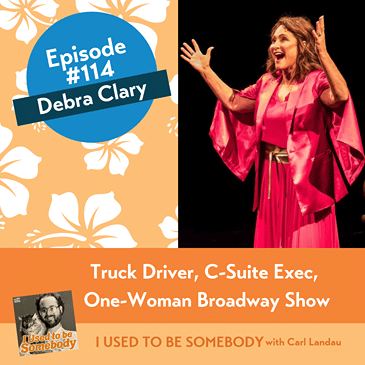
Who starts their career off as a truck driver for Frito-Lay, works their way up to the C-Suite at some of the world's largest food and service companies in the world and then stars in a one-person show about their own life on Broadway?
It's this month's guest Dr. Debra Clary! She's got an amazing story that takes you through so many twist and turns. She started at the bottom of giant Frito-Lay with a truck route. Ends up being a key exec on the historic "flamin' hot" brands. Moves onto Coca-Cola and Jack Daniels. And eventually heads up a new division in a totally different industry (healthcare) Humana.
She's most famous for her work and studies about "curiosity" and it's importance in corporate leadership and life. Writes a best selling book The Curiosity Curve.
Most recently she took her show on the road in her hometown of Louisville. Host Carl wants to know when the movie is coming out?
• More about Debra Clary: https://www.debraclary.com/
• Episode Content: https://pickleballmediahq.com/debra-clary-interview-truck-driver-c-suite-exec-one-woman-broadway-show/
• Sponsored by Capital Advantage: https://capitaladvantage.com/promotion/retirement-planning-guide/
• Sponsored by How to Retire and Not Die: https://garysirak.com/how-to-retire-and-not-die/
• I Used to be Somebody World Tour 2027 Bordeaux, France: https://pickleballmediahq.com/tour/
• Subscribe to the the I Used to be Somebody Newsletter: https://pickleballmediahq.com/contact/subscribe
[00:00:04] Pickleball Media presents the I Used to Be Somebody Show, produced live at the Landau Tiki Bar in Sacramento. Here's our host, Carl Landau.
[00:00:17] Welcome to Landau Tiki Bar and the I Used to Be Somebody Show. What does starting your career off as a truck driver, working your way into a C-suite job for Fortune 500 companies, to starring in your own Broadway one-person show have in common?
[00:00:37] Today's guest is the answer. I'll explain in a minute. First, I want to thank this month's sponsors. Thank you so much to our loyal sponsor, Capital Advantage Wealth Management. And please check out Gary Sirak's very cool new How to Retire and Not Die video series.
[00:00:58] Following today's interview, we've got two super fun segments. First, we talk to the Unretirement Wisdom with the Pros Guys. Today, we talk about the things people miss since retiring from their full-time career. That's followed by Pig Ball Chronicles with Trevor. Today, Trevor and I discussed the unusual places Pig Ball is showing up. For some reason, weddings and prisons came up in the same sentence. You got to check it out.
[00:01:28] I can't wait to get to today's guest. But first, I need to thank one of my past guests, Karen Studes, for introducing me to Deborah Clary. This is one of the strangest and most unlikely guests I've ever had on the show.
[00:01:45] Dr. Deborah Clary, who actually prefers just to be called Deb, started her career in the world of food service as a truck driver at Frito-Lay. She rose through the ranks to a high-ranking C-suite exec job, had a whole bunch of executive jobs with some pretty prominent food service companies.
[00:02:09] And her latest adventure is the creator and star of her own Broadway one-woman show. Sit back and listen to my interview with the amazing Deborah Clary.
[00:02:28] Something really crazy happened to me. A friend of mine had pitched an idea that I had to a producer in New York for a one-woman show about my life, and I got booked. Hi, Deb. Welcome to the I Used to Be Somebody show. Thank you. It's a pleasure to be with you, Carl. Yeah. So are you in Kentucky now? I am in Louisville, Kentucky, home of the Kentucky Derby.
[00:02:58] Yeah. I love Louisville. In fact, I met the guy who plays the trumpet at the beginning of the Derby. We had him, you know, you can hire him and he'll start your conference using it, and it's very impressive. Yes. He indeed is impressive and very talented. Yeah. Deb, I want to introduce you to the audience.
[00:03:22] Dr. Deborah Clary's career started out as a truck driver in the food industry. She spent 20-plus years as an exec in the food and service industry, working for companies like Frida Lay, Coca-Cola, and Jack Daniels. In her mid-career, her focus was much more on healthcare, and eventually she became a very successful consultant on her own.
[00:03:49] Her work has been featured in Forbes, has become an expert in the world of curiosity and the importance of it. In fact, she's the author of the best-selling book, The Curiosity Curve. And now she has a one-woman show, The Curious Woman Show. We're going to talk about that and a lot more, but first on, I used to be somebody. We like to play a little icebreaker game, so are you willing to play the game? Absolutely.
[00:04:16] Okay. Amazing prizes we get to much, much later. The name of our company is Pig Ball Media. Deb, what is your pig ball experience? My pickleball experience? Yes. I have watched it from afar. All of my neighbors play, but I have not played yet. Okay, so I can tell you're excited about Pig Ball. Yes. Anyways, so I normally grade people, but I'm in a good mood, so I won't.
[00:04:45] I'll give you a pass because you know what the word means. Okay. I'm going to tell you why I have not played. I was recently on an airplane to Washington, D.C. Sitting next to me was an orthopedic surgeon. I said, hey, what are you going to Washington, D.C. for? He goes, I'm actually buying a boat. I go, wow, business must be really good. He goes, yeah, pickleball. Okay. That's very true.
[00:05:13] So second question, Deb, what was the worst job you ever had? I was once a dishwasher in a restaurant, and it was a very dirty, messy, ungrateful job, if you will. Yeah, that's got to be way down there. Honestly, jobs like that totally depend if the people you're working with are fun, you know, and then maybe you could make something of it. But I'm guessing this was very early on in your career.
[00:05:43] I was in high school, and I was determined that this would not be my lot in life, washing dishes. Okay. Well, you're a big success. So it's always fun for the audience to get to know the background of each month's guests. So where'd you grow up? I actually grew up in Royal Oak, Michigan, which is about 30 miles north of Detroit. Okay. I actually didn't grow up too far away. I grew up in Cleveland, actually. So I'm also a good Midwesterner. Yes.
[00:06:13] And you know the value of sunshine because we had that lake effect of, you know, the Great Lakes was beautiful, but it brought us lots of clouds. I know. In fact, I remember as a child watching like the news and they said Cleveland had the least amount, I'm sure where you live very similar, had the least amount of sunshine of any city in the country, including Seattle. Wow. Yeah. Okay.
[00:06:40] So now we've lost half the audience talking about weather in the Midwest. Tell us about your family, size of your family. Were you rich or poor? What was your family like, life or anything you want to share? Yeah. So as I said, I grew up just north of Detroit and I had two siblings, two brothers, one older and one younger and traditional family. My dad went to work and my mom stayed home and raised us.
[00:07:05] We were middle class family, but my parents taught me the value of hard work and the value of an education. And that was their focus with us. Yeah. That sounds good. So how would you characterize what a young Deborah was like as an adolescent and teenager? I was fortunate because my parents were very adventurous and curious. They took us to every contiguous state in the United States, including Canada, Mexico.
[00:07:32] So if you could drive there, my parents put us in a station wagon with a pop-up trailer. And every summer we took off and went some crazy adventure. So that stayed with me in terms of wanting to continue to explore, see new things and just have fun. It's amazing. Those experiences when you're young, really, especially when they're positive, stay with you. And that's great. So you went to all 48 states? Yes.
[00:07:59] If you could drive there, we went there by the time I was 18. And that includes driving from Detroit, Michigan, all the way to Anchorage, Alaska. Oh, so 49 states. Yes. If it's attached, we went to it. Oh, yeah. I knew it was attached. I didn't want to get all that technical. But anyway, okay. That's awesome. So did you have any clue what you wanted to do when you were going to grow up? Well, I had my heart set on being a teacher.
[00:08:28] And when I went away to university, my dad discouraged me from doing that because he said, I don't think you'll be happy in a classroom. He knew my adventure side. And he said, and you're expensive. So you're not going to be able to afford your lifestyle being a teacher. So what's interesting after many, many years, and I actually do teach at a university now. And so I finally have found my way back to the classroom. Oh, that's awesome. Yes.
[00:08:57] So I mentioned at the top of the show, you got started as a truck driver. So tell us, what's the story in that? So fresh out of business school, you know, you remember that first professional interview you went to, like, this is it. I am on my way. I interviewed at Frito-Lay and I thought I was going to be a manager at Frito-Lay. And they offered me a role, but it was to be a route driver because they said, everybody
[00:09:27] starts as a route driver because we want you to understand the business from the ground up. And there were no promises, no guarantees that you would ever become a manager. It all depended on your performance. So you can imagine my parents surprised when I come home after, you know, six years at the university. I'm a teamster. And they're like, wow. Okay. Yes. But it ended up being an amazing job because it really did become my classroom.
[00:09:53] It's where I learned how to run a P&L, how to build relationships with store managers and store door receivers, and really how to manage my own time. And it served me well when I began to manage route drivers and then continued to move in my career at Frito-Lay. It was a badge of honor. Yeah. No, I think that's how it is. Is it still that way?
[00:10:17] Like in the food industry, because I know if you work at Wendy's to be a regional, hopefully a regional manager or corporate or something, you start at working at Wendy's. So is it still that way? I don't know. I've been removed from it for a little bit, so I'm not sure. But I think the concept is fabulous. Yeah, I do too. Like I said, you know, you work for the likes of Frito-Lay that you talked about, Coca-Cola, Jack Daniels.
[00:10:44] So what did you ultimately do in the food industry? So after I graduated from being a route driver, I went up the track of operations. So for Frito-Lay, I spent a decade there in operations. And then I took on a developmental assignment and went into marketing. And I had the opportunity to roll out a product, which is now very famous, is the Flamin' Hot potato chips, you know, Flamin' Hot brands.
[00:11:11] And then I moved from there and went to Coca-Cola. And there I was back in a general manager role where I was responsible for five states on the fountain side of the business. And then from there, I moved to Atlanta in a marketing role. And that's where I had this opportunity to take on a global marketing role where I really got to see the world and how things were done differently around the world. And then from there, I moved into strategy with Jack Daniels.
[00:11:39] And while I was at Jack Daniels, I got really fascinated with human behavior. And I'm meaning like I had worked with great leaders, you know, in these Fortune 50 companies. And I've also worked with leaders that weren't so great. And I probably was in both of those camps at some point in my career as well, good leader, bad leader. And so I decided to go back and really study leadership. And so Jack Daniels was very gracious.
[00:12:07] They paid for me to go back for my doctorate at George Washington University in D.C. And I would fly there on a Thursday, go to school 12 hours Friday, 12 hours Saturday, and catch the first flight home on Sunday. And I did that for three years. So I was working full time, going to school full time. Plus, I had teenagers at the time. But I was just so fascinated with behavior and how behavior can really shift a culture of an organization.
[00:12:36] And of course, culture and performance are really synonymous. And so I got interested in that. And then when I graduated, Humana, which is a health and well-being company in the U.S., they were standing up a leadership institute. And they said, gosh, with your business background and your academic background, you'd be perfect to run our institute. And I'm like, no way. I'm going to health care, right? Wow. I'm like, I'm fun.
[00:13:03] Everybody invites me to parties because I always bring the best goods. And I talked to them for nine months and then made the decision to make the shift. And I'm glad I did. So I could take my business acumen, but also the academic theory, which you don't really talk about in corporations. But the underlying practice is based on a theory. And so I had the privilege of standing up that institute. Yeah. I think the way you did it was great.
[00:13:31] Like all the experience, because what were you, was it 18 years in food service? Yeah. Maybe more like 20. Yeah. 20. Okay. But go back to school then, because then you know a lot. So yeah, it seems like it really worked out well. But I am curious. That's a big transition. That's what the podcast is all about. What was that transition like? Because you were an expert, obviously, in food service and all that, working 20 plus years. And then all of a sudden you were in a new industry.
[00:14:01] So what was that transition like? We'll be back in a moment after a short break. Choosing a financial advisor is one of the biggest decisions you need to make in retirement. Now it is more important than ever to protect your retirement savings and investments. Capital Advantage can help individuals like you develop a personalized investment strategy and retirement plan unique to your life and goals.
[00:14:28] For over 40 years, Capital Advantage has been a 100% fee-only fiduciary advisor. Just go to capitaladvantage.com slash podcast. Hundreds of our listeners have bought Gary Strack's book, How to Retire and Not Die. He's come out with a great video series. It's ideal for people approaching or entering retirement. It's a 14 video courses that cover it all.
[00:14:56] Identity beyond work, figuring out your new purpose, give you structure and emotional, social and cognitive health plan. Check it all out at howtoretireandnotdie.com. Welcome back to the show. You were an expert, obviously, in food service and all that, working 20 plus years. And then all of a sudden you were in a new industry.
[00:15:25] So what was that transition like? You know, there's a certain transition when you are in the same industry, but you're moving companies because, you know, every organization does things differently, different purposes and mission, different cultures. But you have an understanding of the business. So when I moved to healthcare, it was wild because I didn't know the company, the culture, the people, and I didn't know the industry. And so it was pretty rough.
[00:15:53] And I suspect I ran over quite a few people because of the speed in which I was accustomed to working in food service was not like that in the healthcare industry. It was just a different pace and it was a different industry. And so I had to step back, understand first, you know, what's the revenue model of this company? Like, how do we actually generate income? So I had to like start from the beginning.
[00:16:19] Now, it's not hard to learn, even though healthcare is complicated, it's heavily regulated, all of those kind of things. But once I understood the fundamental parts of the business, then I think I was able to make a significant contribution. Yeah. Yeah. I could see also you coming into this new industry with a lot of good experience and also being part of the PhD program and all that, that you could really help them because it's
[00:16:46] nice to sort of have someone who's good, who's an outsider. You probably had some good ideas for them that, you know, if you've been in that industry for a million years, where do you get new ideas? Yeah. And I was very fortunate because I joined, it was like 22-0-0-5 and the company was going through a transition where they wanted to be consumer centric. And well, that's what food service is. It's about the consumer.
[00:17:14] And so I did have that kind of knowledge that significantly helped them think about what is important to a consumer. How do you do consumer research? And so I was able to dig back into all that experience I'd had at those other companies to say, here's what's possible here. Now you need to help me put it into your own language and understand legislative issues with this. But this is how we would have done it in food service. Yeah. But then when you added, would you like some fries with that or something?
[00:17:44] Maybe that didn't go over that well. Yeah. That would be the opposite of healthcare. Right. Okay. So you did lead the corporate world and this is once again a podcast for people looking to make a big switch. So how'd you know it was time to leave and go out on your own? Yeah. So what happened to me, it was around 2021, I was sitting in the boardroom, sitting next
[00:18:09] to my CEO and there was somebody presenting at the front of the room and he quietly asked me, do you think curiosity can be learned or is it innate? And I could tell by the way he asked the question, he didn't think the person in front of the room was very curious in terms of how they were responding to questions. And I said, I don't know, but let me go do some research. So I went off for a couple of weeks and came back and said, good news. Curiosity can be learned. He goes, oh, that's really interesting.
[00:18:39] And that was the end of the conversation for him. But for me, it was the beginning because I began to look around at organizations and productivity, engagement, things started to slide. And I had a hypothesis. The reason that this was occurring was because leaders weren't curious. They weren't creating a culture of curiosity. Now at this point, it's only a hypothesis.
[00:19:03] And so for fun, just for fun on my own, I commissioned a group of researchers to go study it. And I asked them to study, tell me the relatedness between leadership, performance, and curiosity. And they're like, well, you need to do this. No, I go, no, I just want you to go out, do primary research on this research question. And if we find something, we have a hit, then we can go deeper in understanding it. And three months passed.
[00:19:33] They came back and said, how'd you know? Wow. Like, you know, three decades in corporate America, you know, navigating complex systems and watching the shift that had occurred over that period of time. And so at that point, I went to the CEO and said, I'm called to go do this work on curiosity. And they're like, what? You're giving up all this?
[00:20:00] And I go, I just feel like I'm called to go do this work. So I had given, you know, a three months notice. Then that later turned into almost a year's notice, which was fine. They continued to ask me to stay. And as I was getting ready to exit, I had already been putting the framework for the book together. Something really crazy happened to me. A friend of mine had pitched an idea that I had to a producer in New York for a one woman
[00:20:29] show about my life. And I got booked. Wow. She came to town one day and said, we're all going to celebrate. And I go, what are we celebrating? And she goes, you. I go, I didn't do anything. She goes, no, no. Your idea for a one woman show, we pitched it in your book. And so get writing. Oh, my God. Had you ever had any experience with being in show business? No, nothing. I mean, I've done many keynotes.
[00:20:58] So I started writing. You know, I tried to get out of it. She goes, it's already on their website. You're doing it. And so I started writing. And then I had a friend, a couple of friends in New York. And they said, hey, we know someone that writes for Broadway. He's a good friend. He would be willing to take a look at your script. I go, great. So I sent it to him. And then we had a phone call. He was very, very gracious. But what I heard was, this sucks. That's what I heard. He goes, you wrote a keynote.
[00:21:28] I go, I know. That's what I do. He goes, it's not going to work. It's not going to work in New York. So he goes, you need to find someone that can adapt it to stage. Now, I'd never heard those words. Yeah, you need to learn how to sing and dance and tell some jokes. No, no, no. You don't need to do that. But you need someone that can put some theatrics behind it. And so I was fortunate to find a woman, very brilliant, that took my script and made it beautiful.
[00:21:58] You know, had a through line, these themes. And then she and I worked together for about six months to get ready. And we took it to New York. We sold out. And it was like, this is amazing. We closed the show. And I said, OK, great. Now I'm going to write the book. And that's what I did. Then I took another six, seven months, wrote the book. Fast Company picked it up. And we launched last October. So almost a year ago, the books won three awards.
[00:22:27] And we became a bestseller. So it just tells you that the message of curiosity is something that people want to learn more about. Oh, my God. So I'm just trying to I'm thinking of, you know, this one woman show because we talk about transitions. Oh, my God. That is a hard turn. I mean. Oh, you're like going from a keynote, which a keynote is really hard to do, too. So you were on Broadway?
[00:22:57] Yeah. And the director, when she started working with me, we would be rehearsing. And she'd say, OK, I need you downstage. I go, what's that? She's like, oh, my gosh. You don't. I go, you got to teach me everything. I don't know this stuff. And so but she was she was highly committed. She believed in the story. And I mean, essentially, the story was about how do you go from a route driver to the corporate boardroom? And again, it's a comedy.
[00:23:24] You know, there I didn't it wasn't about somebody did me wrong. It's like, all right, this happened. And then I did this and this happened. And then it was about motherhood, the things I learned in motherhood and how I took those to the to the boardroom, the lessons I was learning from my children, either from their relationships or from their sporting events. I'm like, oh, man, this makes a great story. And this ties to to leadership.
[00:23:47] And so the show, the original show was was about really kind of the lessons I learned from a route driver being a route driver, being a teamster. Again, you know, a comedy. And then we closed the show. I wrote the book and then I've been doing keynoting. And then last fall, Actress Theater here in Louisville asked if I would do the show here locally. And they contacted my director. And she goes, I don't know. I don't know. She'll say yes. So we talked about it.
[00:24:16] And I said, I won't do that show, but we'll do a new show. And so we just did a new show two weeks ago. And it was called A Curious Woman, Two Truths and a Lie. And this was more about the findings in my book around the neuroscience. You know, what's going on in our brains that precludes us from being curious. And once again, it was a comedy. And the number one thing people have said to me since they've seen the show is, I wish I'd brought a notebook because there were so many valuable lessons. And I'm like, yes.
[00:24:46] Then I hit the mark. Wow, that is amazing. Thank you.
[00:24:51] Thank you. Thank you.
[00:25:22] Thank you. Thank you. Thank you. Thank you. Thank you. Thank you. Thank you. Thank you. you. And so just kind of figuring out how to run a business, even though I'd run, you know,
[00:25:51] million dollar P&Ls for Fortune 50 companies, you know, I had enormous resources, had people around me that could support it. And it took me a while to figure out how to do that. Plus the whole identity of, wait, you don't work for a company anymore. You're on your own. The identity was was difficult. Like you go through this thing of, well, who am I? Well, you're the person that made
[00:26:16] this decision to do this. And it's like reconciling that. And that probably took me a good year. And then, you know, I threw myself into something I had never done before. And that was incredible amount of pressure, but very rewarding as well. Yeah. So, so if you talk to someone in a cocktail party or whatever, and they say, oh, nice meeting you, Deb. What do you do? What do you say?
[00:26:42] Oh, man, I see that's so complicated. I, because I do so many things, but I, I typically say I'm a writer, you know, author and performer. Yeah. Yeah. Cause I mean, it's a, it's a difficult transition. I mean, that's why I came up. I used to be somebody, my, I used to be somebody was I, I've been an entrepreneur since I've been 25 and I was a magazine publisher for 20 years. So that that's what I would always go back to. And I literally
[00:27:11] would say it used to be somebody and, you know, I had these computer magazines, blah, blah, blah. Now I would say I have a podcast, I'm working on a documentary and stuff like that. And I mean, I hardly even think about what I did, whatever, 20 years ago. So give us a little snippet, obviously your authority on curiosity and you think it's really important. So we really haven't talked about curiosity much. So briefly, like what is the pitch on curiosity?
[00:27:41] So if, you know, I'm working with leaders or in organizations, you know, I share with them that there is a direct correlation between leader performance and curiosity, meaning that our research shows that the more curiosity a leader has, so high levels of curiosity equate directly to higher performance. Once leaders hear that, like, oh wait, this isn't a luxury. This isn't a
[00:28:05] nice to have. Say, no, this is a, it's a discipline. Curiosity is a discipline. And when we can get leaders to be more open and creating an environment where people can state their opinion, their point of view, that's when we get the best results. And the other thing is we can measure it. We can measure current state. We can come back in six months, in a year in measure has the culture shifted.
[00:28:32] Yeah. Because I mean, the, the tough sell with a CEO is going to be, they're always just thinking about the bottom line. So there gotta be some people, particularly old school, they're like, I don't even understand this. And I mean, and not even open to it. Absolutely. And first off, when they understand that I used to run P and L's for very large organizations, I come into a conversation with CEOs with credibility
[00:28:58] because of my past experience. And then I say, and here's the data. And I tell my story, you know, that I, when I saw the correlation, the direct correlation, I said, the world needs to hear this. Then they get interested. And then we just have a conversation from there. The majority of my work now is done with really like fortune 50 healthcare companies at the C level.
[00:29:27] And so I will go in and work with the executive team. Really? Like, are they a high performing team and how could curiosity continue to push them in that direction? That makes sense. So, wow. Uh, in the show, how does the comedy part come out? Well, it's like this last show that I did, there are essentially 11 stories and they're, they're personal stories about how I either drifted from curiosity and what happened and,
[00:29:57] or how I really rise when curiosity happened. And again, being a comedy, I blend in the story, but with neuroscience. So like when I, if you were to say, oh, she's doing a show on neuroscience, you would say, I'm not going to that. Right. But if you hear about, uh, the, the title of the show is a curious woman, two truths and a lie, you're like, okay, what are the truths and what are the
[00:30:20] lies? And essentially it was around, um, how our brain evolved in ancient biology, right? Our brain evolved to keep us alive, not to keep us curious. And so I tell stories around how our brain tries to connect quickly to what we know, to what we don't know. And when that happens, we're missing really rich information, right? So that you can see how that can impair relationships, you know, or business
[00:30:47] opportunities if we, if we jump too quickly. And so I tell stories about where that's happened to me and it gets, you know, huge laughs, but people get it like, oh, this is my brain. So for me, I call my brain Gary, I named my brain Gary. And so when Gary says, you can't do that, that no, no, that's going to be embarrassing. Or you might fail at that. I have to talk to Gary and say,
[00:31:13] I know you're scared. You want to protect me, but I need you to trust me on this or we can do it. And, you know, and that's based on science. You know, we have 80, 80,000 thoughts a day and 95% of them are the same thoughts we had the day before. That's Gary. You know, our brain gets into a repetition because our brain is about survival, right? I've got to make sure she's breathing, she's eating and all that stuff. Yeah. So let's talk about unretirement. We've got
[00:31:40] 20 unretirement strategies on the Pig Ball Media website. So I picked out two for you. Number one on our list and in our hearts, developing your routine. So what say you? Yeah. 100%. For me, that was one of the things that got me through, you know, every morning I had my same routine. I get up, meditate, I read, I go to the gym, I come home. Then my day has started.
[00:32:05] And so for me, I'm highly disciplined. And so keeping that discipline routine was super important for me. Yeah. No, it makes a lot of sense. And one of the downfalls when people, you know, after their career is over, I've had, you know, cause I've talked to a lot of people about that year and a lot of people tend to waste it because they haven't developed that routine yet. And we do need routines to
[00:32:31] be successful because we were successful during our career doing that. So why wouldn't that continue post-career? Number two, write a business plan for your second act. Please tell all. I don't know that I wrote a business plan, but I definitely wrote down goals and intentions. You know, when you're running a business, you have people you have to report to. You either have your CEO or your
[00:33:01] board, you're writing a strategic plan. And when you're on your own, for me, it felt different because there were so many unknowns. So I called them goals, things that I wanted to accomplish, such as what do I need to learn? Or at the end of the year, how will I know if I've been successful? So it looked very different. So I didn't have financials around my business plan, but I definitely had goals and intentions.
[00:33:28] Yeah, that makes a lot of sense. And once again, it's just a way to organize yourself. And Deb, what advice do you have for our audience? Our audience has had successful careers. They want to do something new, something more fun, something more meaningful. Do you have any final words of advice for them? I would say that there is incredible freedom and being able to choose your path. And that freedom brings a lot of peace.
[00:33:57] Yeah, it's funny how you have to recognize that, that you do have that freedom to do whatever. And this is your chance right now. Yes. So Dr. Deborah Clary, I can't thank you enough for being our guest this month on the I Used to Be Somebody show. Thank you, Carl. It's just been a real pleasure to be with you. Unretirement wisdom from the pros.
[00:34:23] Today, we've got Gary Sirak from Srak Financial Services and Ian Castile from Capital Advance. Today, we're going to talk about things we miss since retiring from work. And Gary, what do people miss the most in retirement? Well, I think there's two things that really jump out at me. First is community. That community they work in, the people, the friends, the chats about football, baseball,
[00:34:49] whatever they're talking about. That's a huge drop off. And if they haven't really got that community around them in another way, they're in trouble. And I think that's a real issue. And the other thing is routine. I had a gentleman in the other day, this guy's retiring at 66. He has worked for 50 years between school and work. He's always had a routine. And all of a sudden,
[00:35:14] he doesn't have one. And he's like, quite frankly, he's freaking out. I mean, we sat down and talked about that for about a half hour. And we kind of went through some basics. And it was an interesting conversation because he really was a bit terrified about what happens. And he's done, I think, in August, the end of August or something. And I said, you really have to do some homework here and figure out what a new routine will look like.
[00:35:39] Yeah, it can be tough. So Ian, do you have clients that are really missing some aspects from work? Well, you would think that the number one thing people would say is I miss the paycheck that I used to get, or I miss the feelings of accomplishment that I derived from completing the project or closing the deal. But if you talk to people who've been retired for some time, no one ever says that. Yeah. Almost unilaterally, what they're saying is they're talking about their working years and
[00:36:09] what they kind of reminisce fondly about is the people that they had the shared experiences with. So ultimately, I think what people miss the most during retirement from work is their coworkers, right? The team that they would go in every day with, and you can't help but to build friendships and be interested in people's life. And that's the connection that people take with them. And that's what they, I think is the best memory they have of work.
[00:36:34] Yeah. It's sort of funny. I just was thinking myself, I think I'm on year six of retirement and I really can't think of anything. I mean, it's like I've maintained relationships with some of the people that were generally my friends that I used to see outside of work or talk to outside of work, even while I was working. And I just so involved in so many things. I honestly hardly remember what I
[00:37:02] did. I'm not making this up. It's weird. I think that happens. I mean, it's sort of funny just meeting people on the pickball court or something like that. The fact of what they used to do hardly ever even comes up. The further you are away from that retirement, it's sort of amazing how you really do start this whole new life. So Ian and Gary, thank you so much for another great segment of Unretirement Wisdom with the Pros.
[00:37:30] The previous response does not serve as the receipt of or a substitute for personalized investment advice from Capital Advantage. Rather, you should seek advice from the investment professional of your choosing. Different types of investments involve varying degrees of risk, and it should not be assumed that future performance on any specific investment or investment strategy or any non-investment related or planning services, discussion or content will be profitable, be suitable for your portfolio or your individual situation, or prove successful. Pickleball Chronicles with Trevor.
[00:38:00] Hey, Traver. As we all know, pickball is everywhere, but it's showing up in some unusual places. For example, I know weddings. People are getting married on the pickball court. Have you ever been to one of these or heard about one of them? I've heard about it, yes. I've not yet been to one, and I, as you know, I'm getting married later this year, and I ran that by my fiancee. It was like, hey, maybe we should just get married on the
[00:38:28] court where we met. And she was like, in Austin, it's going to be hot, and my family wouldn't think that's very elegant and all that stuff. All right. Never mind, never mind. We'll do a traditional wedding. But it looks like a lot of fun. I mean, I would love to do it or at least attend one. Well, I think you need to stick with one wedding. So, yeah. That's good advice. Yeah. So, anyway, so... But I've read about them and all that sort of stuff, and it sounds like fun. I agree. So,
[00:38:57] so the other thing, I mean, just other ways that pickball has entered into our world. I have a bunch of friends that they'll have family reunions, and having a pickball court is like everyone loves it. And, or they don't know the rules or whatever, but they have a blast doing it. So, like, family reunions are
[00:39:27] really popular. For sure. I mean, just think about the games that usually come out at family reunions. It's, you know, back when I was a kid, it was lawn darts, right? Yeah. I don't really do that anymore. So, now it's like... It's illegal. You're familiar with lawn darts. Oh, I am. I had it while it was still illegal. Yeah, me too. I could tell you a lawn dart story some other time if you like. Okay. But, you know, it's cornhole or it's horseshoes. And, you know, these types of games are usually
[00:39:54] people standing around throwing something with a cup of something in the other hand. Yeah. So, why not do it at a pickleball court and, you know, get four people on the court at the same time and a bunch of others watching and people laughing about great shots or terrible shots or overheads that you completely whiff, you know, things like that. Yeah. No, it's a lot of fun. So, any other strange places that a pickleball is showing up? Well, it's becoming more and more known that pickleball is moving into prisons
[00:40:24] as kind of an athletic program. I mean, that's been going on for a long, long time, decades. Yeah. It just didn't really get the news because pickleball wasn't really in the news much, but it is now. And so, people are more, much more aware of the prison programs that are going on around the country. And there have even been a couple of pro players that have been advocates for this kind of thing and sourcing paddles that they can then donate into prison systems. And then they go in to give lessons for free and things like that. Yeah. I think it's been great in prisons. Definitely.
[00:40:54] You know, talk about a sport that gets people active and social and it can happen for these people too. So. Definitely. I mean, just think of all the laughter that happens on a pickleball court. What better place to introduce more laughter than a prison? Yeah. So, we went from weddings to family reunions to prison. So, we did the whole gamut. I guess. Covered all the bases, I hope.
[00:41:22] Okay. So, thanks, Trevor, for another great segment of Pickball Chronicles with Trevor. Thanks, Carl. Thank you so much for listening to today's show. I was so impressed with Deb Clary. She really is an amazing person. A big thank you to our sponsor, Capital Advantage Wealth Management. And thank you to
[00:41:47] our sponsor, How to Retire and Not Die. Check out the really cool 14-part video series. And a big thanks to this month's star, Debra Clary. Once I hear where she's performing next, her next show, I'll let you know for sure. Her story's amazing. I cannot wait to personally see her live show. That'd be awesome.
[00:42:11] Thank you, Ian and Gary, the Unretirement Wisdom Pros, and Trevor West, my pig ball guy. And a final thank you to my bosses, Diane and Becca. Thank you for letting me keep my job one more month. We'll see you all back next month at the Land of Tiki Bar for another new episode of I Used to Be Somebody. Ahalo.