
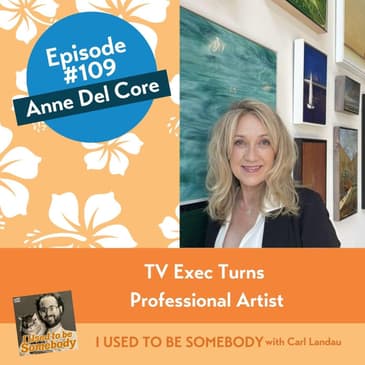
Anne Del Core has the spark! Her enthusiasm for change and reinvention post-career is captivating.
Anne had a cool career in television. She started on the talent side of TV buy quickly realized the biz side was more lucrative. (Her first transition.) She ended up falling in love with that whole side of TV. Her last position was as the General Sales Manager at WKRT-TV in Norfolk, VA as part of a larger network owned by the New York Times.
Then she made another transition to put her big career on hold to raise three children. The family moved around the US a lot for her husband's job as a radio executive. And now she pivoted again (and surprised herself) by becoming an artist. Just four years ago, she was introduced to the world of glass art. She absolutely loves it and specializes in creating beautiful mosaics. This is isn't a hobby. She now has a thriving business of selling awarding-winning art pieces, opening her own solo show and donating art to raise money for nonprofits.
What makes the interview truly special is that Carl and Anne met for the interview live, at the Landau Tiki Bar. It's a super fun, free- spirited conversation that will inspire anyone who is interested in how to take a leap of faith and try something completely new and different. And then just totally going for it!
- More about Anne C. Del Core: https://www.storyglassmosaics.com/artist
- More about Anne's business Storyglass Mosaics: https://www.storyglassmosaics.com
- Episode Content: https://pickleballmediahq.com/blog/anne-del-core-interview-tv-exec-turns-professional-artist
- Sponsored by How to Retire and Not Die Video Series: https://howtoretireandnotdie.com
- Sponsored by Capital Advantage: https://capitaladvantage.com/promotion/retirement-planning-guide
- Subscribe to the the I Used to be Somebody Newsletter: https://pickleballmediahq.com/contact/subscribe
[00:00:04] Pickleball Media presents the I Used to be Somebody show produced live at the Landau Tiki Bar in Sacramento. Here's our host Carl Landau.
[00:00:17] Welcome to Landau Tiki Bar and the I Used to be Somebody show. What does art and TV have to do with each other? I'll explain in a minute. First, I want to thank this month's sponsors. Thank you, Gary Serac, author of How to Retire and Not Die, who just came out with an amazing book.
[00:00:37] This is a amazing video series. It's 14 mini videos that covers all the non-financial parts of retirement, purpose, identity, relationships, and totally helps you prepare and enjoy your next chapter in life. And thank you to our loyal sponsor, Capital Advanced Wealth Management. Following today's interview, we've got two fun segments. First, we talk to the Unretirement Wisdom with the Pros Guys.
[00:01:04] We talk about the importance of prioritizing social connections. Many people think of retirement strictly about the money, but it's really the social connections that bring us happiness. That is followed by Pig Ball Chronicles with Trevor. Trevor and I talk about a part of Pig Ball that's one of my favorites. It's Pig Ball Poaching. Anyway, you don't want to miss that. And I can't wait to get to this month's guests.
[00:01:33] But first, I want to thank Ken Iretani for introducing me to our guest, Anne Delcour. Anne's got a really interesting story. She had a fun career during the heyday of television. At first, she wanted to be on the air and ended up with a really successful career on the business side of TV.
[00:01:54] She raised three kids and ran a busy family life since her husband was a big-time exec in the radio world, which led them to moving all around the country. And just four years ago, by total fate, because of several connections in her life, she ended up being exposed to creating art with glass. Today, she is a very accomplished glass mosaic artist with a thriving business.
[00:02:22] Her enthusiasm for trying something new and reinventing a career later in life is totally infectious. I got to interview her live in the Landau Tiki Bar, which always makes it extra special. Please sit back and enjoy my interview with the very talented Anne DelCour.
[00:02:48] The timeline we have, and I'm like, ooh, maybe I'm halfway done, maybe not. There's a lot, a lot of life, a lot of wonderful opportunities out there. And I think that mindset of what's next and who am I going to be next, I think that keeps you open, right? Like, who do I want to be next? Right. And it keeps you young. Totally keeps me young. Yeah.
[00:03:20] Hi, Anne. Welcome to the I Used to Be Somebody show. Thanks, Carl. I'm so happy to be here. Yeah. So what do you think of the Tiki Bar? The Tiki Bar has got a pretty fabulous vibe. And I hope to be on an invite list to one of the parties that's hosted here someday. It's a very selective group, but I think you'll probably make it. So, Anne, I want to introduce you to the audience.
[00:03:44] Anne Delcour had a successful career for many years as a TV executive. Her last position was general salesman for WTKR TV in Norfolk, Virginia, which was owned by the New York Times. In unretirement, she's a very talented artist. Her specialty is glass mosaic art pieces. I've seen her curtain collection. It's really amazing.
[00:04:12] Her company is called Story Glass Mosaics. So we're going to talk about that and more. But first on the I Used to Be Somebody show, we'd like to play a little icebreaker game. So are you willing to play the game? Absolutely. Okay, let's do it. The name of our company is Pickleball Media. Anne, what is your pickleball experience? I've played pickleball once, Carl. I played last November during a Thanksgiving vacation in Palm Springs. Okay.
[00:04:41] Our family decided to be away for the first time for Thanksgiving. So we went down to a hotel in Palm Springs, and they had a marvelous group of pickleball courts. And we all played. It was first time for most of us, and we had a fabulous time. Oh, good. Yeah. Good. I can tell you're really excited. You've played once and haven't played since. Did someone know how to play, and they knew the score and everything? No. So what were you doing?
[00:05:09] So we were hitting the ball back and forth across the net. Okay. And it isn't until I've listened to more of your podcast that I know that there's a kitchen. So that was the only kitchen that I saw, apparently, at Thanksgiving last year. Okay. Okay. Well, I will take you out if you're interested. I will. And I'm happy to show you how to play. That'd be great. I'd love it. Thank you. The hardest part is the scoring. Anne, what was the worst job you've ever had? I can tell you about my first job.
[00:05:38] My first job was as a TV reporter for a cable TV station in Western Maryland. I was in college, and that was pretty exciting. So that was a time when they didn't have teleprompters yet. So I was reading cards that were held beside the TV cameras. But it was pretty exciting. I covered everything from chili cook-offs to actually a plane crash, which was pretty tragic. Wow.
[00:06:05] But it was something I was interested in because I was studying radio, TV, film in college and communications. And so it was a terrific experience. Yeah. I mean, to be able to do that when you're so young, that's awesome. Yeah. It was amazing. I mean, my first job was being a caddy. I mean, that really didn't lead to anything. So it's always fun for the audience to get to know the background of each month's guest. So where did you grow up? I grew up in Western Maryland, part of the Appalachian Mountains.
[00:06:34] It was a coal mining area. My family was there, though, because my father had come there. He had taken a job at the state university. So it's called Frostburg State University. Okay. His intent, coming to Frostburg from Syracuse University, where he'd gotten his PhD, his intent was to stay for six months until he found something else. And my parents were there for 50 plus years. Oh, wow. So and my mother taught at the university.
[00:07:04] My father taught at the university. What's cool? I'm sorry. It's called Frostburg State University. Okay. They have a really good football team. They had an okay football team. Okay. Okay. Okay. But really a marvelous community. And small town, the town actually doubled in size when the students came back to school. But it was really a very rich environment to grow up in when you're associated with a university in your community. So it was terrific. Yeah. So tell us about your family, size of family. Were you rich or poor?
[00:07:34] What was your family life like or anything you want to share? My family, my mom and dad, and I have four older brothers. My parents had five kids in six years. My mom started having children when she was 36 and had me when she was 42. Really? Really? Wow. That was not the thing to do in those days. It wasn't. No. But they were kind of focused on their career. My mom was a teacher over at the university as well until she had all of us kids. And then she was a full-time mom.
[00:08:04] But she was inspirational and inspirational to me in a lot of what I'm doing now, actually, which is great. So how would you characterize what a young Ann was like as an adolescent teenager? Adolescent teenager. Let's see. So four older brothers. I was out there playing kick the can and wiffle ball with all the boys in the neighborhood. So there weren't any girls in the neighborhood. And you had all these brothers. I had four brothers.
[00:08:31] So we were all close in age and right there in the neighborhood. What was dating like with brothers and father? There wasn't a lot of dating. Not in high school. So it was fun when I got to college because then it was a little more anonymity. They weren't there. Right. Yeah. Did you have any clue whatsoever what you wanted to do when you were going to grow up? So when I was growing up, I actually wanted to be a television reporter. So I studied journalism.
[00:09:00] I studied communication. So that was interesting. And then when I graduated from the University of Maryland, I had two job offers. One was to be a TV reporter and I could make $11,500 a year. Right. The other one was to be a sales trainee at the television station and I could make $36,000 a year. Right.
[00:09:25] So that was one of my pivots right there because I said, oh, I'll just be a salesperson for a short time. I'll learn how to do that. But then you kind of get into it and it got exciting and I was successful. And so I stayed in that sales and marketing and then became a manager. And so that kind of guided me away from being a reporter. Yeah. So I think this happens, although I was sort of pushed by my mother because I was like the
[00:09:54] sports editor of my newspaper and wanted to be a journalist. And in fact, I was going to go to Wisconsin that had this great journalism school. I'm from the Midwest. And she's like, well, you can't make a living doing that. Right. And anyway, I ended up going into the business side and I was in magazine publishing. So, you know, we can talk about two giant industries soon, the magazine industry, the TV industry. But in the day when you and I were in it, they were booming. They were booming. Yeah.
[00:10:23] It was a very exciting time. So you were strictly on the business side. So just so people understand, I assume that it's mostly selling advertising and sponsorships. So I would go out to local businesses and we would help them. Where were you? You've moved around a lot. I have. I was in Hagerstown, Maryland, and then in Norfolk, Virginia for most of my TV career. So it's going around to the local businesses, helping them produce advertisements. Yeah.
[00:10:53] So 30 second commercials and then finding the right program so that they can find the right audience to reach and then helping them grow their businesses with a good marketing plan. Yeah. So what is the relationship, though, the business side with like the talent, you know, the anchors, the reporters, those types? I mean, is there a relationship? Well, they were always fun to hang out with. Yeah. Yeah. So, yeah, I had really good friends who were on the talent side of it, which was a lot of fun.
[00:11:23] And I think we had an appreciation for one another. But you were in, like we talked about the business side of TV, but I'm sure there's some fun, weird TV experiences you can share. Were you ever on the air at all? Just that first job is when I was on the air. Okay. And did a few. Wait, wait. Didn't someone get really sick one day and it's like, oh, we need someone? I wish. Yeah. No. Never happened for me. And you never had any regrets about not being, you know, on the air or anything? Well, I didn't say that. Okay.
[00:11:52] You know, I mean, that's something that I was always interested in. But I was appreciative of the career that I did have because I was given lots of opportunities. Plus made a lot more money. Made a lot more money. Had some really outstanding training working for the New York Times. They put me through some terrific executive training out at Northwestern University. And I felt like my career was developing and I had opportunities along the way. So that was great.
[00:12:21] And then I came to a point in my life where I'm like, well, I had gotten married. My husband was in the radio business. So that was interesting. And we said, well, it was time to start a family. So at that point, I figured that was kind of my first retirement away from a paid job. My husband in the radio business, we were in Norfolk. Then we moved to Sacramento. Then we moved to Atlanta. Then we moved to Austin. And now we're back in Sacramento, all with the media industry.
[00:12:50] So in radio. I mean, that's sort of how it goes. It was a lot of moving. We had three children. So I was the one who was buying and selling the houses, finding the school districts where we wanted to live. It was a full-time job. So that was such an important time. I mean, once you're a parent, you're always a parent. But I know, you know, people don't tell you that. There's no, you know, when you go into the parent business, I just assumed it's like, okay, they hit 18.
[00:13:20] You're an adult and like you're sort of on your own and all that. And apparently that's not how it goes. Apparently. Yes. Because I think we all find that out. You know, it's like, it's so strange. I mean, even when, I mean, my kids are in their 30s and you still worry about them and all that. Just as much. I know. It's like, but no one tells you that. No one tells you that. No. And, you know, we talk a lot about becoming an empty nester.
[00:13:51] When the kids go off, they move out of the house. Yeah. The nest may be empty, but that kind of worry and interest in your kids never goes away. So it's exciting to watch. But yes, it's a significant change in your life. So you really left the business not because you didn't like it or you felt it was because a lot of our guests, it's like they've had these long careers. It's like, oh God, I just, you know, it's not what I signed up for and all that.
[00:14:20] You got out a really good time in television. Like what year? I got out in 1998. Okay. So those are golden years, you know, still for television and all that. It was. Okay. So we're really here to talk about the second act. Now you're a professional artist. So I'm really curious about that whole transition. I mean, were you an artist like your whole life?
[00:14:48] We'll be back in a moment after a short break. Hundreds of our listeners have bought Gary Sirak's book, How to Retire and Not Die. He's come out with a great video series. It's ideal for people approaching or entering retirement. It's a 14 video courses that cover it all. Identity beyond work, figuring out your new purpose, give you structure and emotional, social and cognitive health plan.
[00:15:16] Check it all out at howtoretireandnotdie.com. Choosing a financial advisor is one of the biggest decisions you need to make in retirement. Now it is more important than ever to protect your retirement savings and investments. Capital Advantage can help individuals like you develop a personalized investment strategy and retirement plan unique to your life and goals.
[00:15:44] For over 40 years, Capital Advantage has been a 100% fee-only fiduciary advisor. Just go to capitaladvantage.com slash podcast. Welcome back to the show. Now you're a professional artist. So were you an artist like your whole life?
[00:16:04] No, I took some art classes when I was in college, but I never really delved into my own interest. I had done some paintings when I was younger, but nothing really serious. And then this new career for me started when one of my neighbors invited me to her garage and she made glass mosaics. Right. Why don't you just explain to people exactly what you mean by glass mosaic? Because some people may not know. Right.
[00:16:34] So a glass mosaic is a piece of artwork that's made from most often small, either broken or cut parts of glass that are put together. I kind of do it in a painterly fashion. So often mine, my glass mosaics are depicting a scene. Maybe it's an ocean scene or a sunset. I've done a lot with farmland.
[00:16:57] California is rich with beautiful patchwork farmland that you see when you fly over the Central Valley. So it's given me great content for the glass mosaics. You have this friend that inspired you in some ways. Yeah. And this podcast is for people making a dramatic shift into something new. And it's hard not to be apprehensive because you're going to be doing something you're probably not that good at. Right. Absolutely. You have no idea. Right.
[00:17:25] So what advice do you have about overcoming that apprehension, about doing something that is totally unknown? I think we all have some creative element to us. And I think that there's opportunity for anybody to try something and kind of embrace that. Let me try it. I may not be good at it, but let me keep trying. And that's kind of what happened to me.
[00:17:55] I was like, I had never done a glass mosaic. I tried it. I liked it. And then I was kind of introduced to the possibilities when my neighbor took me to the glass store. And I saw... And when was that? It wasn't that long ago, right? That was 2022. Yeah. That was 2022. So four years ago. Four years ago. But I saw the glass store and I was like, oh, you can buy a big sheet of glass that's four feet tall by three feet wide.
[00:18:24] And I looked at that and I was like, oh, well, wouldn't that be fun if I did XYZ with it? And I had all sorts of ideas going through my head. It just sparked this something inside me. And I was like, I've got to go back there. And that piece of glass is beautiful. And that piece of glass is beautiful. And I see something in this piece of glass.
[00:18:44] And so I kind of just fell in love with the material and then the process of breaking something and putting it back together in a whole new way. Right? And so... As a child, we're not really allowed to do that. Exactly. It's like you get in trouble. Exactly. And so... And even in the early parts of this art exploration here, you know, a piece of glass would break and I'd be like, oh.
[00:19:13] And then I'm like, wait, wait, Ann. You're a mosaic artist. Right. You can put that back together. Right? It can be something else. It can be something else. Exactly. No mistakes. And I also think of that, Carl, as kind of a metaphor for all of us. Right? We have all these pieces of our life that have prepared us for now this new opportunity. We're in... We're of a certain age. Mm-hmm. And I look at that and I'm like, this very much is like a mosaic.
[00:19:43] Our lives, I feel, are very much like a mosaic. And so it's fun for me to think about that as I'm making art because these were something else and now they're something new. Yeah. No, that's amazing. And I'm like totally astonished because Ann just talked about how she just started doing this four years ago. And, you know, on our newsletter and our website, we'll share the artwork.
[00:20:09] And it's like amazing what she's done in a very short amount of time. So we'll talk about that a little bit more. And I was particularly interested in you because I shared with you that my mom was really into working with stained glass. And she loved to do it. The last 20 years of her life, she made hundreds of pieces and mostly just gave away to friends. And it gave her so much pleasure. And then she would call me and she's like, she would get commissioned to do stuff.
[00:20:39] And, oh, my God, here she is like in her mid-60s, you know, and she's like, can't believe this is happening. And it was quite thrilling. So I love your story. So I want to go back a little bit back to your artwork. I'm curious what inspires you because, I mean, your artwork is truly special. Thank you. I want to talk a little bit, Carl, about how this started. Because one of the things that you and I talked about were acts of kindness.
[00:21:08] I think about my neighbor, Judy, and her husband, Andy, how they invited me to go and try to make a glass mosaic. I made a flower. Then took me to the glass door. So that was important. So that was a touch point which really started the change in my life. The second thing that happened was I have a friend who's a photographer and a designer. And she saw some of the glass work that I was producing. And she was like, Ann, I need to photograph these.
[00:21:38] I need to photograph these because these are really special. And she said, Ann, I want to do your portrait. And so I took her up on that. Wait, wait, wait. She wanted to do your? My artist portrait. So she wanted to take a photograph of me. Because often artists will be asked to provide an artist portrait. So we did that. So she did that for me. And then that actually helped me produce my website.
[00:22:03] Then the third thing, Carl, which was really interesting, was my hairstylist said, Ann, these mosaics are really beautiful. Would you put some of them up in my hair salon? So I actually have a hair salon in Midtown Sacramento that acts as my gallery. Hey, you have a captive audience. I keep her walls refreshed with beautiful artwork. And I can sell out of there.
[00:22:30] It's a wonderful partnership that we've developed. But those three touch points there have changed my life. And then I've gotten into this art community, which is a rich and very close-knit community here in Sacramento. And so many people have been supportive. So I've been in other gallery shows. I've donated some artwork to the public television station, to the Crocker Art Museum.
[00:23:00] And it's really opened up a lot of doors, a lot of relationships. So I hope to kind of carry on and support other artists on their journey here as we go. Absolutely. Yeah, that's great. And I mean, that should give inspiration to everyone out there. You know, and it's like you've definitely gotten rewarded. And it sounds like you're trying to, like I said, play it forward. So was there an aha moment, though, when that you can really make a go of this as a professional artist?
[00:23:30] So it was a slow buildup, I would say, Carl. It was I sold a piece, I sold another piece, and then someone asked me to make a piece. And then I was invited to put some things in a gallery. So it was a slow process which started to help build my confidence, right? Because, again, I'm questioning myself. I'm like, oh, people like these? Right, right, right, right, right.
[00:23:57] And then there's a quantum leap to they want to give me money. Yes. That's a lot of pressure. And yes. And then I won some awards at the California State Fair. I won an award at the public television station. So it was those kinds of things that really helped build my confidence. And then I'm like, okay, I can do this. This is who I am. And I embraced that full on, I'm going to be an artist and this is what I'm doing.
[00:24:26] So it's so funny. I know when I was talking to you as we were preparing for this, I said, I want to talk about dinner can wait. Because often my husband will come home from work and I'm still in the studio and I'm in this total mode of I see a piece and I've got to cut this glass just this way and I've got to get these last pieces in before dinner.
[00:24:52] So fortunately, he's been very patient with me and super supportive. So I appreciate that. But I think when you get to a point and you've found something that brings you joy and it actually keeps me up at night sometimes as I'm thinking about what I want to do the next day. And I think how fortunate I am, Carl, that I've found something that I can do for the rest
[00:25:19] of my life that I want to do where I'm producing something. I can say, this is what I've done today. You know, the whole time that you're volunteering and raising a family. Yeah, there's no ultimate product. It's not a product to show at the end. That's why I love the magazine business where you're having these articles written, you
[00:25:45] have all the graphics, all the photographs, you're selling ads, and then it goes to a printer and then you actually have something. A physical something. I know. I sort of need that sort of thing too. I mean, the greatest joy, obviously, for me is the kids and putting forth good people into the world. That is hands down the most exciting thing. But to have something physical that you can show, that you can hang on a wall, that you can share with people that will last for generations. Yeah.
[00:26:15] And you go to their house, you see it. Yeah. It's awesome. $10,000 and up. What's it like, you know, the business side of it? The business. Because I'll tell you, big problem with artists are the ones I know, 99% of them are terrible business people. Right. They have no idea what they're doing. Right.
[00:26:40] They feel weird about the whole thing, you know, and a lot end up giving up because it's like, oh God, it's a lot of work. So tell us about the business side and how, you know. So the business side, I mean, I'm constantly keeping track of the expenses that I have for running the studio, for buying the materials. And then there's marketing. You know, there are all sorts of expenses along the way that you don't necessarily think about when you're selling a piece of artwork.
[00:27:10] It's important. And fortunately, I have some people who can help me with the business side of it and with developing the website because it's not my specialty. It's not my strength. And I'm fortunate enough that I can say I need help with that and I can get help because I am so much happier when I'm in the studio and creating what I'm doing. But nothing happens unless the business runs well though. Yeah. So it's a lot of work.
[00:27:39] And so I try to be very purposeful and work with intent to make sure that I've got my ducks in a row, that I've got my taxes paid. It's part of it. Yeah. Yeah. So not the glamorous part. No, no. But it's important. And I'm sure having a business background was helpful and all that sort of stuff. Absolutely. Like I use, and the thing is, like in the second acts, especially if you're starting a new company
[00:28:07] and all that, you don't have to do everything yourself. I mean, that's the great thing. It's like figure out what you're good at, do that, and then hire out the other stuff. Like I have a virtual assistant company that does all my graphics and they do my website. They do all sorts of stuff. They're fantastic. It doesn't even cost that much money. And then I get to do the things I'd like to do. Well, and it's about being resourceful. We've all had these experiences in our life that have brought us to this moment.
[00:28:37] And using those resources, I think, is really key at this point. So you're doing what you want to do. Yeah. Yeah. That's awesome. So we normally talk about unretirement strategies, which on the Pickball Media website, we have 20 unretirement strategies. And when I gave it to Ann, of course, this is the problem. You give it to a creative type. They're like, well, yeah, I don't like any of those. So she already went through her two, which I thought were really awesome as far as like
[00:29:06] small acts of kindness and also dinner can wait. So she has a very patient husband, which, oh my God, especially if your kids aren't at home and all that, it's so much easier. It's like, I mean, whatever. Things at home are much looser as far as all that sort of stuff. But Carl, I think about those small acts of kindness for those people in my life, those three really impactful people that in their world, they weren't doing anything out of the ordinary. Yeah.
[00:29:37] But it absolutely changed the trajectory of my life. And I think about the impact that any one person can have on another person and their life just by sharing their talent, sharing an idea. Yeah. I'm always grateful about that. That's awesome. So, and what advice do you have for our audience? Our audience have had successful careers. They want to do something new, something more fun, something more meaningful. Do you have any final words of advice for them?
[00:30:07] Expect the unexpected. I think trying something, you don't have to be good at it. You don't have to excel at it right away. But I think if you try something and it leads you down a path in a certain direction, follow that. I think if you're enjoying it, that's what's so exciting. And if it doesn't work out, you can try something else.
[00:30:33] I love this concept of reinventing. My mother lived till just shy of 100 years old and she was reinventing. My mother-in-law reinventing in their 90s. My mother became an author. I mean, it's just inspirational. I look at the timeline we have and I'm like, ooh, maybe I'm halfway done, maybe not.
[00:30:59] There's a lot, a lot of life, a lot of wonderful opportunities out there. And I think that mindset of what's next and who am I going to be next? I think that keeps you open, right? Like, who do I want to be next? Right. And it keeps you young. Totally keeps me young. Yeah. Those are great words of advice. So Anne, what's the best way for people to learn more about you and your art? So I have a website.
[00:31:28] It's storyglassmosaics.com. And you can reach out to me through that. I try to keep it fresh and keep it interesting and put some good artwork out there. That's a good way to reach me. Okay. Awesome. So Anne Delcour, I can't thank you enough for being our guest this month on I Used to Be Somebody. Thanks, Carl. Unretirement wisdom from the pros.
[00:31:54] Today we've got Gary Serac from Serac Financial Services and Ian Castillo from Capital Advantage. Today we're going to talk about the importance of prioritizing social connections. Many retirement experts say this is just as important or maybe more important than money. And I'm just wondering what advice that you guys have. And I really believe totally in this. For longevity and happiness reasons, social connections are so important.
[00:32:23] And there are millions of studies that actually prove this. And that's why we talk about pickpals so much on the podcast because it's like a super easy way to get connected. And so many great people you can meet in retirement. More recently, I was filming my documentary that's coming out in like a year. We were filming 80 people in Houston that get together every week in the senior bowling league. And people absolutely love it. And it's an important part of their life.
[00:32:52] So, Gary, let's start with you. Can you talk about the social side of retirement and give some suggestions or ideas? Well, the whole idea of leaving work is also leaving your community, the people you hang out with, the people you see five days a week, eight hours a day. I think there's a real culture shock when you realize that you're no longer connected to that group. And it becomes a really important shift that you have to find what group are you going to be involved with? Is it going to be your church?
[00:33:22] Is it going to be donating or spending time at a food bank? I mean, there's so many different things. I have a friend of mine that's actually a crossing guard for the school. You get together and you look for something to do that keeps you busy. But when you have a community, it makes all the difference in the world. One of my friends just joined her second book club. And she's now on two book clubs. They meet. I think they drink more wine than discuss books, but they're not positive.
[00:33:51] And they have a great time. And they pick a book to read and they read it and they get together and I guess hypothetically discuss it. But what they do is have a really fun evening. She said, I didn't know half the people in our club. And all of a sudden, I have all these new friends that I never had. That's really cool. And the other day, it's really funny. I ran into someone I hadn't seen in probably two years. She retired. And I said, what do you do? She said, oh, I have a mall walking group. You know, Ohio winter's cold.
[00:34:20] We meet in the mall and we become really good friends. We walk the mall and then we sit down and have coffee. She said, I have like 10 new friends. I never even knew these people. Their backgrounds are fascinating. And when someone's not there, we kind of worry about them. We call. We make sure everybody's okay. Yeah. No, that's great. So Ian, you seem like a social guy. What are your thoughts and examples of the social side of retirement?
[00:34:44] Well, studies show that the strength of social connections directly increases reported happiness levels and directly leads to improved longevity outcomes. So there's no doubt that it's really important. Too many times, I think what I see is people stay in their residence a little bit too long.
[00:35:08] And then when they're really forced to do a decline or health reasons to move into what we'll call their retirement home, whatever that looks like. What that does is it robs them of the ability to go out and make new connections after the move. So my advice and suggestion would be for people to find and then relocate into their quote,
[00:35:31] retirement home, whatever that looks like, prior to experiencing a forcing event like a cognitive decline or health event. Do that because then you're going to have time to make friends. You're going to have the energy to build those social bonds. So doing it early, I think is a key component of success. Don't wait too long. You know, Ian, I can't agree more with you.
[00:35:55] And I've always sort of pushed people that I know that are older to make that move before you're forced to, like you said. And a great example is my mother-in-law. She moved from her condo to assisted living place and she's in her 90s, but she's really with it. And she has made so many connections. And the thing is, most of the time she was by herself unless we were visiting or, you know, her neighbor was visiting or, you know, some other family members.
[00:36:24] And now she has this whole group of friends. It's really cute too, because Diana will pop in to see her and she's like, listen, I'm busy. I'm playing, you know, bridge. I mean, you know, I don't need to see you, which actually puts a big smile on my wife Diana's face. You know, I think these are some great ideas and I've been doing it. I'll just throw out one other thing that I think is important is hanging around people of different ages.
[00:36:52] Because of pickleball and because of our neighborhood, I hang around with a lot of younger people than I am. And it's great. I mean, it's just you get a different outlook of life and all that. So the more social activity you can do, the better. So Gary and Ian, thank you so much for another great segment of Unretirement Wisdom with the Pros. Thanks, Carl. The previous response does not serve as the receipt of or a substitute for personalized investment advice from Capital Advantage.
[00:37:20] Rather, you should seek advice from the investment professional of your choosing. Different types of investments involve varying degrees of risk, and it should not be assumed that future performance on any specific investment or investment strategy or any non-investment related or planning services, discussion or content will be profitable, be suitable for your portfolio or your individual situation, or prove successful. Pickleball Chronicles with Trevor. Hey, Trevor. Are you into poaching? Are we talking eggs? Well, I was...
[00:37:51] No, it's sort of funny. This is a pickleball segment, Carl. I know. And honestly, when I think of poaching, I think about the terrible people that poach elephants and rhinoceros. Oh, jeez. So I was hoping you were going to say no. Way to bring the mood down. But as long as we're talking about pickleball, then yeah. I'm all about poaching. Yeah. So poaching in pickleball court, as I last looked at the rulebook, is legal and is fun. And in fact, I just played pickleball.
[00:38:21] I knew we were going to do the segment, and I was really thinking about it a lot. And it helped me because, you know, I like a lot of people love to poach. So why don't we just go through the keys to successful poaching first? Okay, sure. Where I come from. Oh, boy. Where do I start? Where do you come from? The pickleball school I was coached in. Maybe that's a better way to lead in. Big ball high. Okay.
[00:38:51] Yeah, yeah. University of Pickleball. Is that right next to Beer University? Yeah, because that's where you go after your lessons, right? Okay, go ahead. Sorry. No worries. So I would say the first thing to do is just recognize good opportunities, right? Not every ball that is sailing toward you or toward your partner is a poachable ball. Right.
[00:39:13] So probably the best times to poach are the times where you are already up at the kitchen line, but your partner is stuck in the midcourt or the backcourt near the baseline somewhere. So chances are your opponents are going to target them and try to keep them back deep in the court as far as they can. And, you know, recognize those opportunities where the ball is going to come flying over the net toward your partner who's deep in the court. So that way when you take off to poach that ball and smash it back on your opponents, you're not going to be running into your partner.
[00:39:42] And chances are the ball is going to be clearing the net at a height that is conducive to the shot your opponent is hitting, right? It's probably going to be higher over the net because they want it to go deeper into the court. Yeah. And those high balls are the right ones to put away. Obviously, you're usually hitting the shot with your forehand, right? Well, I can do everything on the court. I believe you. No, no, no, no. I'm fine poaching backhand and all that sort of stuff.
[00:40:08] So I think the big thing is really observing your opponents and seeing are they paying any attention to me, you know, on my side when they're hitting it to the other side. Because sometimes, you know, it just depends on the level of people you're playing with or whatever. Literally, I can just pray for it immediately and I'm going to get that ball if I see them not paying any attention to what I've been doing.
[00:40:36] But the thing that really gets me messed up is particularly the ex-tennis players who love to hit down the line and they'll make you pay for it. I mean, that's the downside of poaching. Yeah, if you leave just a little too early and they hit it behind you down the line. Yeah. Yeah. Yeah. And especially if you're just even leaning a little bit that way, if they're good at it, boy, they're going to get you every time. And it doesn't have to be a perfect shot.
[00:41:05] You know, it's just anywhere near that line. Yeah, for sure. But for players who are coming from tennis, they tend to be a bit more accurate in hitting that shot. For others, you know, eight times out of ten, you can probably let them take that shot because they're a little too excited to hit into the open court, recognizing that you left your position. And they'll hit it long or wide or what have you. Yeah. Or so slowly that you can see it and get back in time to put it away. Yeah. So let's do a flip side.
[00:41:32] How do you beat someone who's a really good poacher? Yeah. Well, you just kind of flip the coin to the other side, right? Keep them back as much as you can. You know, recognize that your opponent is an aggressive player and pretty athletic maybe and that they're looking constantly. Tall and tall. Tall. Sure. Tall, long arms. Yeah. People say that about me from time to time. Yeah. You're like, by the way, for people listening, you're way taller in real life than you sound. I sound like a short guy?
[00:42:01] You don't sound short, but you sound like, how tall are you? Do I fudge the numbers? I'm six, two and a half. Yeah. You sound about six feet, five, 11. Go ahead. Okay. How do you beat a poacher? Oh, that's what we were talking about. Yeah. How do you beat a poacher? You know, recognize when they're taller and they want to crowd the middle or they're looking for those opportunities to put one away. And go behind them. Right? Yeah.
[00:42:26] Or if they get to the ball and they happen to hit it, you know, where you can get it, you don't have to counter really. You don't have to put a good shot back on it. You can just get a paddle on the ball. And if you have the wherewithal, you have the awareness to deflect the ball such that it goes right back at the poacher's body or you redirect it to the open court that the poacher just left.
[00:42:53] Then there's almost no opportunity for them to react and get that ball. And you've got yourself a winner. Yeah. And, oh, God, it's great to like when that person extends when they probably shouldn't and they miss it. And their partner just was sitting there with a really good shot. That's really fun, you know, to frustrate them that way. Of course. Yeah. Yeah. It's always fun to frustrate the opponents.
[00:43:20] So, and I have to tell you, Trevor, since like we started this maybe a couple of years ago, I've actually become a pretty good lobber, which obviously anyone at the net, it's like a great way to beat them. Oh, boy. Yeah. I'm really into lobbing. You know, when you're sort of older and slower, it's a great way to go. Well, if you're playing older and slower people as well. So, yeah, that's true. Lob me.
[00:43:46] My six, two and a half frame with long arms, I'll get that ball or I'll scramble back there to get it. And, you know, I'll frustrate you. Lob me all you want, buddy. Let's go. Okay. Well, it's a little unfair. You're a few years younger. But anyway, that's fine, Trevor. Anyway, I'm really glad people want to hear us talk smack talk 2,000 miles away from each other. So, anyway, thank you, Trevor, for another great segment of Pickleball Chronicles with Trevor. Sure thing, Carl.
[00:44:18] Thank you so much for listening to today's show. I just think Anne Delcor is so inspirational. A big thank you to our sponsors, the new How to Retire and Not Die video series. And thank you, Capital Advantage Wealth Management. And a big thanks to the star of today's show, Anne Delcor. Please take a look at her on our site, Storyglass Mosaic. A link is on our show notes.
[00:44:46] I just can't believe she's only been an artist for four years. Her art is truly amazing. I love it. And thank you, Ian and Gary, the Unreturned Wisdom Pros. And Trevor West, my big ball guy. And a big thank you to my bosses, Diana and Becca. Thank you for letting me keep my job one more month. We'll see you all next month at the Landau Tiki Bar for another new episode of I Used to Be Somebody. Mahalo.